

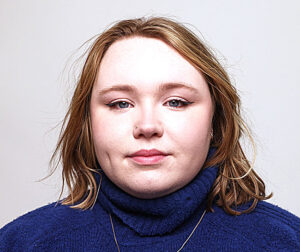
Mary Condon O’Connor told David Hennessy about her play Swan in the Walls that is about to play Hope Theatre in London.
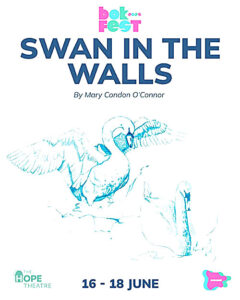
Emerging Tipperary playwright Mary Condon O’Connor is debuting her play Swan in the Walls at the Hope Theatre, London next week.
Directed by Eva Hudson, the play features lead actor, Alex B Crinion with Condon O’Connor also playing the role of the titular Swan.
Inspired by the Irish legend of The Children of Lir, Swan in the Walls is a queer coming-of-age story.
The main protagonist, Caoimhe, has fled home, family, country and a confusing relationship with a childhood friend for drama school in London but after a night out goes wrong, she realises that there is no escape.
From Cahir, Co Tipperary, Mary is a neurodiverse writer, performer, and facilitator, based in London.
She holds a BA in Theatre and Music International from University College Cork and an MA in Applied Theatre from the Royal Central School of Speech and Drama.
Mary specialises in creating inclusive, magic-infused theatre that builds community and empowers individuals to realise their artistic potential.
Her performance credits include Camden Fringe, Clonmel Junction Festival, Southbank Centre, and Brighton’s FemFest.
Additionally, she has facilitated workshops across London and Ireland with organisations such as DreamArts, Half Moon Theatre, Little Angel Theatre and Youth Theatre Ireland.

What inspired you to write the show? Where did it come from?
“My own theatre experiences.
“I’m actually a theatre facilitator first and foremost, so I work with a lot of communities doing drama and I’ve only turned to doing playwriting in the last year.
“But with Swan in the Walls, specifically, I started writing it last summer and I think it was just because I was surrounded by so many amazing groups and communities of people.
“I was doing this project with a group called Campfire Theatre which is all about finding beauty in queerness and I think at the back of my mind something was brewing.
“At the same time, I was doing a lot of puppeteering with Little Angel Theatre over in Islington.
“I was working with a parrot, not a swan but I was doing all these workshops with children.
“It was all about getting kids encouraged in reading and I was thinking, ‘God, there’s something really powerful in how puppets can kind of go really expansive and go out and out and further.
“I feel like when I had a puppet, I could do more mad things on stage and between doing some writing about queerness and working with a puppet, I ended up having the two of those in the back of my head for quite a while.
“And I’ve always been such a fan of mythology and I think at the moment there’s a resurgence of pagan ways both in Ireland but also in the publishing world, there’s a lot of Greek mythology that’s happening.
“And the Children of Lir is one of my favourite Irish myths.
“I just think it’s so beautiful, it’s so sad which I think is also hilarious because it makes it so Irish in a way.
“All of those together kind of blended in my mind a little bit and I felt like this was the perfect way to talk about what it is like being Irish in London, about queerness, and also kind of just my love for folklore.”
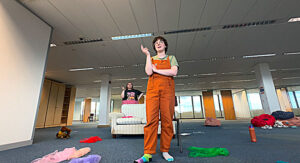
So what has your experience of being Irish in London been?
“I did a Masters at Central School of Speech and Drama and I was so lucky to meet people from all over the world but strangely enough, I was the only Irish person there in my cohort, which I was not expecting that.
“But after a while, I also found a great Irish community here as well.
“It took a while but I definitely did find a fantastic Irish group of people here as well.”
Caoimhe in the play has also left home in Ireland to go to drama school in London, is there a lot of you in the character?
“Yeah, absolutely.
“She’s not the most obvious person you think would go to a drama school.
“She talks about that and her experience of going to a drama school and the mad characters that you meet, any people who do drama or have done youth theatre know the types of people I’m talking about: Very eccentric.
“There is quite a lot of Caoimhe that has a little bit of the heart of me as well.
“But in saying that she’s very much her own fleshed out character.
“Alex B Cronin plays Caoimhe and they do such a fantastic job of giving Caoimhe so much detail and life.
“The work they’ve done on giving Caoimhe just their own fully fleshed out character, jumping off from what I offered on the script is, is beautiful work.”
Alex plays Caoimhe, you’re part of the cast also, isn’t that right?
“Yeah, I play Swan.
“In our production, Swan is portrayed by a puppet.
“I mentioned that I’ve done quite a bit of puppetry and I just love it as an art form of play and being creative and just being a bit wild and wacky.
“I feel like puppetry for adults is such a powerful tool as well, not just for children.
“I think puppets are for everyone, I probably am not alone in saying that but I’m saying it proud and for Swan in the Walls.
“Swan is a puppet that emerges from the walls and has this back and forth nearly like an annoying roommate style but they’re sometimes terrifying, but mostly relatable.”
Is this the first time you’re showing it or have you shown it somewhere else in an earlier form?
“We’ve done a scratch performance.
“Alex did a couple of scenes way back in January when we were just testing out some of the material.
“But no, as a full production, this is its debut.
“It’s being produced by Springbok Productions over at the Hope Theatre as part of their festival Bokfest which is all about uplifting queer voices and different kind of stories.”
That is apt as it is Pride month..
“It’s really such an honour to be part of it because it’s a very different take on queerness and acceptance and with a female character at the heart of the story, it’s offering a different lens into queerness and Irishness and all kind of bundled together in this kind of mad story about stealing swans and garlic chips and all that stuff.”
What was it like growing up gay in Ireland?
“I was still in secondary school still when the referendum came out but even then it took a long time for people to kind of come around to the idea in rural Tipperary.
“I don’t think it was until I entered university that there was just a greater conversation about queerness- And even then coming to London.
“I think theatre and queerness have a unique relationship where there’s so many fantastic artists who are kind of expressing new ideas and voices and platforming their thoughts on a stage.
“I don’t think there’s a better place to do that than theatre.
“I do think theatre is such an important outlet.
“I think I was very, very lucky that I was part of Stagecraft (youth theatre) back in Clonmel when I was younger and there was great things like Clonmel Junction Festival as well.
“I was just very lucky where I grew up.
“There was already so much music and theatre around the place that it kind of really came organically through the community.
“As a working professional in that industry, I’m just trying to give that back to people because I think it’s just the joy of having a third space that isn’t school, that isn’t home where you can really meet people and try things out, fail maybe, do a musical even if you’re not into singing or dancing…
“There’s always space for theatre, no matter who you were.”
Mary is also dyslexic so writes from a neurodiverse perspective..
“With writing it’s been a real journey because for a long time, especially in secondary school, I was kind of told that, ‘Oh, if you’re not reaching these grades, you’re not really able to do creative writing’, even though in secondary school, it was one of my favourite things to do.
“I even did extra essays for my teacher, the poor woman.
“I’d always love to tell stories and I think for myself, it was my own kind of mountain to climb with my neurodiversity.
“But when I came to Central especially, they had such fantastic resources for neurodiverse students.
“I think there was quite a lot of people at drama school who were also neurodiverse.
“There’s so much creativity and it’s just different pathways of thinking and coming together with ideas.
“I think that having that understanding kind of brought me into playwriting where I was like, ‘You know what? I’m going to just try it and see what happens’.
“And here we are.
“I have such a fantastic team behind Swan in the Walls with our brilliant director who is also partly Irish, Eva Hudson, who is a fantastic director/ writer herself.
“Alex is also from Northern Ireland.
“It’s a fully realised Irish team and the piece itself is inherently Irish.
“I’m hoping there’s some Irish bums on seats because otherwise there’s some jokes that will go over people’s heads.
“It’s been really lovely to kind of talk about our own experiences of being Irish and also living in London together, and I think that comes forward really well in the piece.
“The whole piece is very much about kind of, ‘What does it mean to kind of come home to yourself, both physically and also emotionally, spiritually’?
“We follow Caoimhe as they kind of unpick themselves and are kind of pressured to do so by the arrival of Swan kind of disrupting their space and kind of challenging them to figure themselves out, to help them both move on.”
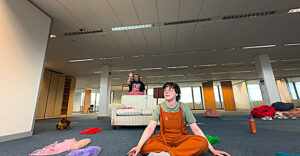
The big question the piece asks is, Is it ever too late to ring the bell and come back to yourself?
“I think The Children of Lir, what kind of really strikes me about that myth is the periods of time that the swans have to spend in each location and there’s just this constant waiting for something to happen, like a bell.
“That kind of motif runs through the play as well.
“It’s about Caoimhe’s own queer awakening and realisation of herself, and what is home and actually who can be home and what does that mean?
“And how can we realise this, and how can we kind of feel the most comfortable in ourselves?
“I really think that’s Caoimhe’s big question.
“That’s her journey that we see her go through in the piece.
“If you’ve come see the piece, you’ll see me as a swan but also I hope that you come away with a thought, maybe you might want to do a catch up with a friend or something, or send a message out.
“I think if people walk away feeling that, I’ve done my job.”
For the show Mary has also taken inspiration from Irish dancer and choreographer Michael Keegan- Dolan.
“Teac Damsa did a production of Swan Lake.
“It’s a dance piece so very, very different from my own but I saw that three or four times.
“The choreographer Michael Keegan-Dolan is a massive inspiration for me.
“I think I’ve seen nearly every single one of his pieces.
“I’m really inspired by his work and even though it’s very different, I’m working more with words and obviously they work with dance, I just think his motifs and how he kind of breaks down and looks at Irishness in a very different lens is really inspiring to watch.”
What about plans for the future, would you like to bring this show back for a longer run? “I’d love to bring it back home at some point.
“I think that would be a really fulfilling way to give back to the people who’ve given me so much theatre and love, the people back home.
“I think that would be a really special opportunity to do that at the moment.
“I’m quite early into my playwriting career so I’ve got a lot of learning to do.
“I want to stick with the playwriting for now, we’ll see how I go.”
Swan in the Walls is at Hope Theatre, Islington 16- 18 June as part of Bokfest.
For tickets and more information, click here.
For more information about Mary, click here.