


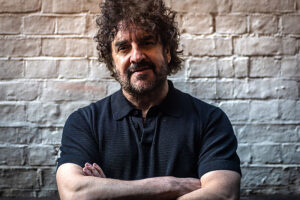
Merseyside singer-songwriter IAN PROWSE on his new album No Names which blends protest songs with deeply personal stories, and reflects the Irish influences that have shaped his life and music.
Merseyside singer-songwriter Ian Prowse’s biggest hit Does This Train Stop on Merseyside? was an Irish chart topper for Christy Moore.
His extensive connections to Ireland, and to Irish performers, include Damien Dempsey on a song about Bobby Sands as well as to long-time friend and collaborator Elvis Costello for whom he opened on his last three concert tours.
The 62-year-old has just released an album, No Names, which features his 14-year-old daughter, Rosalita Prowse.
Ian started in indie rock band Pele in 1991 which supported bands like The Pogues and Del Amitri.
Tell us about the new album..
“It’s divided into two. Some of it might be described as old style protest songs, although I don’t consider myself a political singer because life is so much more than that and I don’t want to paint myself into a corner.
“But some of those songs are my rants against the injustices of the world, in an inclusive way.
“And half the songs on the album are personal songs from memory or from my life with my daughter or my relationships, heartbreak and observations.

“So, there’s everything on there. I’m very, very, very happy with this record.”
You have many Irish links, do you have Irish blood?
“There is on my dad’s side, yeah. It’s Traveller blood from what we can ascertain from family stories.
“Here in Liverpool, 90 per cent of people have varying degrees of Irish blood.”

One track, When Bobby Was Alive, is about hunger striker Bobby Sands and was co- written with Damien Dempsey..
“I have a master’s degree in Irish studies so it’s not unusual for me to refer to something like this in a song.
“I wanted to write a song that wasn’t an old-time rebel song, that talked about Bobby Sands as a human being, because obviously outside of his activism, he was just a fella with family and interests.
“He particularly loved Motown music, Band of Gold by Freda Payne was Bobby Sands’s favourite song.
“I talk about him in his ordinary life but then Damo takes it somewhere else.
“One of my band members, Fiona McConnell, who’s from Cavan, sings that lovely part at the end which talks about the effect Bobby had on a lot of people’s lives, that he’s effectively still here in a lot of people’s consciousness.
“That’s the whole idea, so it’s not a rebel song in that old sense. It’s bigger than that.
“I couldn’t have imagined it being any better so I’m very happy with that song.
“My love of Celtic soul music comes through on all the records I make really but on this one, it’s particularly beautiful because Damo’s a good friend, we’ve been mates for 21 years.
“We sat opposite each other in his front room and wrote the song. It only took about an hour.
“When we finished, he said, ‘Right, let’s go and refresh ourselves’.
“I thought, ‘Are we going to the pub?’ and you have got to bear in mind this was in December.
“What he meant was, ‘We’re going for a dip in Dublin Bay’.
“So, we got in his car, drove to the Bull Wall in Dublin Bay, we went into the water, and it nearly killed me – but there were loads of people swimming in the water.
“It was a proper shock to the system, but I did it and Damo was like, ‘Well done’.
“I nearly died.”
You have written other Irish themed songs..
“On my Here I Lie album I did a song called Joseph.
“The famous folk song Grace is Joseph singing to Grace, on Joseph it’s Grace singing to him, the other side of that story.
“I have a song called American Wake, a six-minute epic about the Irish experience in America, it’s not all ‘woe is me’, there’s obviously a lot of success there as well.
“You don’t have such an undertaking as doing a master’s degree in Irish studies, like I did, for it not to seep into your music and songs.
“You don’t need a master’s degree in Irish studies, like I have, for it to seep into your music and songs.
“Obviously they’re relatively Irish but they’re also human stories and that’s what I love about it and that’s what Liverpool loves about it.
“There’s so many great Irish stories here in Liverpool – it’s living history.”
You have also written songs about Che Guevara and Diego Maradona..
“Diego Maradona is fascinating. I wrote that song about him because it was as if he was so talented it took control over him.
“The song Diego laments whilst talking about how lucky we were to see him.
“I Did It for Love is in honour of Che Guevara’s famous saying that at the heart of every revolutionary are feelings of real love.
“(My Name Is) Dessie Warren, was written by a friend of mine Alan Parry, it is a great song to play live because everybody joins in.
“Dessie was put in prison for standing up for ordinary people’s safety at work.”
What reaction have you got so far to your song about Bobby Sands song?
“Some good friends of mine in Belfast played it to Bobby’s family and it’s had a lovely reaction.
“Damo sent it to a lot of people who were comrades of his.
“These people knew him and loved him, again not as an activist but as a fella.
“We’ve had nothing but a fabulous reaction to it across the board and that’s a relief and a huge honour.”
The LP opens with To The Letter about how people present themselves..
“Musically speaking it’s as if The Waterboys’ We Will Not Be Lovers has gone out on the ale with David Bowie’s Heroes and called for Elvis Costello’s Tokyo Storm Warning on the way.
“The song just poured out.
“UK politics has been in turmoil for at least ten years since Jeremy Corbyn became the leader of the Labour Party.
“A lot of music journalists and some bands and artists pass themselves off as hating the Tories’ and as vaguely leftist socialist.
“But when we had a genuine chance of a little bit of mild socialism under Jeremy Corbyn and some wealth redistribution it was remarkable how many people either didn’t support him or joined in the chorus of establishment hatred and smears against him.
“The Manic Street Preachers rode into town on revolutionary socialist rhetoric and quoted socialist tracts in interviews – they did a Guardian interview against Corbyn.
“That’s worthy of ranting against because it’s so phony, that’s what that song’s about. They’re not the only ones, there’s plenty of others, but they’re the ones that I would be thinking of in some of the verses.”

Why the title No Names?
“I’m from a council estate in Ellesmere Port which is a deeply working-class town.
“It’s a very industrial place or it was at least when I was brought up there.
“There was the law of the land, the police would obviously enforce that, but there was also the law of the street.
“If there was an incident, it would flash around the town.
“If the authorities come asking questions, then the cry would go out, ‘No names, no names’ meaning ‘don’t say anything should you be asked’.
“It always struck me as powerful and a little bit scary so that song basically talks about the fact that if you’re brought up in a place like this, violence is ever present and you need to develop skills to avoid it if you’re not a hard case – which I’m not. You have to be canny to avoid a kicking of some sort.
“It’s just a testimony to that world.
“It’s interesting because I was talking to my dad about it and he said, ‘Well, we had a third authority, the priest and he held the most authority’.
“It’s not the same now obviously but back when he was young, the person they were most scared of was the priest.”
Christy Moore covered your Does This Train Stop on Merseyside? and topped the Irish charts…
“Mind blowing. We’ve become mates and I love him. He’s really funny, if I see him, he just does an hour of slagging me which I love.
“When he used to come and play at the Philharmonic Hall here in Liverpool, people would just burst into applause as soon as he sang the key lines in the song.
“Sometimes I forget and every now and again I’ll be reminded he did the song and it’s one of the honours of my life, his friendship and his generosity doing the song because he’s Christy Moore – he’s the uncrowned king of all Ireland.”
Elvis Costello is also a guest on the album..
“I’ve been mates with Elvis for 24 years and I’ve done everything you can do in the music industry with him.
“We released a duet together. I’ve been his opening act on three tours. I’ve been in the band playing with him.
“He’s a lovely friend, great craic to hang out with, I love him.”
You’ve also worked with The Pogues..
“Over the years we’ve done quite a few bits and pieces. We did a tour with them in ‘92.
“Shane was so badly behaved that they weren’t really allowing him on the stage.
“Gerry Conlon (of the Guildford Four) had just come out the nick and he was with them, so they were 24-hour-party people.
“I became good friends with Gerry later which was beautiful. Every time I went to Belfast, we’d meet up.
“I did a gig for him and Gareth Peirce, his lawyer, at the Irish Centre in London.
“I miss him. If I’m in Belfast, I go and see his grave and say hello to him.”

The Waterboys’ Steve Wickham also features on the album..
“There’s a brilliant festival here in the south of England called Wickham Festival. Steve was on the bill with us.
“I sent him an unsolicited message about four years ago asking him to join me and my band playing Fisherman’s Blues which he co-wrote and he got back and said he’d love to do it.
“I was on a high.
“Steve’s playing on the Fisherman’s Blues album opened my soul to that music with an infusion of Celtic Soul, when music joyful and sorrowful at the same time.”
You have been described as the ‘Scouse Springsteen’, you must be stoked when people do that..
“Yeah, that makes me happy because Bruce is my hero.
“I love everything about him.”
No Names by Ian Prowse is out now.
Ian tours No Names around the UK and Ireland from September, He plays Belfast’s The Deer’s Head on 25 September and Dublin’s The Sound House on 26 September. He finishes the tour at London’s 100 Club on 14 November.
For more information, click here.
