


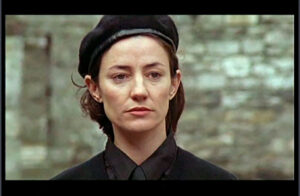
Director and screenwriter Maeve Murphy spoke to David Hennessy ahead of this year’s London Breeze Film Festival where she has two films including a 25th anniversary of her hunger strike drama Silent Grace.
Acclaimed Belfast film maker Maeve Murphy, is the acclaimed writer/ director of such films as 2001’s Silent Grace about hunger strikers in Armagh Women’s Prison.
The film, starring Orla Brady, 65, and inspired by true events, was named as one of the most important Irish films ever made.
There will be a 25th anniversary screening at this year’s London Breeze Film Festival.
The festival will also show a more current film by Murphy, domestic abuse drama The Wolf (2026), a collaboration with writer and actress Kellie Shirley, which won Best Director at London Rolling Film Festival (LRFF).
Maeve Murphy spoke to The Irish World.
Q: Hard to believe it is 25 years since Silent Grace…
“Well exactly. It’s an incredible privilege to have made a film that still matters enough to get a 25th anniversary screening
“The incredible thing about that film, which is why it has this lasting power, is it manages to resonate.
“When it had its revival between 2017 and 2020 there was that huge wave with the whole #MeToo thing to do with equality in the film industry and it hit that wave.

“These women had not only been written out of history but cultural history because there was so little in Troubles cinema to do with women who were involved.
“There have obviously a number of films about male hunger strikers, which are brilliant by the way, but including it with that had a huge impact on the canonisation of the film.
“From then on, it was right at the centre of Troubles films rather than at the periphery.
“It’s absolutely now on equal ground which is such an honour. It really, really is. I have no complaints at all.
“Silent Grace is still resonating.
“It resonates with The Wolf in a different way which is what can happen to women behind closed doors.
“One may be a prison; the other is a house with an abuser in it.”
Q: Silent Grace was ahead of its time in being a predominantly female led film. Actors like Hollywood star Patrick Bergin were just in supporting roles…
“The calibre of actor attracted to it was great.
“As you say, Patrick Bergin, of Sleeping with the Enemy (1991) with Julia Roberts, and everything else. He’s an extraordinary actor.
“He came in and had half a day to do that scene. I was so impressed by his ability to play the moment, play the silence, be present.
“Obviously, there was Orla Brady’s extraordinary performance and Conor Mullen’s as well, he was brilliant as the governor.
“He really pitched it correctly as a man who had to be quite cool and ruthless as the prison governor in a situation where the personal gets locked away because it’s such a highly charged political situation – which it was, the hunger strikes and the dirty protests – but his humanity leaks out around the edges.
“That is the other side of the film, it humanises everybody, something in him is troubled by this situation.
“It’s not just black and white, easy answers, goodies and baddies, or anything like that at all.
“It’s finding the human in this inhumane situation.
“Some Mother’s Son (starring Helen Mirren and Aidan Gillen) came before it (1997) and I was very inspired by that because it also looked at the human aspect, the mothers.
“They did it that in a different way – one mother didn’t want her son to die, the other mother understood why her son asked her to let him die.
“Putting life at the centre of a hunger strike film is really important for that film and also for mine, in a different way, because ‘Eileen’ doesn’t die but you’re respecting the gravitas of those people fighting for what they believed.
“It changed everything in terms of the course of The Troubles – the peace process grew out of that because it was such a rock bottom moment, there was something about starvation.”
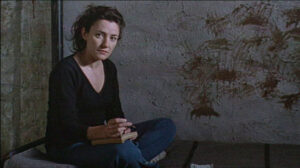
Q: The character of ‘Aine’ (Cathleen Bradley), a young tearaway who claims to be a Republican to make prison time easier for her and who ends up sharing a cell with Orla Brady’s ‘Eileen’ is the audience’s way in, isn’t she?
“Yeah, absolutely, she’s the audience’s eye in the sense she is the outsider, a little rebel renegade who’s not taking it seriously, who thinks, ‘I can say I’m a Republican’ in the courtroom and she gets thrown in with them and then it’s such a shock because she can’t just say, ‘No, I don’t want to be with them anymore’.
“She’s faced with the reality of incarceration. It’s a wakeup call because those people become human to her and Eileen becomes a friend.
“She doesn’t want somebody who’s been so good to her, who really helped her, to die.
“What always drew me to the subject was it blew my mind that those protests happened with women.
“It was not in the mainstream media at all.
“I wondered how you would survive, how you would get through that.
“The ‘Aine’ character goes on a huge growing curve to realise how serious this all is – it is life and death.”
Q: Did you feel a great sense of responsibility taking on this subject?
“Oh hugely, massively because you’re not just taking their story and putting it on screen. You’re aware this hasn’t been on screen.
“I did my research and talked to some of the women who’d been on the protest and another woman who was on a different hunker strike.
“I tried to make it as close to the essence of what that experience would have been like dramatically but also connecting to an audience which is why ‘Aine’ was so important because she also provides a bit of very Northern Irish, very Belfast, gallows humour.
“It’s respectful of their desire for political status but also makes sure it’s a humanist film which values life.”
Q: What were the reactions from women involved in this protest and protests like it?
“There was a screening at Belfast Film Festival, and a number of the women were there. One stood up and thanked me for telling their story and another one said, ‘It wouldn’t have been like that…’
“I said, ‘Well that’s always the way’ and that was it really. There was a healthy space between us which is good and right.”
Q: Could you have thought when you were making it 25 years ago that it would still be finding an audience all these years on?
“It did well when it was first released but I never thought it would have that staying power so, no, never in a million years did I think it would still be being shown, still being talked about
“There’s something in it that people love, it has a universal power that goes beyond the political situation.
“There’s something about a group of women standing up for something, which we still haven’t seen that many films do.”
Q: Do you reflect as well on all that has changed in Northern Ireland since the film was made?
“It’s being shown at a time when there is now peace in Northern Ireland and Republican women are in positions of political power, not on the periphery but right at the centre. That is a massive change.
“I’m so proud of the Good Friday Agreement. It shows the need for that kind of agreement all over the world and not to give up hope because the hunger strike seemed to be a deadlock, it to be impossible to resolve but the impossible was made possible.
“It was hope in a situation that seemed to be hopeless.
“If we managed to achieve that in Northern Ireland, people were able to sit down and talk to each other after situations like that, then it is possible in any place.
“Dialogue can work in any place, and peace can be created from it.”

Q: Let’s talk about your film The Wolf…
“It only struck me yesterday that they’re both films about incarceration, women suffering behind closed doors. I’d never thought of that before.
“The Wolf opens our heart again to the humanity of a woman being in that situation, the horror of domestic violence, how it includes children and sometimes can involve money and always involves finding a safe place to go.
“The stakes are incredibly high; it doesn’t have to be headline news for the situation to be just as hard.
“In Silent Grace people always talk about the spirit of humanity, the humour in it and the strong bonds between the women. What’s really important about (The Wolf) is that people see a shred of hope – they see this woman who quietly gets away and a fantastic performance from Kellie Shirley and a fantastic performance from James Harkness.
“What I love about that is she doesn’t trumpet to him, ‘I’m leaving you’, it’s a really quiet inner decision to get away.
“In terms of film, it’s really nice to give people a sense of relief that sometimes people do get away and we’re so happy she does and with her child as well.”
Q: What have audiences’ reactions been?
“(The film) opens people’s hearts what those women are going through, just connecting with human beings.
“Anybody, any of us could end up in a situation like that if we take the wrong turn or make the wrong choice.”

Q: The Wolf ends with Kellie’s character taking her son to safety in Belfast…
“There is a little bit of irony in going to Belfast for safety, but that irony is probably just for people who remember The Troubles.
“It just shows you the importance of family, of a safe place that’s far away because that’s what gives us the hope at the end.
“With audiences watching it in Brixton, you could hear the ‘Urgh!’ reaction to the headbutt then in other places the focus was more, ‘Well, she got away’.
“It changes from place to place, from audience to audience but it’s being received really well.”
London Breeze Film Festival is on 21-25 October. For tickets and more information, click here. Silent Grace is on at 10.30am Friday 23 October at The Garden Cinema. The Wolf is on at Regent Street Cinema on Wednesday 21 October as part of UK Women of Film programme at 2pm.
