

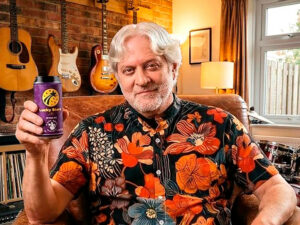
Singer- songwriter Dean Friedman told David Hennessy about his career spanning several decades, his Irish musical links and why the Easter Rising inspired one of his songs.
The American singer- songwriter Dean Friedman recently toured the UK and Ireland.
Friedman is known for hits like Ariel and, his biggest hit in the UK, Lucky Stars.
Another track of his that became well known in the long run is McDonald’s Girl. Although it was banned initially, the fast food chain would eventually ask to use it.
Hailed by critics and fans alike as one of the finest songwriters of his generation, Dean has been covered by acts like The Barenaked Ladies, Ben Folds Five, Ariel Pink, The Tone Rangers, and The Blenders.
He also inspired Half Man Half Biscuit for their track, The Bastard Son of Dean Friedman.
Dean was also one of the first artists to crowdfund their music, something many artists do now.
Dean played Dublin and Belfast on his recent tour.
The tour culminated in Dean’s own curated event, SongFest, a two-day micro-festival in Rugby, featuring leading UK singer-songwriters and special guest Kiki Dee.
Dean Friedman took time out of his tour to chat to the Irish World about it all.

How are you enjoying your current tour of the UK and Ireland?
“I’m always grateful to be able to hop on stage and share my songs with what’s always an enthusiastic and friendly audience.
“It’s still a surprise when I’m onstage and realise that everyone in the audience knows the words to some of these songs and sings right along with me, I still get a kick out of that.”
You have had hits with songs like Ariel and Lucky Stars, do you always know what you have when you write them?
“There’s some songs that you write and you think, ‘If that gets the proper opportunity, that’s a surefire hit’.
“I did feel that way about Ariel.
“I also felt that way about McDonald’s Girl which was banned by the BBC but did get a lot of airplay in Ireland which I’m grateful for.
“Even though it was banned and I lost my record deal and I was out in the wilderness for almost two decades, the song itself insisted on being heard.
“I had always believed it to be a pure pop song and it just kept making its way around the world.
“First a then unknown band called Barenaked Ladies did a cover.
“They had their first hit in Canada with it.
“Then a band in the States called The Blenders did a cover.
“Then a cappella groups at Ivy League colleges all over the United States did their own versions of McDonald’s Girl.
“So year after year the song, without any help from a record company or a publisher, just kept spreading around the world.
“It took about 33 years for finally a call to come through from corporate headquarters at McDonald’s asking if they could license the song for a national TV and radio campaign.
“I said, ‘That’s great, what took you so f**king long?’
“So yes, some songs you write and you say, ‘Yep, that’s a surefire hit’, and some of them take a couple of decades to prove themselves.”
You mentioned getting dropped by your label. You were a pioneer in that you were among the first artists to adopt a crowdfunding model, something that is now very common..
“It’s true and it was really by default.
“There was no one else doing it for me but I knew that there was an audience out there if I could only find a way to reach them.
“I had a bunch of songs.
“I wanted to get back in the studio but I needed the funds to upgrade the studio to pay musicians because I’ve always believed that musicians ought to get paid which is not a common philosophy in the music business.
“I wrote an email to a few thousand folks on my email list explaining that I was ready to record: If they would pre-order an album, I would go in the studio and deliver an album in a year.
“I was a little afraid everyone would write back and say, ‘Dean, why don’t you get a proper job? I work for a living, why don’t you?’
“Some people wrote exactly that.
“Some people were supportive of the idea.
“In 2001 I was able to raise the money to crowdfund the album that became The Treehouse Journals.
“The band Marillion had done that prior but as far as I know, I was the first solo artist to crowdfund an album on the internet and I’ve been doing it to raise funds for my albums ever since.
“What it means is that it sort of sidesteps all the gatekeepers of the record business: The publishers, the labels, the agent.
“Instead of trying to please some A and R guy that wouldn’t know a good record if it bit him, I was really only intending to please my listening audience.
“I’m grateful that that’s worked out and, as you say, since then it’s become par for the course.
“But, like I said, it was purely by default.
“I wasn’t being necessarily innovative, just trying to make an album.”
What was your experience of the labels while you were with them?
“Well originally I was signed to a small independent label in the States called Lifesong Records but it became clear pretty early that they didn’t really understand what I was doing.
“In fact when my second album came out, ‘Well well’ said the Rocking Chair: They hated it.
“I had to convince them to keep Lucky Stars on the album.
“Not long after that, we got a telex from England saying that Lucky Stars had entered the charts and was racing to the top.
“The album they hated, the single they didn’t even want on the album was music I believed in and after, I always was a little suspect of their taste.
“That sort of confirmed that they really didn’t understand what I was doing and also it was very clear from the very beginning, when Ariel was racing up the charts, they couldn’t keep up with the demand.
“They just didn’t have the resources or the gumption to service that record in the way that it could have been.
“It was very exciting working with record companies but it was also at the same time clear to me that there were a lot of things, a lot of mistakes being made. That was frustrating.
“The truth is that my experience between working with conventional mainstream labels and doing it independently was I made more money selling a thousand units as an independent artist than I ever did selling a million units as on mainstream labels.”
I understand you grew up in a musical house, was it always music for you?
“It was inevitable that music was going to be a part of my life but it wasn’t until I started doing little gigs in high school, where I’d get 10 bucks or 15 bucks to do a coffee house, that it dawned on me that I could do something that I love doing anyway and actually get paid for it.
“I’m still working on the getting paid part,” Dean laughs.
“But also it was an era where singer-songwriters were really coming into their own.
“The heroes of my generation were all pop stars and rock stars and singer-songwriters.
“When I was nine years old my dad, who was working in commercial television, took me to a recording studio and recorded my first song that I ever wrote called Summertime.
“It was an innocent little kid song but not bad for a nine year old.
“I played the record for my fourth grade teacher.
“She played it for her brother.
“He played it for a publisher in the music business in New York.
“They offered me a publishing contract at the age of nine.
“I went home and I practiced my signature for a week.
“We had a signing ceremony over milk and cookies in my dining room.
“I signed a publishing contract with a company called Elevator Music when I was nine years old and a few months later, it went bankrupt which foreshadowed my experience in the music business,” Dean laughs.
“But one thing it did do is it made me really confident in my abilities as a songwriter because at that tender age to get that positive reinforcement was really powerful.
“So to answer your question, Did I always think that music was going to be something that I did? From that age of nine I somehow accepted that I was good enough to be a professional songwriter and musician and I never shook that irrational feeling.”
For one song you were inspired by events of the Easter Rising..
“The Ducks of St. Stephen’s Green.
“I’ve always enjoyed visiting Ireland.
“It’s just that wonderful, magical place that people describe.
“They really celebrate lyrics, lyricists, poets and songwriters in a way that not every country does.
“It was 2016 where I started noticing a lot of posts on Facebook from folks in Ireland about the Easter Rising.
“Now being an American, my sense of history goes back maybe ten years so I started going online to research the Easter Rising and try to understand what happened.
“In the course of educating myself about it, I came upon what’s apparently a true story about a gamekeeper in St. Stephen’s Green who, in an effort to protect his ducks, actually negotiated a truce every afternoon between both sides so that he could feed his ducks and incredibly, both the Irish Citizens Army and the British troops laid down their arms and stopped killing each other just long enough for James Kearney to feed his ducks.
“It just made an impression upon me as suggesting that even in the midst of crazy, insane, bloody warfare that both sides still had an instinct to protect the innocent, even if they’re covered in feathers.
“That was the genesis of the song.
“It (St Stephen’s Green)’s still a place that I love to visit and stroll around.
“It’s an idyllic little park in the middle of Dublin and I’ve always been proud of the song because I think it tells a true story that means something to people.”
You are going there many years now, have you always enjoyed your Irish shows?
“Absolutely.
“I just always enjoy it.
“It’s an audience that’s receptive to lyrics and that’s a big part of what I do, tell stories.
“We always had a nice time visiting that neck of the woods and looking forward to returning.
“There’s one song actually in particular called The Lakelands.
“It’s something I wrote about the Lake District but it had sort of an Irish feel about it.
“When I wrote it, I played it for a publisher in Ireland and he was putting together a compilation album called Green Velvet.
“The compilation album consisted of traditional Irish folk songs by all these great Irish songwriters.
“He was missing a track so he said, ‘Dean, that song The Lakelands is perfect for this compilation album, Green Velvet. Can I license it?’
“And I said, ‘Sure’.
“So along with all these classic traditional Irish folk songs is The Lakelands by this Jewish kid, Dean Friedman.
“I was always proud of that and it became a bestseller.
“It was one of my biggest selling records.
“Fr that era, there are maybe a million people in Ireland that have a copy of that Green Velvet LP that they were playing and hearing The Lakelands.
“I always enjoy slipping that into the set because people recognise it and say, ‘I didn’t know you wrote that’.”
You have the festival Songfest coming up in late August that will also feature Kiki Dee and Carmello Luggeri. Are you looking forward to that?
“Absolutely.
“I’ve been touring the UK and Ireland for close to 50 years now and I’ve made a lot of friends and a lot of musician friends as well.
“One of my frustrations is that our tour itineraries would always conflict so I thought, ‘Gee, let me invite some of my favourite songwriters. We’ll rent out a hotel, and we’ll share our audiences and we’ll share the stage for a weekend’.
“I did it (in 2018) and it went so well because not just the audience but the artists performing had such a good time that I have been doing it ever since, except for those lockdown years.
“This year It will be three days of just some of the finest singer songwriters working today.”
What’s next? I assume the songwriting never ends..
“Well I’m always sketching and jotting down ideas.
“It’s usually only after I’ve done a crowdfunding campaign that I buckle down and start writing.
“I think Cole Porter said his inspiration is when the director picks up the phone call and hires him to do a gig.
“My inspiration is when I realise that my audience has already sent me money and paid for an album that I now need to go into the studio and write and record.
“I’m always writing and getting ready to do the next album.
“But this year I’ve started a music memoir.
“I realised that my erstwhile music career is a curious tale to tell.
“People are always asking about how these strange things happened, how I wound up writing the first consumer guide for synthesizers, how I created the first virtual reality video game for Nickelodeon television, how I built strange musical instruments for children’s museums all over the world.
“It’s a curious tale of my music career and also my multimedia career which always has some element of music in it.
“Every day the first thing I do when I get up is I write a little bit with the goal of publishing this music memoir.
“2028 will be the 50th anniversary of my biggest album ‘Well well’ said the Rocking Chair.
“I’ve got a year and a half to do it but it’s a big job.
“That’s what’s next on the agenda and I’m looking forward to getting it out there.”
Speaking of writing a memoir and looking back on your career, what leaps out as highlights of all you have done?
“Well some of the things that come to mind immediately are hiding in a box on the set of The Big Breakfast when I was told to jump out and surprise Gabby Roslin.
“That was one of those moments of contemplation where you’re in the dark, in the cold, in a box and you can’t help but ponder what you did to wind up in this place and time.
“Another moment that comes to mind was when the great legendary punk band Half Man Half Biscuit invited me to share one of my songs at one of their concerts.
“They had written a song called The Bastard Son of Dean Friedman which puzzled me at first until I listened to it and it was great.
“But then I realised, of course, that I would have to have been seven years old to have fathered Nigel Blackwell and even though I was a precocious seven-year-old, I wasn’t that precocious.
“But I met the guys.
“They’re really great.
“I wrote a riposte to that song called A Baker’s Tale telling the true story of the dubious origins of Nigel Blackwell and how he became Half Man Half Biscuit.
“It was all in good fun and they invited me to sing that song for their audience.
“I was a little nervous but by the second chorus they were all joining along and the end of the show, Half Man Half Biscuit invited me on stage to join them for a rousing rendition of The Bastard Son of Dean Friedman.
“Those were a couple of career highlights that come to mind.
“Also doing Top of the Pops and all that stuff.
“It’s been an unusual career.
“I’m sure most recording artists could probably say the same but I got no complaints.
“Well I got plenty of complaints but they’re not going to accomplish much.
“And for all the trials and tribulations in my career, I wound up meeting my wife and having great kids, and none of that would have happened if I had taken a conventional route.
“I’m pretty content.
“I really wouldn’t swap this crazy life with anybody.”
For more information, click here.
