


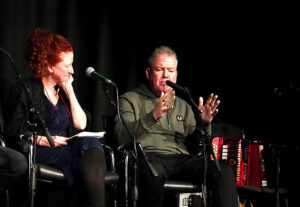
Andy Nolan, well known musician on the London scene, told David Hennessy about his crime book Green Bloods as he marked a year since its publication.
Local London-Irish musician Andy Nolan, formerly of The BibleCode Sundays, is also a true crime writer with his book Green Bloods about Irish involvement in London’s criminal underworld.
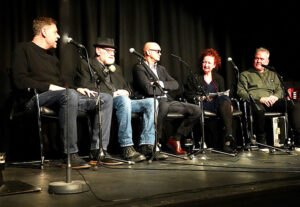
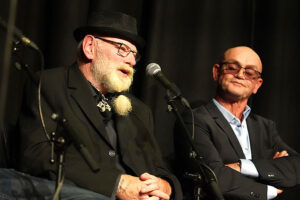
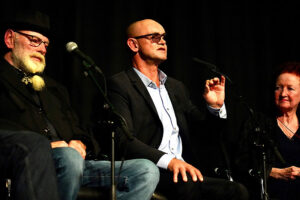
Andy was at The Irish Cultural Centre in Hammersmith recently for a book signing and Q&A session for which he was be joined by some of the former career criminals he features in the book.
Andy profiles past gangland figures like ‘enforcers’ Bobby Cummines, Danny ‘Longdog’ O’Halloran and Bobby McKew who worked for Billy Hill, who preceded The Kray twins, Reggie and Ronnie.
He also looks at London Irish armed robbers Noel ‘Razor’ Smith, Ray Bishop, as well as Sean and Vinnie Bradish.
The Bradish brothers were prominent in North-West London for scores of bank robberies and security van raids in the late 1990s and 2000s.
Ryan O’Halloran, Noel ‘Razor’ Smith and Ray Bishop were at the Hammersmith event.
Andy Nolan spoke to The Irish World ahead of the event: “Hammersmith is very important to me. I was born and brought up here. My parents emigrated here in 1959.
“I’m playing a few songs with Darren Morrissey from Two Canoes.
“We’ve written a song called The Guardian Gael of Camden Town.

“Guardian Gael is how Billy Hill became known because he was a Robin Hood character around Camden.
“As much as he was a ruthless criminal, he was also very generous to the community around him, many of which were Irish second generation like himself.”
Andy took ten years to write before its publication a year ago. Some of those featured in it died in the past year.
“We lost a few participants in the book, Bobby Cummines, Michael Emmett, his brother Brian Emmett Jr, which was very, very sad because these guys were great guys to interview, full of amazing stories and stories of redemption, especially Bobby Cummines and Michael Emmett.
“Bobby Cummines was such a great talker but another contender for that would have been Michael Emmett who was definitely a great talker.
“These guys can talk till the cows come home but it’s not a glorification of crime, it’s anything but.
“It’s pointing out the errors of their ways and how kids these days do not want to fall down those traps.
“It was so easy to write their chapters because they were just full of stories and enlightenment.
“I didn’t want the book to be about glorifying crime.
“These guys were accessible because they were so open about their criminal past and their brighter future now, that was the beauty of it.
“That’s why it was important to me that whenever there was a redemption story, and there usually was, I highlighted that and made sure that it was prevalent.”
Bobby Cummins is candid about how a customer in one of his bank robberies, who had been gagged, choked and died..
“He never intended that but then people would argue, ‘Don’t go into a bank with shotguns and gag people’ and he would admit that. That lived with him for the rest of his life.
“He really never recovered from that, and he always harboured that in his heart.
“He always said that was the one thing he would love to have changed.
“He was always regretful and remorseful about that.
“These guys are not always monsters, especially the guys that profiled in this book.
“They also tried to help their community, they realised they were taking but they wanted to give back.
“When they could give back, they did. I’m not saying it’s right that you take with one hand and give back with the other but that’s how these guys operated, the mantra they lived with whether we like it or not.
“Most of these guys were dirt poor, they didn’t have a lot of opportunities and did what they had to do.
“It was a different time, a tough time, for the Irish over here back then.”
Was it hard to square the men you interviewed with the vicious crimes they committed?
“Absolutely, yeah. Ray Bishop who often says, ‘What would I say to my younger self now?’ and he would encourage that young person to keep their head down at school, not follow his path.
“Having said that, he remembered the difficulties he had and the lack of opportunities he had as a youngster where he saw no way out.
“Noel ‘Razor’ Smith and Ray Bishop were harassed by police, so their path of criminality was as much about rebelling against the system as about making a quick few quid.
“They were young, rebellious teenagers rebelling against a system they felt was setting them up to fail at every corner.
“If the police found out you were from an Irish family, it gave them even more to go on, and many Irishmen and women here were fitted up.
“They were despised by the establishment, and easy pickings for a Paddy wagon, accused of stuff that they didn’t do.
“That happened to Razor Smith and Ray Bishop a lot in an age where there were no camera phones, there no CCTV at the mercy of these corrupt policemen.
“There’s a few more char acters in the book where this set them on a life of crime.”
Ronnie and Reggie Kray reportedly had Irish blood themselves and a number of their associates and henchmen also had Irish heritage..
“The main criminal would have been Albie Donoghue, born in Dublin, who was one of their heavies and debt collectors.
“A lot of these London Irish criminals, including Albie Donoghue, who worked with The Krays, didn’t have a lot of respect for them because they never ran into a bank (to rob it), they were opportunists, extortionists.
“If you carried out a bank robbery or a Post Office robbery the twins would be around your house the next morning looking for a share.
“They were two tough characters, three brothers in total if you consider Charlie Kray, so they had a presence.
“They were tough lads, but when it came to graft, they would take from others which was really frowned upon within the criminal fraternity.
“There was a big Irish presence around the Krays – the Barry family, the Donovans, the Shea family.”
The Krays had a run-in with the IRA during their time in prison..
“The IRA guys stood with the Jamaican boys who were getting bullied by the Krays and some of their outfit that were behind bars at the same time.
“Word got to Charlie Kray, the elder brother, on the outside. The IRA told him it had to stop and it stopped immediately.”
The book describes a 1970s funeral cortege through Kilburn..
“Yeah, it was Michael Gaughan’s funeral, the IRA hunger striker. “He was from Mayo and doing armed robberies around London, that’s how he got imprisoned and he ended up going on hunger strike.
“A lot of these London Irish criminals were on the same prison wings as the IRA guys.
“British prisons were full of IRA prisoners, and they became quite friendly with the London Irish criminals.
“A lot of guys, from Freddie Foreman through to Frankie Fraser, household names in the British underworld, had Irish heritage through their grandparents and a lot of these guys knew these IRA prisoners and, in some cases, believe it or not, were quite sympathetic.
“The Richardsons were in that bracket.
“They served time with IRA prisoners and became really friendly with them and became sympathetic.
“A lot of these guys had no prejudices towards the Irish.
“It was quite common for criminals born here of Irish heritage to be helped by crime families and the IRA back in Ireland.
“People frown upon stuff like that, but these worlds were interchangeable. They all knew each other.
“They were sharing prison cells, prison landings and when they got out, they remained in contact.
“It was quite easy for the likes of Freddie Foreman to pick up the phone and call someone in Ireland to get stuff arranged.
“That was so common back then.
“The British underworld and the Irish underworld were just inextricably linked through Irish emigration to this country.
“A lot of people will wrestle with that and not want to accept it, but they’ve got one thing in common, they were hated by the police.”
Some of your stories feature familiar landmarks like Early’s Café in Cricklewood and the Kingdom bar in Kilburn..
“I wanted people to pick up this book and feel like they were quickly getting immersed into a completely different world and era.
“Real events and real places were really important to me so people would go, ‘Oh my God, I do remember that cafe down there and I remember when that pub used to be there. Maybe those guys were sitting right next to me all the time before they went off and robbed a load of banks.’
“And there’s every chance that they were.
“I wanted to bring it up close and personal to them to make them realise these people walk among us, and it could have been you if you’d had similar breaks.
“Who’s to say it couldn’t have been you as well?”
Green Bloods is out now.
