


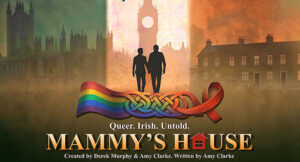
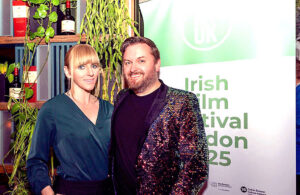
Derek Murphy and Amy Clarke told David Hennessy about their forthcoming play Mammy’s House which looks at the Irish experience of the AIDS/ HIV crisis of the 1980s.
A new play that explores the untold story of the Irish experience of the AIDS crisis of the 1980s.
Starting in Camden of 1985, Mammy’s House tells the story of how a small, queer Irish household deal with the AIDs disaster first in the distance and then more close to home.
Inspired by the teachings of Dr Joseph Healy, actor Derek Murphy saw an untold story from an era that has been documented in series like It’s A Sin but not from the Irish point of view.
Derek approached his friend and writer Amy Clarke and she joined the project.
Mammy’s House has been supported by the Irish government’s Emigrant Support Programme.
There is also a crowdfunder which is still running.
As well as being an actor, Derek also leads Q- IFTUK, the queer arm of Irish Film and Television UK.
Amy Clarke is an award-winning screenwriter from West Cork. Her debut short film, Sequins, screened at over 24 international festivals (including BAFTA and Oscar qualifiers).
Her comedy pilot Coming of Age was a 2025 Austin Film Festival Second Rounder.

Derek and Amy took time to chat to the Irish World about Mammy’s House.
Where did the idea for Mammy’s House come from?
Derek: “During the early days of lockdown, I came across this online talk that was being given by Dr. Joseph Healy about LGBT Irish migrants during the AIDS crisis.
“I’d never heard about it from an Irish point of view before.
“It was around the time It’s a Sin was on.
“Essentially what Joseph Healy said during his talk was he said it was amazing but one of the huge glaring omissions from it was that there was no Irish characters.
“He said at the time it would have been unrealistic for there not to be Irish people around.
“It was the ‘80s, there was a huge number of Irish people in London and there was a huge number of Irish queer people in London because in Ireland at the time, it was illegal to be gay up and then especially during the actual height of the AIDS crisis, there was no HIV/ AIDS healthcare in Ireland at all so they all came over here.
“A few different points and facts that he pointed out were rather shocking including one of them being that at the height of the crisis in the ‘80s that some of the AIDS wards in London were 50% Irish.
“I was like, ‘I’ve never thought of any of this from the Irish point of view. Let me go away and research it and see what else I can find out about it’.
“I went off and there was practically nothing: There’s no movies about it, there’s no books about it, there’s no plays about it.
“There are loads of plays about HIV/ AIDS but there’s none from an Irish point of view.
“The guys at the Irish Cultural Centre, William and Ros, were absolutely amazing and really, really supportive.
“Through them I managed to get some funding through the Emigrant Support Programme at which point I turned to my bestie Amy, who is an amazing writer and was like, ‘Would you like to come on board and write this?’”
Amy: “When Derek told me about all of this I was like, ‘Oh, that’s shocking’.
“At the time, we were thinking of it as a one man show and then when we got the research and development funding and started interviewing people, it very quickly became apparent that this was a much bigger story and we couldn’t even begin to do it justice in a one man show and because of the diversity of people’s experiences, it’s something that needed to be told through a full play and lots of different characters.”
Derek: “We started doing a year of research and development and we interviewed a lot of amazing people including Dr. Joseph Healy, Bernárd Lynch and lots of others.
“We have hours and hours of footage and it quickly became very apparent to both of us that this story is absolutely enormous.
“And the stories that we were hearing were horrific but some were also hilarious because there’s an Irish sense of humour obviously involved in everything and then it really became apparent to us about how difficult it was going to be to try and make this into one story.”
Amy: “I wanted it to feel authentic to an Irish audience as well.
“Joseph was telling us about how there were respite homes all across the UK so if you just needed a few days, just someone to feed you, somewhere to go and just relax and recuperate a bit, because obviously with people’s immune systems being as weak as they were, it was a lifeline to be able to go and just not have to think about stuff for a few days.
“I’ve set it in Camden and it’s owned by this gay Irish man, who will be played by Derek.
“He’s been taking in queer Irish lodgers who’ve had to run away from Ireland for one reason or another and they’ve nowhere else to go.
“We meet them at that point in time where he’s just got his lodgers, they’re living quite normal lives.
“Derek’s character’s nickname is Mammy because he’s like the Mammy of the house.
“That’s the way that I wanted to build what this chosen family looked like and then the AIDS crisis becomes more prominent as the play goes on and it’s affecting their life outside the front door of Mammy’s house, and then as it continues, it comes inside the house and how they deal with that and how it then goes from becoming this home for queer runaways to being a place of refuge for Irish men who are suffering with HIV.
“I feel that was the best avenue to go down in terms of bringing it back into the Irish family experience and a specifically Irish story around the AIDS crisis.”
It sounds like a story of ordinary people getting thrown into extraordinary times..
Amy: “Yeah, I think we saw that in COVID as well.
“We were all living very normal lives and then suddenly we have to adjust ourselves to deal with it.
“The difference with COVID is it was happening to everyone all at once so you had government responses very quickly but when it is mainly targeted to the gay community, then we saw that everyone turning its back on it.”
Derek: “The massive difference was nobody was being blamed for getting COVID.
“These people were not only contracting HIV and AIDS, they were then being blamed for doing so and condemned and judged for doing so.
“Society as a whole was turning their back on them.
“There’s such a vast difference between the two.
“It just sort of baffles your mind that this actually happened and it happened not that long ago.”
Amy: “I think there’s something quite interesting about the Irish experience of AIDS and HIV in that growing up in Catholic Ireland, in a shame-based society, being told that being anything other than what you’re expected to be is wrong and shameful and it’s your fault and that being gay is a choice- You just can imagine that when you’re diagnosed with HIV and you’re gay and you’re Irish, the added weight of that shame of thinking, ‘Well maybe they were right, maybe this is punishment’.
“Because people didn’t know what it was then and all the papers were saying ‘It’s a gay plague, you wouldn’t get this if you weren’t gay’ and if that’s all you’ve got, there’s no science at that point then it’s very easy to blame yourself.”
Derek: “It’s so easy to look at something like this and focus on the trauma and the damage and the negative side of it but like anything, like Covid, it brought out some of the best in people as well.
“You had people who were coming to the forefront and helping and supporting and doing everything they could to try and make things better.
“During our research, it was an emotional rollercoaster going through it all because listening to some of the stuff that these people did was absolutely incredible and if it takes us doing this and everything else to scream their names from the rooftops and get them the recognition that they deserve for the amount of work, support, effort, blood, sweat and tears they put in, then we’ll do it.”
Amy: “It’s like what the lesbian community did with running blood drives and stepping up and taking care of the dying men.
“I’ve got an Irish lesbian character in the play and she is, bless her, the embodiment of all the lesbians who did that in one character.”
Derek: “We have a feeling of responsibility now to tell these people’s story.”
An untold story for sure, did you find tragic stories of Irish people away from home perishing from the disease but still too ashamed to contact home?
Derek: “Even now I guarantee you there’s people whose uncle died of a heart attack and that’s the family lore that they’re being told but the actual truth of it is they passed away from AIDS or HIV.”
Amy: “A lot of them, I think, lied and they said, ‘Oh, I got a job in England and I’m moving away’.
“And then they go there, they go into an NHS hospital and they would die and the family would be told why and they’d just say, ‘Oh yeah, he got cancer, he had a heart attack’, and that’s what everyone would believe.
“Another thing that I’ve been quite mindful of in this play is Irish humour because we are a self-deprecating people.
“We like to try and make light of situations particularly, I think, the worse they get, the more we try and deflect with humour.
“I remember when we did the first draft read through, people’s initial feedback was, ‘I wasn’t expecting to be laughing and then I felt guilty for laughing’.
“I was like, ‘Well that’s an Irish response right there’.
“And you’re like, ‘No, you should’ because we meet these people before the crisis has hit them so they’re living their normal life so there should be humour in there and then I think Irish people have a very distinct way of dealing with tragedy through humour so it’s an important part of it as well.”
Derek: “Some of the stories that we heard during the interviews for this are hilarious.
“Sad circumstances but they were really, really funny and people did crazy things which are just as much a part of the story as everything else.”
Were there other stories about families who were there for loved ones?
Amy: “Being in New York, Bernard did say whenever there was a young Irish man that was coming to the end of his battle, he would phone the family and the mothers, 99% of them would come.
“It was always the mother but they would come.
“He would pick them up from the airport and he’d just say that they were sick.
“He wouldn’t say what was wrong with them but, ‘You need to come if you want to make your peace and say goodbye’.
“And they would always know, ‘They’d always ask me if their son had the Rock Hudson disease’.
“They would just know and they were coming because they wanted to make their peace with their son before he passed away.
“Equally there were families that just said, ‘No, I don’t want anything to do with the body, they’re no son of mine’.
“That would happen, not necessarily just Irish families.
“So there was both sides of that.”
Were there stories about nurses being reluctant to treat AIDS/ HIV patients, to the point of even being reluctant to bring food into their rooms?
Derek: “Bernard had a rather horrific story.
“I think it was more New York than it was here but the early days of it, they wouldn’t bring food into the rooms.
“They would leave the food at the doors.
“It’s so easy to look back and have such harsh judgment on it all, it was different time and people were terrified and clueless, people didn’t know what the hell was going on but he did have these horrible stories.
“They would find trays of mouldy food at the door because they wouldn’t bring the food into the people in the actual room and of course, they were too sick to get out of the bed and go get it.
“That just sounds like something from a horror film.”
Amy: “And that’s in the book All the Young Men by Ruth Coker Burks.
“She was visiting a friend at the hospital who had cancer and she saw a door with tape across it and a tray of food outside.
“She went in and there was a dying man in there and then whenever she would go to the hospital to visit her friend, she did start taking the trays of food into the room and feeding the men in there.
“The nurses would be like, ‘What are you doing? You can’t go in there’.
“And she was like, ‘Well, are you going to do it?’
“And they went, ‘No’.
“So she’d be like, ‘Right, well just leave me to it then, it’s my choice’.
“It was happening all over the states definitely.”
Derek: “It’s important to remember as well that Ireland has come on leaps and bounds in the past 10, 20, 30 years and it is a different place now.
“It has changed a lot, but this happened.
“People went through this and there’s a lot of healing that still needs to happen and healing starts with recognition and just even telling the story to recognise that it did happen and that people went through this.
“There are a lot of people who survived this and are still living with it to this day.”
Amy: “It’s definitely been cathartic for the people that we’ve spoken to.”
Derek: “It was like therapy speaking to people because we would go in with lists of questions in case they’re uncomfortable talking about it.
“In every single case you just started with one question and it was like they were desperate to get it out.
“They just started talking and talking and talking and talking and it happened with almost every single one.
“And it’s because they’re probably not asked about it and it’s not a conversation that comes up.”
After all that has gone into it and how personal it is not just to you there must be great responsibility you feel..
Derek: “Joseph and Bernard have both read the script and we’ve had a fantastic response from them.
“Obviously we interviewed a lot of people.
“We will be inviting all of them to come see the show.
“It wouldn’t be possible without us having been able to sit down and talk to them and them being so open and honest about their experiences.
“It’s a story that you could easily pigeonhole it into a gay play, an Irish play but it’s broader than that, it’s about our history, it’s about community, it’s about society, it’s about people, it really is a story open to everyone and should be heard and seen by everyone because there’s elements of it that refer to all of our histories.
“You don’t have to be Irish, you don’t have to be gay to know about what happened before and like everything in history, the more we understand about why these things happened, the more hopefully it’ll never happen again.
“It really is a story that’s open to everyone.”
Amy: “This is a human story.
“It’s a part of Irish history and Irish history has been known in the past to be swept under the rug but we’re getting better at talking about it and this is another cathartic step in becoming more an Ireland that accepts its citizens for whoever they are.”
Mammy’s House runs 1- 13 September Upstairs at the Gate.
For tickets and more information, click here.
You can still donate to the Crowdfunder here.
