



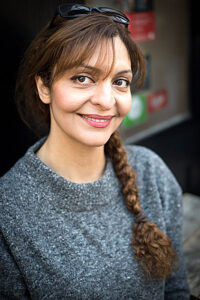
Atoosa Sepehr, whose story of escaping a bad marriage and the oppressive regime of Iran inspired the play My English Persian Kitchen, told David Hennessy how she was lucky to get out.
Following sellout runs at Edinburgh and Soho Theatre last year, My English Persian Kitchen by Hannah Khalil has returned to Soho Theatre and is about to embark on a tour that takes in Bristol Old Vic and venues in the north and south of Ireland.
It is based on the story of food writer Atoosa Sepehr.
In December 2007, Atoosa Sepehr arrived in the UK from Iran. She was 30 years old, fleeing a disastrous marriage and her escape was an overnight flit. She’d packed in under an hour, was driven to Tehran at speed by her mother, bought a ticket in cash and raced through departures. In Iran, divorce wasn’t easy without a husband’s agreement, which Sepehr knew her husband would never give. He also holds the power to ban his wife from leaving the country.
Alone in London and still reeling from fleeing a traumatic personal situation in Iran, Atoosa began to crave home cooking.
But she had never learned to cook.
She would try to learn with tips from relatives on the other side of the world, often sharing with neighbours who noticed the delicious aromas wafting out of her kitchen.
In the play, the actress Isabella Nefar tells her story of survival as she cooks traditional Ash Reshteh, a Persian noodle soup.
Without warning the scenario flicks to the past with the kitchen bench setting being transformed into an airport, a taxi, a bedroom.
The production concludes with a shared meal with audiences invited to gather around the kitchen bench to sample the Ash Reshteh.

Interviewed by The Irish World last year, playwright Hannah Khalil was born to Palestinian father and Irish mother.
Atoosa Sepehr, who now lives in Belfast, told The Irish World the true story behind the play.
My English Persian Kitchen has been such a success, what was your initial reaction to hearing someone wanted to make a play about your story?
“It was a big surprise.
“In the beginning I thought, ‘Is it real?’
“It was only when I went and I met David (Luff, head of Soho Theatre) I was like, ‘Oh my God, this is real’.”
That was the start of the journey. What is it like for you to sit and watch the play? It must bring up emotions..
“Yes, a lot.
“It (the writing) was quite hard for me and also the fact that you don’t know how people are going to perceive it.
“Everything was a little bit overwhelming for me.”

How did you find working with playwright Hannah Khalil?
“When I met Hannah, I just knew she was going to be the one because we just clicked and we felt like we could make this story work together.
“She was very generous with her time.
“She spent a lot of hours going through my story and writing it, drafting it and again, rewriting it.”
The story is about your escape from the oppressive regime and a bad marriage. You just had to get away, didn’t you?
“Yes, my problem was my husband at that point- It wasn’t really the regime- because the men in Iran had the right to ban you from leaving the country if they wanted to.
“And also the other problem was if I wanted to get divorced, which I wanted, I wouldn’t have had the permission unless he wanted to get divorced.
“He should have granted me the divorce and he wouldn’t have done that. I knew that was going to stop me from my work as well because the job I had was mainly outside Iran and I knew as soon as I say to him, ‘I want to get divorced’, first of all he’s not going to give me the divorce and second of all, he would be like, ‘Okay, I’m going to ban you from leaving the country’, as a kind of control thing, you know?
“So without him knowing, I started applying for jobs in London and I got one because the company that I was working with had a branch in London as well.
“They didn’t know my circumstances.

“I just applied for a job and thankfully, they needed me there but only when I knew that I had my visa and I had everything sorted, I asked for divorce and everything went mad and he was like, ‘No, I’m not going to give you the divorce’.
“And it got to the stage that I had to call my parents because my parents didn’t know anything up to that point.
“Because he was living in the flat that was originally my flat but I couldn’t ask him to leave, he would have not left and I couldn’t have left and leave him in my flat so everything was so complicated.
“My parents came and finally he left.
“He called me and he said, ‘Atoosa, I’m sorry. Please, let’s give it a go’.
“And I was like, ‘No, we need to really get divorced, we can stay friends’.
“And that was the moment he realised I’m not going to come back and he said to me, ‘Okay, tomorrow I’m going to ban you from leaving the country’.
“And I knew he was not bluffing.
“He was writing the codes and everything, managing the database (in the passport office) so he was just a minute of asking a colleague put a tick in front of my name and that was that.
“I knew this was going to happen so I called my mum and I said, ‘This has happened’.
“And my mum said, ‘You need to leave as soon as possible’.
“I had to gather money from friends and everyone because at the time in Iran, there was no cash machines and I knew when you buy it last minute, tickets are quite expensive.
“I just packed myself.
“I can’t even remember what I put there.
“I didn’t know what to take because I knew I was not going to go back.
“I just packed my stuff and my mum drove all the way back.
“She said, ‘I have to take Atoosa to the airport’.
“And she got penalty because she passed all the speed camera.
“She was like, ‘I don’t care, we just have to get to the airport’.
“I got to the airport and got the ticket.
“I’m not exaggerating: It was the very last ticket.
“I got out of the country and in the morning, my ex called my dad and said, ‘Oh, I have banned Atoosa’.
“But it was just a matter of an hour that I was out.”

You were out but alone in London, what were the emotions of that?
“I was so confused because everything happened so sudden.
“I was really all over the place and all I wanted to do was get my job in place and find a place to move.
“But at the same time, I was completely all over the place.
“Looking back, I was depressed.
“But one thing that I didn’t know when I was applying for my visa and getting everything sorted to come to London was when you applied for work permit, you would have got a letter from the home office as approval but the part that I missed was I didn’t know this letter needed to be taken to the embassy in your home country. That was the part that I missed so when I came here and I thought, ‘Everything is sorted. I don’t need to go back’, only then I realised, ‘Oh no, I have to go back again’.
“And I was banned from leaving the country, I didn’t have an option to go back.
“My parents did everything to convince him to give me the divorce.
“At one point they even agreed to pay him and he agreed to give me the divorce when there was money involved but last minute he said, ‘No, I am not going to give her this divorce’.
“It was kind of like this pride, ‘How dare she leave me like this?’
“And when I got to the fifth month and I realised nothing can be done, I went to see a solicitor who I thought was going to help me to find a way.
“She said to me, ‘You can apply for asylum’.
“I didn’t want to be here as an asylum seeker but I didn’t have a choice.
“So I said, ‘Okay’.
“Although it wasn’t really my preferred choice but it was my only way because I had less than a month for that letter to be expired.
“My dad just called his solicitor and said, ‘Atoosa is not coming back. She doesn’t need to come back so don’t worry about the divorce. He can stay married for the rest of his life’.
“And when he got the news he thought, ‘Okay, what am I going to do? I’m going to create a trap for her’.
“And after a couple of days, the solicitor called my dad and said to my dad, ‘Atoosa can come back whenever she wants. All the bans are lifted, she’s safe and he’s very sorry and he’s regretting what he’s done. She can leave and when she comes, we can do the divorce and everything if she wants to come, whenever she wants to come’.
“But the thing was that he didn’t know that I am in a desperate situation to come back.
“He just thought maybe I’m missing my parents or I want to be in Iran.
“He didn’t have a clue as to what was happening.
“So my dad said to me, ‘Let me check and see what he says is true’.
“It took my dad a couple of days to find out if I am really free to come to Iran and if I am not banned.
“I remember the day my dad called me and said, ‘Atoosa, I have checked everything and you are not banned from leaving the country. Just come back straight away’.
“I remember I called my office and I said to my boss, ‘I need to go’.
“And they knew at that point what was happening.
“And he said to me, ‘Why are you going?’
“I said, ‘My dad is saying, ‘Come, it’s safe’.’
“And he said to me, ‘Your dad is mad. Don’t listen to him. If you go, this is a trap. You’re gonna be staying there. You won’t be able to get back’.
“But I went back straight away in the morning.
“I went to the embassy, got my passport stamped and we went straight away back to the airport but the thing was there was no ticket and I had to stay until the morning.
“The morning after, I got to the plane and I left thinking, ‘Everything is normal, everything is okay, nothing has happened’.
“On the way home after dropping me at the airport, my parents received a phone call from the police saying, ‘We know Atoosa is back in Iran and we need to talk to her’.
“And my dad said to them, ‘She’s not here, she’s gone back to London’.
“And they were like, ‘No, it can’t be possible’.
“What happened was when I arrived in Iran, he checks the system, sees that I am in.
“He sent a letter or a call to the person who was meant to put the tick in front of my name.
“That person was a woman.
“I don’t know if she felt for me and she didn’t do it straight away or she just forgot but she put the tick in front of my name the morning after but again an hour before that, I was out so I escaped twice, luckily.
“It was just a piece of luck not once, twice.”

It was homesickness that led you to explore the food of your home country..
“Yes, the second time I came I knew, ‘This is it. I’m not going back. I’m going to be here’.
“And that was really hard, not that I was unhappy. I escaped and I was in a good country.
“It was just when you suddenly lose everything, you’re like, ‘I am on my own here’.
“I was completely down and depressed and I started cooking food.
“And one thing that started giving me comfort is the smell of food taking me back home.
“And when I was in Iran, I never cooked properly because I never wanted to be in the kitchen and be associated with a woman in the kitchen.
“I always wanted to work to be equal to a man and be independent.
“So it was part of me that came out but I always suppressed it and I started cooking and cooking.
“And the more I cooked, the more I called my mum, my grandma, my aunts getting all the recipes right.
“And, as a result, I was getting back to my normal self.
“My neighbours, who I was living with at the time in the block of flats, started asking, ‘Atoosa every time we’re coming to the block, there is a smell of food. What’s happening?’
“And they never talked to me before.
“They never noticed me before.
“I realised, ‘Wow, people are interested’.
“And while I was cooking, I was taking food to my neighbours as well some days and some days, I was inviting them to my home and that became my community, that became my way of knowing myself in this country and building a community.
“And from there, I ended up with a notebook of recipes that were all from my mum and previous generations.
“I realised people in Europe, people in the UK didn’t know much about Persian food and didn’t know much about Iran.
“Everything you hear about Iran is negative.
“I just wanted to bring something different and show Iran in a different angle,
“I just wanted to show a good part of Iran.
“And I started writing the book (From a Persian Kitchen) and then I started pitching it to the publishing company and when I got the deal, it was unbelievable. I couldn’t believe it.
“I was so becoming attached to food that I wanted to open a new chapter in my life, something that is me.
“I always wanted to be proving myself that I am equal to a man but at one point, I realised I don’t need to prove myself anymore.
“It (Studying nutritional therapy) opened a completely different door to me and now I see clients and I’m helping people. I can see now I can make proper changes in people’s lives, for people that they’ve been struggling for years and now they’re getting comfort, they’re getting the results. That is something I can’t put price on.”
What is it like to see people resonating with the play? I’m sure it is not just Persian people..
“The story is not really specific to Iran or Persia or a certain group of people.
“It’s a story that is common everywhere in the world.
“First it is being stuck in an unhappy marriage and trying to get out of it which is very common.
“And the rights of women.
“Even this part of the world still, there are some differences between the rights for man or woman.
“And also the process you start to build a new community.
“It happens, especially these days.
“It happens to many people who have to leave everything and come to a new country and start from beginning and create a community around themselves.
“It was so relatable to many people.
“Many people came to me from China or from other countries.
“Somehow they felt and they went through my journey.”
You now live in Belfast, how do you like it there?
“The people are very welcoming.
“I lived in London For 15 years.
“Nobody ever asked me, ‘Your accent, where you from?’
“(in Belfast) they are so interested. They talk to you.”
My English Persian Kitchen is at Soho Theatre until Saturday 11 October. For more information and to book, click here.
My English Persian Kitchen is at Bristol Old Vic 14- 18 October. For more information and to book, click here.
My English Persian Kitchen is at Pavilion Theatre, Dun Laoghaire, Dublin 21- 22 October. For more information and to book, click here.
My English Persian Kitchen is at Lyric Theatre Belfast (presented by Belfast International Arts Festival), Dublin 21- 22 October. For more information and to book, click here.
For more information about Atoosa, click here.
