



Cork actor and playwright Aaron O’Neill told David Hennessy about his absurd one man show The Pigeon Factory which deals with themes of social media, isolation and capitalism.
Cork playwright and actor Aaron O’Neill, artistic director of Oh! Scare Wilde Productions, is bringing his absurd one man show The Pigeon Factory to the Edinburgh Fringe.
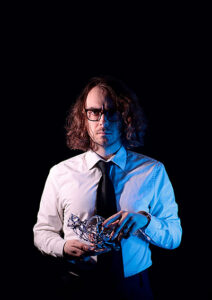
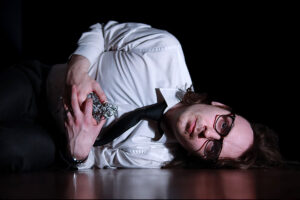
Tracing the descent of an unhinged man into a delusion of 1950s suburban perfection, the darkly absurd one-man drama frames the domestic household as a factory assembly line staffed by pigeons.
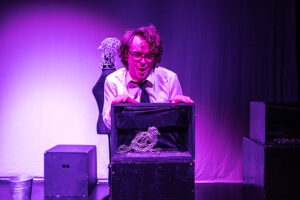
Attempting to maintain a perfect life with his mannequin wife Marianne and a brood of birds that he keeps in boxes, Walden hosts the audience as guests in his home.
The play serves as satire of modern productivity and the lengths we go to justify constant output, with the isolated man surviving solely on his pigeon children’s eggs for nourishment.
Dee Finn directs.
Aaron took time to the chat to the Irish World.
Where did the idea for The Pigeon Factory come from?
“I was reading a lot about the internet and social media companies and how all this tech distracts us.

“And then a name kept coming up.
“That name was B. F. Skinner and he was a scientist and father of behaviourism back in the 20th century.
“He did these experiments involving pigeons in boxes.
“He had these glass and metal boxes called operant conditioning chambers, or Skinner boxes as some people call them, and he trained the pigeons to carry out these complex tasks involving pushing buttons and pulling levers randomising their reward with food and things like that.
“He was able to condition their behaviour and train them to do quite complex tasks.
“Skinner believed that this was applicable to humans and that we could condition people to create a perfect society.
“He had this utopian, in his mind, vision of the world.
“All that was swimming around in my head and the reason Skinner kept coming up with these tech guys is because they were very open about how they use those kinds of conditioning techniques in their algorithms to make people addicted to their apps.
“There was something about the image of the pigeons in the boxes that just really struck me.
“It was just such a bizarre image and it all came in a flash.
“I was like, ‘Oh yeah, I see the stage. I see all the cages here. I see this guy. I see this mannequin’.
“It all just came in a flash and I kind of worked from there.”
Does the image strike you because in a way we have turned into pigeons by social media companies?
“Yeah, that was the initial crux of the idea and it evolved into something a bit bigger than the social media thing.
“It became more about capitalist society and how we view ourselves as productive beings and things like that.
“You couldn’t get away from the idea of being in a box, being trapped but I got the sense that even the person trapping the people in the boxes is trapped in his own way.”
Capitalism is a big theme..
“Yeah, it’s definitely a central theme of it.
“It’s funny how that came out because that was not my intention starting to write it.
“I was thinking about social media and algorithms and it evolved into something bigger about capitalism more generally and how it makes us think about ourselves, how we only value ourselves by how productive we are.
“I think everyone knows that feeling.
“I’m someone who is often anxious when I have free time.
“I’m anxious on a day off and I’m like, ‘Oh God, is there something I should be doing?’
“And obviously that’s me as a freelance artist talking but I think it’s true to a lot of people these days and that kept coming up because this character is working these pigeons like an assembly line and he’s pushing them to lay eggs all the time.
“I think it was Dee my director who asked, ‘What’s the urgency? What’s making him do this?’
“Then it really started going into that bigger capitalistic direction and this character’s past traumas came out.
“I think this is a guy who was in the workforce, who really believed in the ‘work hard and you’ll be successful’ kind of dream, who had a terrible time of it and didn’t go anywhere with it but instead of learning from that and saying, ‘Maybe this system that we have isn’t very good’, he thought, ‘Well, what if I just recreate the system but with me at the top?’
“That’s what his world is really.
“He’s trapped and wounded by the capitalist system but he isn’t yet at a place where he can figure out that that’s the problem.
“He’s just thinking, ‘No, no, no, I need to be in charge. That’s the real issue here’.
“There’s a book called Capitalist Realism that was a big inspiration for this show.
“It’s about the idea that capitalism is so ingrained in our society that we can’t even conceive of an alternative to it.
“The whole idea of buying and selling and things having value and working for money and things like that is so ingrained in how we live, we just can’t think of another way.
“And the terrible thing is that it doesn’t have to be this way.
“I think what the powers that be would like us to think is that this is just the way it is and there’s no better way to do things but there is, of course.
“We should always be asking for a better world.
“We should always be asking for a better way.
“I hesitate to say what that better world can be but certainly not this.
“That was big in my mind when writing it so I think this is a character who, in various ways in his life, can’t think of another way to be and the inevitable drama that comes from that.”
Isolation is another big theme of the piece..
“Yeah, for sure.
“This main character Walden, essentially you’re viewing his mind.
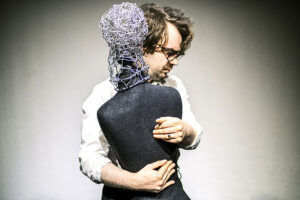
“He’s a very lonely man who’s run away from the world and created this, in his mind, perfect world with this family of pigeons and with his beautiful wife who is just a mannequin with a pigeon’s head.
“Everything that happens is a projection of his own mind and emotions.
“And it tells a lot about him, the kind of world he that he would create.
“He’s someone who is very adrift in life and doesn’t really know what love is and is trying to create a very twisted version of it.
“It’s a shame that that resonates with so many people.
“It’s obviously not good to hear but we do live in an increasingly isolated world.”
The irony is that modern technology means we are more connected than ever but loneliness is at a record height. Obviously this character has a mannequin for a wife..
“Yeah, me and my director Dee had a chat.
“Obviously Walden has his mannequin wife and we make sure to avoid any implications that he has sex with the mannequin or anything because we were like, ‘That’s not what it is and that’s just not the kind of joke we’re looking to make’.
“We’re like, ‘It is about the companionship thing for this character’.
“But it’s interesting as well because he also is not terribly nice to her.
“I think his vision of what a marriage is and what a wife is is informed by the culture of old family sitcoms or the nuclear family from the 50s and 60s and that kind of bickering, ‘Oh, take my wife, please’ kind of stuff.
“We had this idea that everything in his world or the way he views family and the world around him is totally informed by the traditional culture of Western family values and it’s all very twisted in his head.
“The way he treats his children is like he’s their father but he’s also this stern, almost abusive manager or something so it’s just this horrible mix of societal messaging in his head.
“So yeah, no sex with the mannequin. I can confirm.”
Good to know that it’s not one of those shows.
So it is traditional or perhaps outdated family ideals that informs his views: Husband, wife, ‘be quiet kids’..
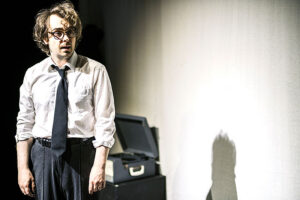
“Exactly, it’s very much like ‘Father knows best’ 1950s propaganda and that patriarchal view of the world where the wife stays home and does the cooking and the looking after the kids and the kids behave and be quiet and defer to father’s wisdom.
“It’s quite an unpleasant view of life.
“But that kind of stuff still hangs around unfortunately.
“It’s funny.
“I think we’ve progressed in a lot of ways obviously but I think some of those ingrained values are still there under the surface for a lot of people.
“We’re less overt about it now but I think a lot of men, and I don’t want to just point the finger at men, I think women too, however much they’re consciously aware of it, do absorb those kinds of gender roles.
“Obviously it was more overt in the past and it’s more overt in the way that Walden goes about it obviously with that sort of 50s aesthetic but I think that that is still a thing today to some degree.
“One of the things we were talking about, me and my director, about the character of Walden, is that he just internalises societal messaging in a way that he isn’t aware that he’s doing it.
“It’s not conscious, and I think a lot of people do that.
“I think we all do.
“We have these unspoken, unquestioned assumptions within us that we act upon and I think people can make themselves quite miserable because they’re kind of following a script, a life script that doesn’t necessarily apply to them.
“The 50s thing is a good way to get that across.
“Everyone knows that kind of image and that kind of iconography.
“The 50s and 60s in America, that kind of peak propaganda, that peak Hollywood, Western dominance. Everyone knows that imagery so it’s quite fun to distort that then to make it dark or give it a bit of an edge.”
The 50s is the perfect image in that way because war is over but the youth are not yet rebelling with 60s freedom. In other words father has it just the way he likes it..
“Yeah, it was and it wasn’t because obviously that’s certainly the image that the American government and things like that at the time wanted to push: ‘We are the greatest country on earth. We have our happy families here with their white picket fences’.
“There was very much a projected image of stability and calm and economically there was a big boom and in the West at least one was more likely to be in a stable economic situation but as we know now more with time women, for example, had it really horrible at that time.
“That was peak Valium era, just medicating away all their problems.
“So there’s always been a darkness under that image and I’m obviously not the first person to point that out or exploit that for entertainment.
“I’m a big fan of David Lynch and that’s a big thread in his work, the happy Americana surface and then the dark underbelly.
“But it’s a fun one to probe and dig deeper into.
“It’s always juicy, a happy facade with a dark underbelly.
“People love that.”
It’s just yourself onstage, isn’t that right? I mean aside from the pigeons?
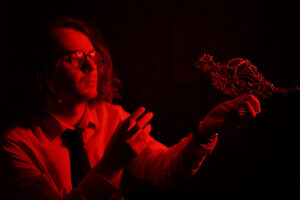
“It’s me and a few little wire sculptures of pigeons that my director’s cousin actually beautifully made.
“But because it’s all very heightened and absurd pretty close to the start, you’re kind of like, ‘This guy is not right’.
“He claims to be the father of a load of pigeons and he’s got a mannequin wife so he’s a bit cracked from the start.
“But actually something that we changed about it recently, in terms of how I played it, was in the original run of the show I played it very big and very manic.
“From the first word of the play, you got the impression that this guy was completely off his rocker whereas when we ran it in the Cork Fringe Festival a few months ago, what we did was just pull the performance way back and make him a lot more controlled and a lot more almost reasonable seeming.
“I think the more you play into that, that he seems to be this reasonable authority figure, the more the absurdity of it hits of what he’s saying and doing and then the moments when he does lose control is a lot more impactful.
“At the start the audience might think, ‘This guy’s okay, he’s doing some weird stuff but he seems okay’.
“And then as it goes on, obviously the extent of his mental damage becomes apparent that this is not a healthy man living a healthy life.”
You have described the show as ‘exactly the kind of weirdo-fuelled oddity that people ought to be stumbling upon at a fringe festival’ , adding that you’re ‘tremendously excited to be that weirdo’…
“Yeah, totally.
“It’s just how my mind works.
“I can’t seem to make it work in any other way: The weird sh*t just keeps coming in.
“But I’m a big believer in that you should respect audiences’ ability to take that stuff and to navigate it.
“I think if you trust an audience, let them into your world, they’ll come.
“Also it’s a funny show.
“There’s a lot of gags in it.
“That’s also an impulse of mine I can’t stop.
“People have a really good time.
“People have said parts of it are a bit like stand up almost, the way the character’s talking to the audience.
“Trust the audience to come along for the ride and they’ll hopefully get something out of it.
“The jokes coming to me, that’s something my director Dee is very good at balancing that impulse.
“She’ll read the script and she’ll be, ‘No, no, no, take that joke out. Be serious for one second’.
“So we’ve got a good balance, I think.”
You don’t want the joke to take away from the subject matter because the show has some serious messages..
“Yeah, there’s big themes being tackled and we’re always very cautious about never preaching to an audience because no audience likes to be preached to even if they agree with what’s being said.
“The themes emerge from the character and their situation and the ideas that you’re grappling with.
“I think audiences are smart.
“They pick up on this stuff.
“You don’t have to turn to them and tell them what the theme is.
“This is clearly a character who’s dealing with a lot of isolation born of his economic situation and his experiences in the workforce.
“You can trust people with that and to take the character seriously as well.
“It’s a silly show, it’s absurd but it’s real for the character and the character is feeling real emotions and it’s important to respect that, even if it’s insane.
“He’s fantasizing about his pigeons marrying JFK.
“It’s utterly fucking ridiculous but this is real to the character so it’s important to be true to that, I suppose.”
Edinburgh is a great platform for a show like this, isn’t it?
“Oh, I’m thrilled.
“I’m so delighted to be over there.
“I long dreamed of going to Edinburgh.
“Never had the money to do it but Culture Ireland have been really, really good.
“I’m just really thrilled to be not just in a fringe festival, in the fringe festival because it’s a very fringe show.”
Are you thinking of a further life beyond Edinburgh for the show?
“No concrete plans but fingers crossed.
“I’m certainly not done with the pigeons yet.”
The Pigeon Factory is at Underbelly Cowgate, Jelly Belly 5- 30 August as part of Edinburgh Fringe.
For booking and more information, click here.
For more information about Oh! Scare Wilde Productions, click here.