

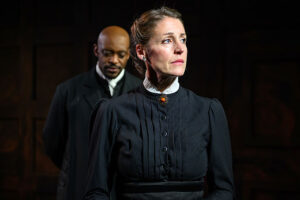
County Down stage and screen actress Flora Montgomery, 52, has appeared in When Brendan Met Trudy (written by Roddy Doyle), Basic Instinct 2, The Crown (as ‘Norma Major’) and ‘Tanya Conway’ in Monarch of the Glen among many screen credits that stretch back to the ‘90s.
The accomplished West End stage actress won an award for playing the lead in Strindberg’s Miss Julie and shared the stage with Jonathan Pryce in The Reckoning.
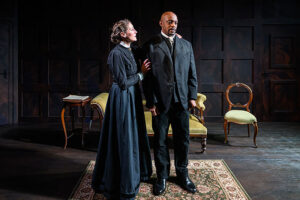
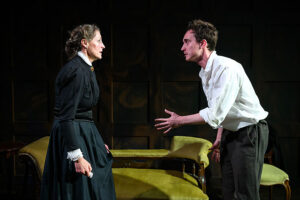
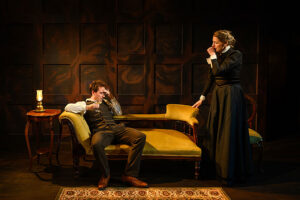
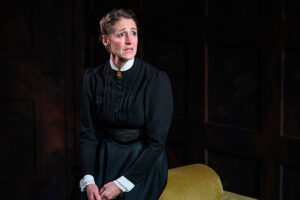
She is back onstage in London playing ‘Mrs Alving’ in Henrik Ibsen’s Ghosts at Jermyn Street Theatre in which her character has spent years managing her late husband’s legacy and is preparing for the opening of an orphanage in his name.
Her son, ‘Oswald’, returns home for the opening and his own plans bring hidden family tensions to the surface.
Kwame Owusu directs the cast that also includes Oliver Alvin-Wilson as ‘Pastor Manders’, Cecila Appiah as ‘Regina’, Peter F Gardiner as ‘Jacob’ and Joe Pitts as ‘Oswald’.
Flora spoke to The Irish World.
Is ‘Mrs Helen Alving’ a role you’ve long wanted to play?
“I didn’t know this play and when I was saying to friends, ‘I’m going up for Ghosts’, they said, ‘What, Mrs. Alving?’ I said, ‘Yes’, and they said it’s the quintessential role.
“I had no idea about Ghosts. I had never seen it, never read it.
“I’ve been lucky to play ‘Miss Julie’ and some of the great female powerful roles and then when I opened it and read it, I went, ‘Oh my gosh, I’m just going to cut off an arm to do this’.

“It is one of those moments when the right people come together. The kindest, loveliest, most hardworking people with the same intention of putting on a really good piece of work have come together.
“We’re all very grateful to be working together and to be working on this extraordinary play.
“When I was doing the preparation for the part, I read the play again and again and again and I just couldn’t believe how many layers there are to this play.
“Even now, four weeks in, it reveals itself in a different way every single night.
“We know that Ibsen is there in the corridor of greats and the reason is because there are unfathomable depths in his writing and it’s just a joy to do.
“I know that even on the last night something will pop up that I hadn’t seen or hadn’t heard.
“It’s all in the language, it’s all in the text.
“I’m very lucky because we’re with a cast that everybody is so in tune with each other that something surprising comes up every single night – that is all thanks to Ibsen’s extraordinary writing.
“You could do this play for a year and never get bored.”
Was Ibsen ahead of his time?
“I find it hard to believe this was written in 1881. It is so current, so radical, so feminist and outspoken.
“The issues he tackles are just as vital and important to discuss in society today as in 1881 – the plight of individuals against society, against God, the suppression not just of women but of men and women against societal norms, against expectations, against the heavy weight of what is right, what is wrong, how we lie to those we love to protect them from reality, the weight of the patriarchy, the weight of the Church and what is even more current today, the weight of populism.
“People are frightened to speak up.
“We have more means to speak up but we see all the time this oppression of people who speak up and speak out and people who are silenced and that is exactly what Ibsen was writing about, voiceless people trying to fight against the norm and the expectations of an oppressive society.
“The great tragedy, which I was very uncomfortable with at the beginning, is that Helen doesn’t succeed.
“In the end she takes the blame for things that happened that are not her fault. She thought she was doing the right thing, she did the wrong things, but she thought she was doing them for the right reason.
“She was trying to give her son a better life and maybe make a better life for her. In the end, she turns in on herself and goes, ‘Maybe this was all because of me’.
“I really grappled with why Ibsen, who was trying to write this piece as a shout against the oppression he was experiencing, that she is defeated by them in the end.
“It’s because he wanted to say, ‘This is the beginning of the conversation, not the end’.
“It’s even more powerful for him to say, ‘It’s not working and we’ve got to keep up the fight because ‘Helen’, ‘Mrs. Alving’ nearly got there but she didn’t’.
“It’s a call to keep going, keep fighting, we’re not winning yet, it’s very tragic there is no feminist victory at the end, no victory for her.
“That she takes the blame for it all herself is the ultimate weight that the conversation still has to carry on.”
Is ‘Helen’ protecting her son ‘Oswald’ at the sacrifice of her own protection?
“Every mother would lay down their life for their child, and every mother has probably sacrificed a lot of who they are for their child.
“That’s great and that’s our natural instinct.
“She felt she was protecting him from an imperfect life and maybe it’s okay to have an imperfect life and truth is more important.
“If she had protected him by saying to him, ‘This is the reality of the life we live in and we will get through it together’, he might have been a very different child. Who’s to know?
“Who is to know whether if you live in a very abusive relationship with a drunk, violent man, is it better to send your child away and give him a life of lies so you have protected him from the truth and let him believe his father was a good person and a magnificent person, or is it better let them see the truth?
“I don’t know what I would do as a mother. It’s the most horrific and unimaginable situation to put a woman and a child in but that’s the choice she made.
“I might have done the same thing in 1881.
“The saddest thing is she takes responsibility for her husband’s actions and thinks she made him turn to drink and be violent.
“Many women think that today in marriages, and many husbands.
“There are a lot of people, men or women, in abusive relationships who blame themselves and children in those situations often blame themselves – which is why she took him out of the situation.
“What is important about the play is that people go away and discuss these things. They have been doing this for over 150 years. How extraordinary is that?
“You can feel it at the end of the play when the lights go down.
“On the previews, we had a five second blackout at the end for people to compose themselves and now we have a 15 second blackout and still people don’t clap – which is hopefully not because they didn’t like it,” Flora laughs.
“The whole room takes 15 seconds, which is a long time, to remove themselves from the tragedy and absorb it and return to reality but you feel they’re taking it with them.
“What a gift for an actor, or any of us, to be involved in something that has importance.
I can’t sleep very well after this play, it’s hard not to carry it.
“I am finding it harder than I thought to decompress.
“It has to do with the space. If we were on the Wyndham stage with a proscenium arch and removed from the audience where you need to project and there is a sense of distance, (it would be different).
“(Here at the Jermyn) there’s no distance, there’s no remove from the piece, we are all in the piece and it is so intimate and so genuine and having the audience right beside you, you can’t not be 100 per cent in it because they would know.
“It’s the joy of being in a small space because it absorbs you into the absolute immediacy of the piece and you can feel it with the audience.
“No one breathes for 90 minutes, they come in and sit still, and you can feel the audience moving forward and coming on this journey and that is because of Kwame and because of Ibsen.
“It’s a joy. I thought I’d find it terrifying to play a role like this with the audience so close by.
“I was terrified of that, but I am so grateful that this is in such an intimate place, and I can’t imagine us doing it in a big theatre.
“The audience are very respectful in that they know they’re right beside us; there’s no opening of cans and eating crisps.
“Go to a big theatre nowadays and people are watching telly; they just carry on talking.
“That is the beauty of this piece and a theatre like the Jermyn Street.
“All the reviews have said, ‘This is theatre in its purest, purest form’.
“It is an absolute collaboration between the audience and the actors, and we just go into a vacuum. I cannot imagine doing this in a bigger theatre.
“You can feel the audience and it’s a real marriage.”
You weren’t familiar with this play but were you familiar with Ibsen?
“Yes, completely. I never did A Doll’s House in which ‘Nora’ is one of the great parts. So is ‘Mrs. Alving’.
“Ibsen says this is ‘Nora’ if she’d never left, he felt her story wasn’t done, that if she had stayed in the house living in the oppression, this is what would have happened.
“This is the story of the women who didn’t escape, the women who stayed and lived under oppression, and never managed to leave.
“At the end of the play, she’s there alone, she’s got nothing, everyone has left her.
“Everyone leaves on the ferry – she’s on the island alone with the orphanage.
“She realises you can’t kill ghosts, they come back to haunt you whether that ghost is your attachment to faith or the ghosts of our parents’ ideals or the ghosts of our own childhood.”
What has struck you about people’s reactions to the play?
“I’m always amazed because if I’ve got a friend in, they want to talk about it.
“Three of my girlfriends came and they sent me really long texts the next day.
“What a brilliant thing to have three girlfriends who have nothing to do with theatre just really passionate about what this is saying about women. That’s why we do what we do, isn’t it?
“Parts for middle aged men are really juicy; the really juicy female roles are few and far between.
“As they get these older parts, the women have so much depth and so much experience to them that it’s very rich to play these extraordinary women because they’ve lived life.
“These older parts of women are so rich and complex because they’ve lived.
“I wish there were more of them but I’m very lucky to have played this one.”
Ghosts is at Jermyn Street Theatre until 14 November.
For booking and more information, click here.
