

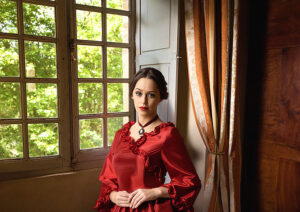
John Goodrum of Rumpus Theatre told David Hennessy about bringing Candida to the Irish Cultural Centre for the Shaw Festival.
Rumpus Theatre Company will present Candida as part of the Shaw Festival that is coming to The Irish Cultural Centre in Hammersmith.
Candida is the story of the title character who must choose between two men, her mature, idealistic clergyman husband or the young, impulsive Bohemian poet who is convinced that only he truly understands her.
Written in 1894, the play was not an immediate hit in London but in 1904 would be so popular its phenomenon was described as Candidamania.
The Irish World chatted to John Goodrum of Rumpus Theatre who is directing the piece as well as playing the role of the Reverend Morell.
His remaining cast is Sarah Wynne Kordas, David Gilbrook, David Martin, Karen Henson and Pavan Marue.
What made you as a company want to take on Candida?
“Well it all comes from a relationship we developed with the Shaw Society.
“In 2024 we were asked by a theatre company down in Broadstairs, the Sarah Thorne Theatre, to produce a play and tour it in memory of a chap called Michael Friend who was a very great director of Bernard Shaw plays and did a lot at Shaw’s Corner and for the Shaw Society.

“So we produced Arms and the Man which is a great light comedy with darker, deeper themes.
“I think it’s one of Shaw’s most popular works.
“We toured that through the autumn of 2024 when lovely people from the Shaw Society came to see that and asked us if we’d like to take that one to Shaw’s Corner as part of their Bernard Shaw birthday weekend celebrations there.
“They very kindly sponsored us to do it so we said yes and that went down very well last year so they very kindly asked us to do another one this year and their chosen one was Candida.
“Again it’s one of his early plays and it’s a lovely light romantic comedy if you don’t go too deeply into it so it’s a nice one to play as an actor and as a theatre company because it’s immediately appealing to audiences.
“But it’s a lovely play and with lovely characterful parts in it for actors so we’re really looking forward to doing it.”
There’s three characters at the centre of the story, isn’t that right?
“Yes, there’s a love triangle.
“There’s obviously the title character Candida and she’s married to a vicar, The Reverend James Morel who is a very well-known speaker in the late 19th century.
“He was supposed to be very strongly moralistic and a very socialist background so he was very upright and upstanding and people used to love to hear him speak because he’s got a great orator ability.
“She’s married to him but then they’ve taken under their wing a young nobleman, son of an earl called Eugene Marchbanks who is sort of a bit of a lost soul, just very young, very early 20s or late teens.
“They’ve taken him under their wing but he then develops this crush on Candida and challenges Morel about it and the whole thing develops from that ending up with Candida being made by the two men to choose between them.”
The play is more than 100 years old but does it still have resonances for today?
“I think Bernard Shaw’s dialogue is incredibly contemporary actually.
“It will sound strange to compare him to Alan Ayckbourn but with Alan Ayckbourn’s lines, sometimes the construction of the sentence isn’t quite how you’d expect to say it but you have to learn it absolutely precisely and then when you say it, it feels perfectly natural, and Bernard Shaw has the similar sort of writing style.
“You look at it on the page and it sounds quite literary but when you speak it out loud, it sounds totally natural so from that point of view, there’s nothing old-fashioned about it for an audience at all.
“Of course the whole love thing is immediately contemporary.
“There’s nothing outdated about that.
“You take a Shakespearean love play like As You Like It, that’s just as relevant now as it was then.
“So yes, it’s immediate.
“I would say it’s very much relevant.
“I mean the themes of 19th century socialism we’re still discussing right and left today even more so than ever.
“And Candida’s father makes a bit of an appearance in it.
“Morell calls him ‘a scoundrel of capitalist’ and he’s very much opposed to Morel’s views as Morell is opposed to his views but they agree to get along with each other as long as they’re both true to their own selves and what they should be, but he’s got a lovely sort of cockney way of speaking which is very much a forerunner of Alfred Doolittle in Pygmalion, I think, or My Fair Lady, as it became.”
Does Shaw poke fun at Victorian society much like Oscar Wilde in something like An Ideal Husband, isn’t that also a theme of the play?
“I would say definitely so.
“I would say Bernard Shaw was always mocking society really because he was, in a way, a bit of an outsider and ahead of his time.
“It very much does mock society but it also sends up this sort of Oscar Wilde thing slightly because Marchbanks, the young poet, could be said to be a very young form of Oscar Wilde because he’s so airy fairy and into his poetry and away with the clouds.
“He becomes so convinced, bless him, that he’s in love with Candida and only he can make her happy but the play reveals otherwise possibly.
“Shaw presents both sides of an argument and in a way allows you to make your own decision.”

It was not an immediate success onstage in London but a few years later it became very much part of the zeitgeist. The play has an interesting history, doesn’t it?
“It really does.
“Yes, I think it was put on briefly and was not a success at all at the very beginning in London but then it went to America and was a huge success in America, and Candidamania was the order of the day.
“People would go and see it again and again and again to try and sort of work out what Shaw actually meant and what really was the character of Candida.
“One interpretation is that she’s actually fully aware of the effect she’s having on Marchbanks and she’s actually playing him along as a kind of femme fatale whereas others think she’s kind of innocent and she’s just reacting to circumstances as it goes along.
“I think they like going along and just seeing the various interpretations of it for themselves.
“Of course when it came back to London with that American success behind it, it really became quite a sensation.”
As you say it is a play and a character that can be interpreted different ways..
“Yes, I think what one has to do as a director or as a theatre company is take quite a firm view yourself on what the interpretation is but as long as you’ve got a clear interpretation yourself, that presents a clear production for an audience to see and they can- not necessarily get your interpretation of it, they will take their own interpretation of it as long as you’ve got a clear line through.
“If you create something that’s slightly fuzzy, then that just confuses people but as long as you’ve got a nice, crisp, strong production, then they can take whatever they want from it really.
“I mean the other ones are a bit more black and white in a way because Eugene is obviously what he is.
“He’s a romantic poet who’s a little bit lost for himself but youthfully enthusiastic.
“The vicar is very much set in his ways until he’s knocked off his pedestal and the capitalist is the capitalist, the secretary is the secretary and the curate is the curate.
“But Candida, the whole play is named after her so it’s obviously what we’re meant to concentrate on and the whole thing revolves around so I think the audience will be concentrating on how the different relationships interact and what they mean to each other.
“It also covers the different forms of love.
“There’s the genuine affectionate love between Candida and her husband Morell and then there’s the romantic idea of love which Marchbanks creates for himself in his head.
“Marchbanks is acting out some sort of romantic ideal which Candida either innocently or knowingly plays along with.”
This is the second Shaw piece you have done in the last while, would you say you have a new respect for him?
“Well, I always admired him and I remember many, many years ago seeing live a production of Arms and the Man with Richard Briars back in the 1980s.
“It made such an impression on me that I knew that someday I’d be involved with that.
“I’ve seen various Shaw productions over the years and he’s always a fascinating writer both because of the ideas behind it, the intellect but also because of the sheer theatricality of it.
“He was very much a man of the theatre and knew how to make a play work.”
This new festival could go on to be a regular tribute to him..
“How exciting that is to do a celebration of George Bernard Shaw at the Irish Cultural Centre in London.
“Hopefully that will become a fixture over many years.
“We’re looking forward to doing it.
“We’re grateful to the Shaw Society for sponsoring us.
“It will be a real privilege to go to the Irish Cultural Centre, it feels like that’s taking George Bernard Shaw home.”
The inaugural Shaw Festival takes place Friday 10- Sunday 12 July at The Irish Cultural Centre in Hammersmith. For booking and more information, click here.
Rumpus Theatre present Candida at 7.30pm Saturday 11 July and at 2.30pm on Sunday 12 July at The Irish Cultural Centre as part of the Shaw Festival.
Both shows will be followed by a Q and A with John and more cast members.
Rumpus Theatre also take Candida to Sarah Thorne Theatre Broadstairs Saturday 18 and Sunday 19 July and Shaw’s Corner the following weekend.
