


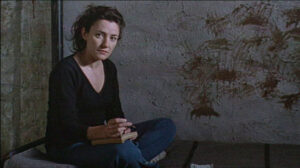
Orla Brady spoke to David Hennessy about 25 years since she played Republican leader Eileen in the women’s hunger strike film, Silent Grace.
A familiar face in some of US TV’s most popular drama series is the multi-award-winning actor Orla Brady, from Dublin.
Already a successful stage and screen actor in Ireland and the UK, Brady, 65, moved to the US in 2001 where she has been in demand ever since – especially in big budget science fiction dramas including Into the Badlands, Star Trek: Picard, and most recently Disney’s Marvel series VisionQuest.
Orla Brady spoke to The Irish World.
It is 25 years since you starred in the Northern Ireland hunger strike drama based on true events, Maeve Murphy’s Silent Grace, can you believe it?
“With everything that’s kicking off in the world, specifically in Northern Ireland, but also this upswell of the seduction of ideology of people like the character I played at the time, it doesn’t feel like a theme that is anything but current – so it doesn’t feel like it’s 25 years ago.
“I would be perfectly happy with it if we had made it this year and it was going out now.
“The last time I looked at it, which was a few years ago, I remember thinking, ‘I don’t feel it has dated’ – it feels quite fresh.
“There are a few roles I’ve done, and things I’ve been part of, that I’m really proud of and this is one of them.”
Did you feel a great responsibility taking on the role?

“We’re talking about things that are very sensitive and remain very sensitive but as an actor you have to embody the person whoever they are and not go to judgement or lecturing about them.
“You have to just sit in the shoes of somebody who, in this case, is a very true believer – so I didn’t think of it as a heavy responsibility.
“I felt if I could comfortably sit in her point of view that that’s all I had to do, and I do remember Maeve being a very relaxed director.
“She trusted me with the character, and she had obviously written it.
“She also has a lived experience as a woman from Northern Ireland that we didn’t have in the south.
“We were deeply conscious of it but it’s a very different kettle of fish than being there in it having the things that happened at that time happen to your community.
“I had to trust she would tell me if I wasn’t getting it and I never sensed that from her.”
You featured in her more recent short film St Pancras Sunrise which is to be a full-length feature film so that relationship with Maeve Murphy clearly continues…
“I very much believe in her as a director.
“At the time we made Silent Grace, it was still relatively unusual for a woman to take command of a feature film and also to be given the space to speak about something that was seen as very unattractive – women who were angry, who had a point of view, who were determined to make their own protest and not be in the background and not be the women behind the men.
“Obviously at the time this film talks about (1980) the men (hunger strikers), because they were dying, were very prominent.
“What I loved when she initially approached me is the fact that there are many hidden histories and this was one of them.
“The women were also on hunger strike.
“None of them died but they were prepared to.
“It really struck me that we never heard about it.
“We’re still just trying to give a bit of space for those women and to just say, ‘Women were part of the story, we weren’t just in the background supporting the men’.
“When I talked to people about it, there was a reaction against the fact that it was a dirty protest – in the case of the men, it was fully accepted and in the case of the women, there was a recoil from it.
“It was women who were not sweet and fragrant, who were prepared to get dirty.
“Obviously they were in a ‘no wash’ protest and their bluff, if you like, was met by the authorities and so they had trouble with the fact that they had no menstrual care. It was dreadful conditions.
“There was still a sense that people recoiled from the fact, ‘We want our heroines to somehow just be a bit not too unattractive’.”
What do you remember of the times depicted in the film?
“I remember coming home from school and even in Dublin when the men were dying, you saw a lot of people in black armbands because there was sorrow, there was shock.
“There were young men dying, being allowed to die. Whether you agreed or disagreed, it was a terrible time.
“It was abominable so that strange oppressive cloud was around at the time and so with the peace accord, that beautiful moment that happened, we felt that had become something that was history like in the same way we felt that after the Second World War, probably globally, we thought, ‘Well, now we know, we will never do this again. We know where that leads us and it leads us to a dark place’.
“We felt it was settled history and a generation has grown up puzzled by what all that was about and again, you think, good that they’re puzzled, they should be puzzled.
“Why on Earth were we in that dark place where people were being killed in the streets and yet there seems to be some cycle where there’s great mischief in the world and there’s extremity.
“I’m not sure why.
“It’s way above my pay grade or my own understanding of the world to understand why it’s happening exactly, but we seem to be going to a place where a recourse to extremity seems like an option.
“I’m glad that film is there to explore that mindset and helps to speak about why a young person would be in that place.
“We need to understand it because we’re in those waters again.
“There can be a cruelty within ideology, as we know. It can end up in people doing terrible harm in the name of a cause.
“You have to settle into your humanity, and you don’t know that as easily when you’re young.
“You do when you’re older.
“That’s why when people are caught trying to set a bomb or whatever, they’re frequently young because they haven’t had that moment of understanding.
“Maeve wrote a lovely script…it was the odd couple in jail.”
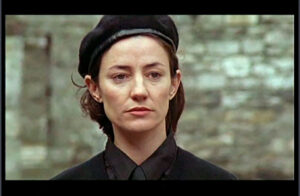
Q: Was that film ahead of its time in telling a female story?
“It was a little ahead of its time. Maeve is very determined.
“She’s got a bit of steel in her, and I mean that in a good way. You have to have that as an artist.
“She knew she could have told a story that was more commercial, more attractive but she wanted to tell this.
“I admire her for that because film is difficult in the first instance – but to tell a story that people didn’t necessarily want to hear at that time (was even harder).
“It would be easier for her to make now.
“A few years ago, I went to see an Alanis Morissette concert.
“I know her, only slightly, but I worked with her and she’s lovely and we went to see this concert.
“I thought, ‘We’re the generation that lived that album (1995’s Jagged Little Pill)’.
“The audience was full of 20-somethings, 30-somethings – and they all knew the words. It was as if the album came out that week.
“I asked her about that afterwards, she thought yes, people heard it at the time but are really hearing it now because they’re more prepared to ask, ‘Why?’
“I’m talking about her unfettered anger at things that happened to her as a young woman in the music business – it happens in every business.
“This is something we are all prepared to talk about now that we didn’t feel we could talk about then.
“We were compromised and attacked and put in positions we had to walk away from. It was difficult back then but, if anything, she was kicking the door open with that album and now it’s easier for everyone to really agree with her and think, ‘Why did we put up with the fact that to get and keep a job there seemed to be an inevitable sense of having to fight off the boss. If you brought it up, it was like, ‘What did you expect? You just have to do your best’.
“We were in an era where we had been socialised into that.
“There is now a generation of women who can’t believe we put up with it. I’m so pleased they find it puzzling that we did.
“The day after the Irish referendum on abortion, I was at home in California, some friends were coming for lunch the next day.
“I didn’t know if the referendum would work and feared it would be lost again for a generation.
“I was very on tenterhooks.
“Anyway, I got the news that night that the exit polls were showing it was happening and I very, very happy.
“Some people arrived the next day, one of whom was an Irish woman and we both looked at each other and started crying.
“Everyone else was puzzled. They were saying, ‘But you’ve won.’
“What we realised then is, when something changes, you’re not triumphant – you actually go into a kind of sorrow for all the lost years.
“You think, ‘Why did we live under that? Why did we accept that? Why were all these women and children and men harmed by this repressive, dreadful rule where they were denied healthcare?’
“The poor woman Savita Halappanavar, the woman who died in pain when she needn’t, and all the ones we haven’t heard about – you go into a sorrow more than you rejoice.
Q: Another film you were in that told an important real-life story was A Love Divided (1999) where you and Liam Cunningham played the couple at the centre of the Fethard-on-Sea sectarian boycott…
“People still don’t know that story they still don’t know that within my lifetime, we were calling that a mixed marriage which is extraordinary.
“It is very puzzling for people who came a little bit after me that we were still doing that. It’s puzzling to me that well into my lifetime, we still had mother and baby homes and Magdalene Laundries.
“We tolerated it because when something is a norm, it takes a more unusual person, a braver soul, to unpick that norm, to question it, to go against the authority as it stands.
“I remember a time when it was unquestioning, your adherence to what you were told by the priests – so we incarcerated women and children, we allowed them to die.
“We did not honour their lives. We tolerated that as a society. It appals me and makes me question who we were, why we allowed ourselves to be persuaded into such cruelty in the name of something that is supposed to be a byword for mercy.
“I don’t know why there haven’t been proper reparations made to those women and children.
“I don’t know how the Catholic Church to this day can stand proud and not sell a few grounds, churches, bit of marble, bit of gold, and make true reparations to the people they hurt.
“I don’t understand why they won’t do that.”
Silent Grace screens 10.30am Friday 23 October at The Garden Cinema.
London Breeze Film Festival runs 21- 25 October. For more information, click here.
