


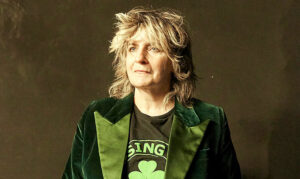
Kate Kerrigan told David Hennessy about her show Am I Irish Yet? which three years on from its London premiere continues to strike a chord with a second generation audience.
Author Kate Kerrigan (real name Morag Prunty) was brought up in Hendon by parents from Ballina, Co. Mayo and Killoe, Co. Longford never in any doubt about her Irishness.
She has now lived in Ireland for many years, is married to an Irish man and has two Irish children.
But in her show, which she has now been taking to venues around Britain and Ireland since 2023, she still asks, Am I Irish Yet?
Am I Irish Yet? deals with the challenges of growing up second generation Irish in the 70s and 80s, when they were the ‘bombing Irish’ in London and ‘the English cousins’ when they returned to Ireland.
Previously more a writer of fiction whose Ellis Island trilogy has been a New York Times bestseller, Kate was ‘pushed’ to tell this story, which she performs herself, to highlight what it is like for those called things such as ‘Plastic Paddy’.
She believes the show has opened the conversation about second generation identity and wishes to use the show’s momentum for greater change in the community.
We caught up with Kate to chat about the continued success of the show ahead of her recent dates in Woking, London’s Claddagh Ring and Lewisham Irish Centre.
Kate is about to take the show to Lewisham and is set to take it to Belfast next year.
“We keep finding these new places that invite us in.

“I can’t believe it’s still going.”
I bet when you started doing the show more than three years ago or more, you didn’t think you’d still be going with it now..
“I really didn’t, the word of mouth on it is just mad but the other thing is that I’m still enjoying it.
“It’s the same show.
“I’m still loving doing it, still enjoying being on stage.
“You would think I’d be sick of the sound of my own voice now but no, it’s great.
“We’re doing the Waterfront in Belfast next year which is a really big venue, so it’s growing.
“It’s building a following and it’s been really good.
“I’ve been doing it for four years and I think it has really kickstarted a conversation about not just what it means to be Irish but specifically for the Irish in Britain and those of us who are second generation.
“I think people seem to be getting the message that we are bona fide Irish people, the children of emigrants and the grandchildren of emigrants and it’s been a really interesting journey and an eye opener as well particularly not just for people like us who are second generation but there’s a lot of grandchildren with Irish grandparents who moved over.
“There’s a lot of them coming along and listening to the show and questioning their own identity and looking for that kind of legacy identity that we searched for from our parents.”
Has the show struck such a chord that it has even come as a surprise to you?
“It has and I think it’s because I’m saying something that resonates and that hasn’t necessarily come up before.
“People are still coming and they’re relating to it and saying, ‘Thank you for bringing this to people’s attention’.
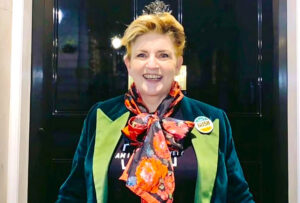
“Last year I was invited to the Patrick’s Day reception up in Downing Street and it was amazing.
“It was an extraordinary experience and everybody that I spoke to in there, I was just astonished at how many people in there had seen the show or heard of the show and who were really interested in it.
“And at Downing Street, I met the new British ambassador in Ireland and she is married to an Irishman.
“She speaks as Gaeilge.
“She learned Irish before she moved over as part of her job even though she’s fully English.
“And now, of course, she’s bringing up her children in Ireland and they’re kind of going, ‘Well are we English or are we Irish?’
“I’m now advocating really they should be able to choose.
“They should be able to go with whatever identity they feel most relates to them.”
The conversation seems to be happening more and more now with other shows and podcasts and books also looking at these same issues..
“Yeah, it’s kind of broken through and there are other shows happening and memoirs coming out but the truth is that this is a conversation that’s been happening for a long time among the Irish in Britain, among the organisations here but people haven’t really spoken out about it before because there is still that kind of unconscious bias that exists between those of us who are English and Irish.
“It’s a problematic mix and it’s always been a very binary thing historically and culturally: Irish is good, English is bad and carrying both of those things, it is a very complex and interesting thing.
“I do feel that it has its place politically as well because everyone understands that the greatest asset that the Irish have, the greatest power that we have, is our Irishness.
“You only have to look at Trump coming over to Ireland last week and being plummased to death and lapping up every minute of it.
“We’re very popular all over the world and yet there is still a kind of a hierarchy of Irishness at play, an awful lot of which is attached to having an Irish accent.
“But there are more people talking about it which is great and I’m delighted by that because it widens the conversation.”
What have the reactions been like when you have taken the show to Ireland? Has it broken down that barrier?
“Yeah, I think it’s one of the powerful things about art is that people do come and see the show and they enjoy it.
“Because they enjoy it and they can relate to it, it isn’t just me complaining and moaning, it is entertainment and I am very honest in it.
“The experience in Ireland is amazing.
“First of all, you have a certain number of people like myself come but the strongest response is very often from people who have no experience of emigration at all and people who have used the term ‘plastic paddy’, and who have been quite derisive and it does change their minds.
“I have often had people wait for me after the show and there are people who’ve no experience of it at all and they say, ‘Thank you for putting that in front of us’, because fundamentally the Irish born and the people that have always been here, they understand emigration and deep down they know what was behind it, that the people that left didn’t always want to leave, that they were building a better life and the relationship with emigrants in all countries is very complex.
“A lot of people have responded and said, ‘Thanks, I hadn’t thought of it like that’.
“And they get it.”
One person who has endorsed the show is the actor Stephen Mangan. He is not one of them but there were many British- born people in the public eye whose Irishness was not so apparent. I am thinking of people like Boy George and many more..
“I don’t think it’s that people have a problem doing it.
“They’re what I call the hidden Irish so they’re not hiding their Irishness but particularly growing up in London in the 80s, they were subjected to the same prejudices and confusions and conflictions of all of us in terms of relating to their relating to Ireland as it is now against their own Irish heritage.
“I mean Dermot O’Leary is a good example because he’s very active in the Irish in Britain scene particularly with the Camden Irish Centre.
“He speaks in a way that’s very articulate about his Irishness but also about assimilating his English birthplace, being a very successful English celebrity.
“But the Irish media are still questioning him like he’s not an oddity but that he’s exceptional, ‘Oh, you’ve got Irish parents. You consider yourself Irish..’
“He represents the vast millions and millions of millions so there’s a level of acceptance for people.
“I do think things are changing and I do think that just having voices out there, myself and other people are doing shows about it and sharing our experiences and advocating for the people who are unwittingly English in the way that we speak.
“Identity is complex and I do think, in a way, it’s unique to the Irish because of the level and the desperation of our emigrant population, just the sheer volume of us that went over to the UK and that went over to America.
“And then you have people like Cillian.
“You have this hierarchic thing where you have Cillian Murphy talking about moving his children back to Ireland from England because he couldn’t bear them having posh little English accents and you’re kind of going, ‘Is that okay actually?’
“I think it’s derisive for those of us who do have English accents.
“But I think things are changing but I’d like there to be more activity in Ireland.
“I’m certainly going to keep doing shows here.
“Doing Belfast next year will be very, very interesting because I think one of the most salient things is when people come down from the north of Ireland, regardless of what side of the fence they’re from, particularly people from the Irish Catholic community in the north who have grown up speaking Irish, who are very involved in GAA and brought up steeped in Irish culture and literature and who were very, very proud and protective of their Irish heritage and when they come down they’re othered, ‘Oh, you’re not really Irish’ or ‘you’re different from us’.
“It’s incredible.”
What has been the highlight of your journey with the show up until now?
“Well, there’s been so many.
“There are no highlights because every single show that I do, I just meet so many people and I just get so validated by it.
“I mean it’s been the most exciting journey for me and I just feel really privileged that I’m still on it, people still want to come and see the show.”
Do you think you have achieved what you wanted to achieve?
“Yeah, I absolutely have.
“I absolutely have.
“I’m writing a memoir at the moment and that’s just taken things to another level being able to look at my life in terms of the things that identify me as Irish on a kind of a deeper level.
“The relationship with my mother, my grandmother, my history, my relationship with London, really kind of digging deeper into the structure of how identity is built in all of us and how much our legacy heritage means to us and how important it is or how not important it is.
“I’m 62 now and I really do feel that this has closed a circle for me personally as well as professionally.
“Having written fiction and journalism all of my life, I suppose the experience of my life kind of put it into perspective and to still be learning about something, to be learning about identity, learning about Irish history, learning about my community.
“I’ve had a very successful career as a writer but the kind of the validation, personally and professionally, that I’ve had from Am I Irish Yet? and also the opportunity to do something about it.
“I’m kind of moving into the area now of wanting to be more active in making a difference in lobbying the diaspora network in Ireland, lobbying the politicians to recognise diaspora in a deeper and more different way to make it less transactional, to develop a deeper understanding of Irish identity, particularly in the UK and to highlight some of the dissonance.
“The show has uncovered a dissonance.
“I just want to bring that to the attention of people over here, people in power over here so that they can listen to the Irish in Britain and come up with a solution that goes a bit deeper than just funding projects to keep us where we are.
“There’s a huge discussion (after each and every show) and we’re making sure now that we brought the show to the attention of people that are working in the diaspora movement, people who are in charge of funding the diaspora.
“I’m not going to be just letting that go.
“As the show continues, I want it to really become that really kind of use that voice to make a difference.
“We are garnering support to make a difference and to highlight this to people so it’s gone from just being a show, and it’s gradually turning into a bit of a movement and I’m going to make sure that I keep that going.
“We’ve been dismissed for such a long time and the voice is growing and the voice is there so I want to make sure that it continues to be heard.”
Am I Irish Yet? is at Lewisham Irish Centre on Friday 2 October and Saturday 3 October.
You can book at: https://www.ticketsource.com/am-i-irish-yet
