

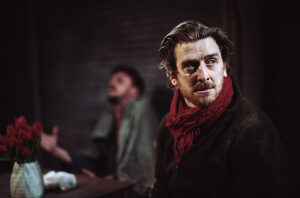
Ian Toner spoke to David Hennessy about the London premiere of Simon Stephens’ A Slow Fire currently playing at Jermyn Street Theatre.
Simon Stephens’ A Slow Fire is currently having its London premiere at Jermyn Street Theatre.
The play comes here after its world premiere at Dublin’s Glass Mask earlier this year and retains much of the same cast and team.
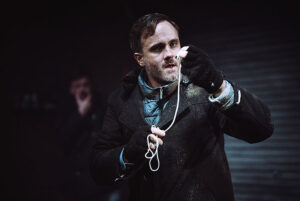
Rex Ryan directs the cast which is made of Ian Toner, Ross Gaynor, Fionn Ó Loingsigh and Holly Demaine.
Toner and Gaynor play Reece and Ashton.
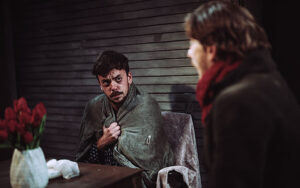
Years after the apocalypse, Ashton and Reese survive in a bunker.
They spend their days acting out stories from the before times. When a stranger appears, they must ask if he represents hope or danger.
Simon Stephens is the Tony and Olivier Award- winning playwright of plays like Punk Rock, Pornography and The Curious Incident of the Dog in the Nighttime.
Ian Toner, who plays Reece, took time to chat to the Irish World.
Ian’s theatre credits include The Vortex, Romeo and Juliet, Look Back in Anger (Gate Theatre, Dublin), Double Cross (Lyric Theatre and Abbey Theatre, Dublin), The Treaty (National Concert Hall, Dublin), The Delirium Archive (Project Arts Centre, Dublin), Children of the Sun (Abbey Theatre, Dublin).
His screen credits include Harald & Sonja, The Dry, Storyland, Smother, Vikings: Valhalla, The Titans That Built America Catch 22, The Commoner, Bloodaxe and Aisha.

How does it feel to be bringing A Slow Fire to London?
“It’s pretty amazing.
“Simon Stephens, I think, is legitimately one of the great playwrights in the world.
“I think this is a really lovely Simon Stephens play and it feels very exciting.
“It was very exciting to be able to premiere it in Dublin.
“I think it’s really cool that Simon has a real connection with Glass Mask back in Dublin.
“He really loves the theatre company and the venue which is a small 70 seater on Dawson Street in Dublin, similar to Jermyn Street here in Soho so we’re doing it in these small, intimate theatre spaces that really suit the play because it’s quite a claustrophobic, intense kind of play.
“It’s a tough piece of work.
“It asks a lot of the actors but that’s what you want to do as well.”
Has it changed or evolved since the Dublin iteration?
“I think so.
“The space is quite different.
“There’s been people who have seen it in both places and haven’t necessarily seen a huge change, but it feels very different for us.
“It’s more of a theatrical space.
“Glass Mask is a really lovely space in Dublin but it’s quite limited in terms what you can do with lights and things like that.
“It doesn’t have a huge rig whereas Jermyn Street is proper, beautiful theatre that’s been around for a while so it does feel quite different.
“It feels more theatrical to me, I guess.
“Different audiences as well.
“It’s funny to hear what English audiences react to versus Irish audiences.
“They laugh at different things and it’s kind of surprising.
“It feels like doing it.
“It feels slightly new to hear it in front of an English audience, you get surprised again by what people react to.”
What attracted you to the play? What made you want to play Reece?
“It was Simon that attracted me to it first, being able to work on his work.
“It felt like it had a very Irish sensibility.
“Simon’s mother is Irish and he just recently got his Irish passport, I think and it feels quite Enda Walsh-y.
“It feels quite Beckettian so there’s interesting things in that.
“It feels very, very current to me.
“It feels like it speaks to a lot of anxieties that we have at the minute as a species but it also does it with a really deft humanity and a dark sense of humour.
“It’s challenging for actors and audiences but it’s also a very soft, tender play as well.
“It asks a lot of the actors because the parts in it are so good.
“He writes extraordinary parts.
“I’ve been in two Simon Stephens plays.
“When I did Punk Rock in Belfast 12 years ago, I remember going home after rehearsals and I had to wrap myself in a duvet and eat chocolate and watch sitcoms because it was just so demanding and there’s so much depth to the characters.
“He asks a lot of actors but that’s what you want.
“He writes just incredible parts for actors so there’s a huge amount of range in the parts.
“You get to kind of do everything.”
Do you like how much of it is up to interpretation particularly at the outset?
“For sure.
“He doesn’t patronise his audience.
“It does require a little bit of work to keep up with but essentially there’s a narrative that’s unfolding on the stage which is a relationship in a very particular circumstance, a post-apocalyptic circumstance and that relationship is loving and tender but also sort of stuck and sort of detrimental to both people in its own way.
“And then a third person comes along and it changes the dynamic so that’s quite a straightforward narrative.
“The other stuff that we get is the backstory, the pre-apocalyptic backstory so when you think about the play like that, it’s not that complex but the way it is presented does require work, requires some listening from the audience.
“I think you can hear the audience once they kind of get it and click into the language of the play.
“You can hear them being satisfied by it.
“It’s a challenging piece of work in its own way.
“But I think the people that like it really love it as well and part of that is that you have to earn it a little bit as an audience member.”
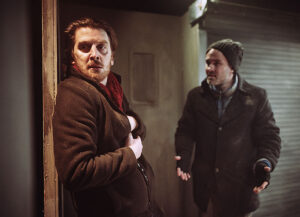
In their lives before Reece was a porter while Ashton was a professor so they would have had little to do with each other then but are now all each other has..
“Yeah, there’s a really fun thing to play around with there.
“I’ve never made a decision as to how healthy that relationship is.
“The play asks that question: Is the relationship unhealthy, codependent? Is it manipulative in some ways?
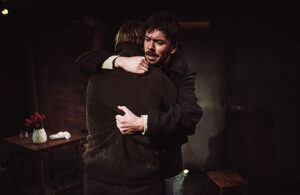
“They’re both very dependent on each other but there’s an interesting, fun thing to play which is that they’re two people who have lived in a shed for three years and they love each other but they’re getting really annoyed at each other, as you would.
“It’s the only other person that you’ve seen in three years so there’s some echoes of COVID to it.
“For me it’s quite a post-COVID play but ultimately, they do love each other and that’s what the play is about.
“It’s kind of what keeps us going after everything is gone and so it’s about hope and love.
“I think that’s at the core of it.
“If those two characters don’t love each other, then the play doesn’t really work and I’ve been in a situation a lot, as an actor, where you’re playing a character and you’re going, ‘Does this character love this other character?’
“And the more interesting answer is always yes so it’s almost always the case that, ‘Yes, I do love this other character’ because it gives you so much more to play for.
“It’s really beautifully written that relationship between the two of them because all Reece wants is to go and find his family who he knows deep down are dead, I think.
“That’s open for interpretation but at the same time, he can’t abandon his friends so again, it’s just really rich stuff to play.
“It’s fantastic.”
To pass the time Reece and Ashton act out these events from their past lives that signify hope. It’s interesting what they choose..
“They have a really interesting relationship to hope because Reece, my character, has a line where he says, ‘Having hope is different from having that hope satisfied. It’s the hope that matters’.
“And that’s why they play those scenes, because they know that they’re in a situation where there may not be a silver lining at the end of this.
“They can’t see their way out of the situation so it’s not important that something good actually happens.
“What’s important is the feeling that something good could happen.
“That’s Simon’s exploration of hope.
“The good thing doesn’t have to happen.
“The play is an exploration of hope and lots of other things but that’s kind of the resounding theme in it.”
Reece has this watch. It’s nothing special but he hopes to give it to his son one day. He holds onto that..
“Yeah he has this idea of fixing the things that he f**ked up before.
“He has this idea of fixing the relationships that he feels he ruined and Ashton didn’t really have that.
“He feels like a character who was probably quite lonely before the apocalypse happened.
“Reece has an ex who he feels like he ruined the relationship with.
“He has a son who he feels like he was never a good enough father to.
“There is a sense of wanting to redeem that and that’s keeping him going, wanting to fix that.
“And I think, in a weird way, he probably transfers some of that onto his relationship with Ashton who’s the only person who’s still in his life and so he decides to look after Ashton as best he can.
“Ashton is somebody who is kind of weak and quite ill and struggling, Reece is, in a weird way, trying to fix the relationships he messed up by loving someone.”
Ashton is unable to leave the bunker which means Reece is the one who ventures out..
“Yeah, Ashton built the shelter so he’s saved Reece’s life. Simple as that.
“I don’t think Reece was going to survive if he hadn’t found someone and he found Ashton.
“I think he feels a huge debt to him for that.
“I think at the start of the play we meet a Reece who is ready to leave.
“He feels, ‘We can’t stay here’.
“And that’s what ignites the action of the play really, is Reece’s starting to feel like, ‘We need to get out of here’.
“And I think when Presley comes along, he appears to be somebody who’s a survivor and is able to fend for himself.
“That’s when it becomes a reality to Reece that maybe they can get out of here, maybe there is something else.
“That relationship is based on that initial debt where Ashton did save Reece’s life and now they’re kind of saving each other.”
Something Reece notices and reports on his returns is that the tracks are disappearing which seems to symbolise something, that there is no going back maybe..
“That’s the first thing that’s flagged as a strange thing in this world which is actually yes, symbolic of civilization falling apart and also the idea that there might be people approaching on them, how scary it is the idea of other people.
“The tracks are gone, somebody is taking them.
“If the tracks are being taken, then there is somebody encroaching on them, there is somebody close by which is probably an exciting thought and a scary thought at the same time.
“It’s great writing.
“It’s very brave writing actually.
“I think Simon just gives you little pieces of information like that and lets you interpret them as you wish.
“We asked him a lot of questions at the start of rehearsals and his answer often was, ‘I don’t know’.
“We had to figure that out for ourselves.
“That’s how he likes to do it.
“He puts the play down on the page.
“Once it’s down on the page, he’s like, ‘It’s up to you guys to interpret it’.”
As you say this is your second Simon Stephens play as you did Punk Rock 12 years ago so very early in your career..
“Yeah, I think it was one of the first gigs I did up in the Lyric in Belfast, Selina Cartmell directing Punk Rock. It was great.
“It was also one of the best productions I’ve ever done probably so started high.
“It was brilliant.
“It was really good, a challenging piece.
“He’s very much at the top in terms of living playwrights.
“I think he’s written some magnificent stuff.
“He’s so prolific.
“I think a big part of it is he just writes fantastic parts for actors.
“I think that’s a big part of what audiences want to see is actors really being stretched and people connect with when you write characters that are real.
“For people that come to see this, you’ll see the scenes where we are playing out things that are very universal like the death of a loved one and those are heavy places to go every night for actors
“This play is also very funny though.
“There’s some great gags in it and it’s very playful, very energetic.
“I feel tired when I come off stage.
“I feel like I’ve run a half marathon but I think that’s all to do with the level of experience and depth he’s bringing to the work.”
Is it draining as well as tiring?
“The play requires a lot of concentration.
“Me and Ross are on stage from the start.
“It’s all very dense.
“Once you come on, you’re not really let off the hook.
“I have a couple of brief water breaks but it’s tough.
“But I’m a sucker for punishment.
“I love demanding work but I want to be doing stuff that leaves me tired and challenged.
“I’m very excited by new writing and contemporary theatre.
“I think it’s very exciting to work on a play that hasn’t been done before.
“There’s a sort of ownership to that.
“I think new writing is always ambitious because you don’t actually know if a script works until it’s in front of an audience.
“Even really experienced writers don’t really know until it gets in front of an audience what it is.
“It’s always shocking to hear what audiences react to and what they laugh at.
“Inherently I think new writing is riskier and more ambitious but when it’s good, it’s just an incredible thing to be a part of.
“And also I think that playwrights who are writing now with contemporary voices are speaking to things that we’re experiencing now.
“You can reinterpret an older play and make it more contemporary, modern but it isn’t coming from a playwright with a contemporary perspective so for me I feel that when I’m reading a script, I feel like that feels contemporary.
“I feel like the person is experiencing the same things I’m experiencing and that’s important to me.
“I love doing new writing.”
Would you like to see the piece get another life after Dublin and London?
“I’d love to go New York.
“That would be great if that can happen.
“We enjoy doing this.
“A lot of people have really loved it so hopefully it has another life.”
This is your West End debut, how does it feel? Has it always been a dream?
“Yeah, for sure.
“It’s a big bucket list thing to be honest and it just feels very, very cool to be here.
“If you’re a theatre actor, there’s something special about London for everyone.
“I’ve seen so much great theatre here.
“I feel like there’s real taste in London for the sort of work that I like, maybe more challenging contemporary work.
“I think theatre here can be riskier, less conservative than it is in a lot of places.
“There’s definitely something special about London.
“There’s just a lot of work here that I really admire.
“A lot of theatres here that I really like and hopefully it won’t be too long (before I’m back).”
A Slow Fire plays at Jermyn Street Theatre until 26 September.
For booking and more information, click here.