


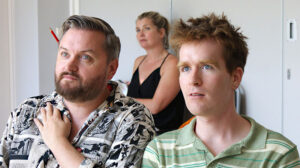
David Hennesy spoke to the director and two members of the cast of Mammy’s House, a new play revisiting the HIV/AIDS crisis of the 1980s from an Irish perspective.
A new play that explores the untold story of the Irish experience of the AIDS crisis of the 1980s is playing at Upstairs at the Gatehouse theatre in North London.
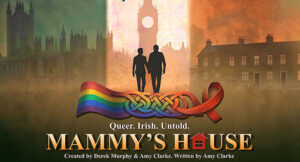
Starting in Camden of 1985, Mammy’s House tells the story of how a small, queer Irish household deal with the AIDs disaster first in the distance and then more close to home.
Inspired by the teachings of Dr Joseph Healy, actor Derek Murphy saw an untold story from an era that has been documented in series like It’s A Sin but not from the Irish point of view.
Derek approached his friend and writer Amy Clarke and she joined the project.
Brian Brady directs the cast that includes Derek himself as Mammy, Jemma Curran as Mags, Conor O’Dwyer as Nellie, Justin Ensor as Shay, Ciara Pouncett as Sally and Stephen Cheriton as Ginny Tonic.
Director Brian Brady and actors Ciara Pouncett and Conor O’Dwyer took time out of rehearsals to talk to The Irish World.
Brian Brady, from Chapelizod in Dublin, is a theatre director with over three decades of experience championing new writing on stage.
He began his career as Staff Director and later Associate Director at the Abbey Theatre where he directed 16 productions across the Abbey and Peacock stages.
Ciara Pouncett grew up in Finchley and has family in Dublin, Kildare and Limerick.

Her theatre work includes Draining the Swamp (UK tour), Said Shed (The Other Palace), Flotsam (King’s Head) and Little Echoes (Hope Theatre). Her screen credits include Smothered, Eastenders and Fixed.
Conor O’Dwyer is from Salt Hill in Galway. Homo(sapien), his self written solo show, won the Oscar Wilde Award for Best New Writing and the Fringe Theatre Award.
What brought you to this project?
Brian: “Fate brought me to it.
“I met Derek and Stephen a couple of years ago and they told me about the project.
“Roll on almost two years and they reached out to me and said, ‘Would you be interested in being involved in the production?’
“They sent me the play and I couldn’t say no actually.
“It’s a play that is so full of heart and so full of resonance for anybody with a heart that it’s hard not to be completely intrigued.
“I’m Irish.
“I’m gay.
“I’m old enough to remember the 80s although I wasn’t living in London at the time, but certainly the themes of the play and the story itself were very immediately resonant for me so I could not say no.
“It landed on my lap, I feel very fortunate and it’s been a great thing so far to be involved in.”
Ciara: “I saw it on Spotlight and I saw that they were looking for people who had lived experience of Irish culture and the themes within the play.
“I grew up in London.
“My parents moved here and raised us but we were the only family here, the rest of my family was in Ireland, and still are.
“Even though I was brought up in London, I’m very much rooted in the Irish culture.
“But also my uncle, who grew up in Ireland, actually was a gay man in the 80s and did move to New York, and then did sadly die from AIDS.
“He came back to London and he lived with us before he died.
“My mum, who had formerly been a nurse, and my dad helped look after him so it really pulled at me when I saw it.
“I was like, ‘Oh my god, I understand this. I really do’.
“I wrote to the producer to just say, ‘This is my experience. I really want to be part of this play’.”
Conor: “Actually it felt serendipitous to me for different reasons.
“I think a lot of queer work historically ends in doom and gloom.
“The ‘kill your gays’ trope is still alive and kicking and I think it’s important to fight against that but still carry the weight of the difficult challenges.
“Obviously there is tragedy in this because it is a play about AIDS but that is about chosen family, it’s about friendship, it’s about heart, it’s about Irishness.
“Seven pages was the audition so I didn’t have a clear picture of the whole thing but those seven pages painted a play.
“They were so powerful and really funny and I just immediately fell in love with my character.
“I just felt like this character lived right under my skin and because it’s such an important story and such important experience that this man had, I really just felt an obligation to do it as well and as truthfully as possible.
“It felt serendipitous in that regard.”
Did it feel like an untold story in that we have had things like It’s A Sin but it’s never been told from the Irish perspective?
Brian: “I had never heard it told.
“I think the most arresting thing was something that Derek told me when we first met that his initial inspiration was learning the fact that there was a time in the 1980s when, in the AIDS clinics in London, up to 50% of the patients were gay Irish men.
“When he first said that to me I thought, ‘Well, that’s a mistake. That’s impossible’.
“He was like, ‘Nope, that’s it’.
“And I looked into it a little bit and it is indeed a fact.
“And similarly, when I’ve relayed that information people go, ‘No, that’s impossible’.
“And you’re kind of left scratching your head going, ‘How can that be from such a small nation?’
“Well actually the height of emigration in the kind of late ‘70s, early ‘80s does explain why there would have been such a high proportion of Irish men and then the oppressive nature of the society and the absolute cruel nature in which homosexuality was regarded and treated redoubled that fact.
“I hadn’t fully appreciated the magnitude of the story and very quickly thought, ‘We have to tell this story and hopefully we’ll tell it well’.
“And hopefully we’ll have an opportunity to go on telling it.
“This is the first iteration.
“This is the first outing of this play.
“I really hope that enough people see it and enough people recognise how important it is that we will go on to tell it beyond the Gatehouse.”
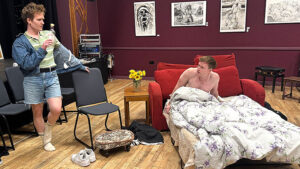
Ciara: “When I was younger, I knew the stigma it carried to be homosexual in Ireland.
“I was very aware of that, the fact that my uncle had gone to New York and everything that surrounded it.
“I’m someone who has some lived experience of that time with my uncle but I still didn’t know a lot of this stuff because it happened and then we moved on.
“It’s easy to forget just how difficult it must have been to be a young gay Irish man in those times and everything that went with it and just the horror of it really.
“I think that is why it’s so important to have it out there.”
Conor: “I’m obviously speaking of this from a very privileged perspective.
“I’m (born) 1998.
“I feel like I would have had a prejudice before, been like, ‘Listen lads, we’ve told that story enough’.
“Because I baulk from things that are completely tragic nowadays because I just feel like we need hope.
“We need hope, especially in the queer community.
“I’m very lucky and privileged to not really have lived that experience but also, there’s an obligation that I’m learning to know of that history.
“Okay, tolerance is decreasing (now) and there are problems but it’s not marginally to the same extent what it was 40 years ago.
“It’s shocking to me to realise that that was reality.
“There’s an obligation, I think, to know the history, to know what paved the way and to make sure that we don’t repeat it again.
“But also, I think the reason I really, really deeply connect with this project is because there’s joy in this.
“It holds both and I think more than the obligation to be like, ‘This is something awful that happened that we need to never let happen again’ to me it feels more pertinent to be like, ‘Let’s celebrate the people that lived and died’.
“I think this play does that so well.
“These were people.
“Let’s celebrate their joy, their light.
“I think it’s really important to lead with that joy because that’s what was lost so I think it’s finding the lives in that and the heart in that, and the friendship and the laughs and the dreams that existed, that were taken away but that did exist and honouring their existence.”
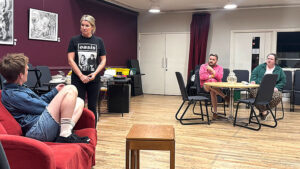
Brian: “It’s quite a subversive play because it celebrates family but it celebrates chosen family and it shoots down in flames something that is often, I think, unhelpful in Irish society: The sanctity of the family, when we all know a lot of traditional Irish families are not entirely highly functioning units and not entirely cherishing places where love thrives and where people thrive.
“This play presents a family but it’s not a biological family but by God, it’s a great family.
“They’re a great family.
“That’s what’s a bit naughty and a bit subversive and a bit quirky and a bit funny about this play: They are family.
“They’re not family but they are family.
“They’re what family should be.”
The piece is based on real interviews done with people who were there for this crisis, do you feel a responsibility in that way?
Brian: “I know Bernard (Lynch) and I’ve spoken to him on several occasions.
“Another really inspiring man Dr. Joseph Healy, whose experiences informed the writing of the play, also who came in to meet the cast and talk about his experiences.
“He was a young early 20s man when he arrived in London in the 80s.
“I’m not sure whether I feel particularly a responsibility to them specifically but I do feel like they’ve kind of passed on the baton a little bit or we have borrowed the baton for a while and then we’ll give it back to them because they have been absolute giants.
“We’re all looking after each other and making sure that none of it is getting too heavy.
“We all have to walk out of here at the end of the day back into our real lives.
“That’s the responsibility we have to each other.
“We need to be kind to each other but we need to keep working hard to tell the story.”
Conor: “I definitely feel a responsibility but it’s not just responsibility for the weight of it and the seriousness, I think I feel a real responsibility to hold the weight of it and again keep reminding myself to bring out the joy.
“I think that’s what I feel like.
“I think we’d be doing all of those people, thousands and thousands of people, such an injustice if they’re reduced to a period of time, a statistic, one of many.
“I think there’s a responsibility in showing their hearts and their dreams and all of that spirit.
“I think there’s a beautiful shared energy in the rehearsal room as well, just on a more kind of bigger sense because I think there’s this beautiful shared responsibility that I think we all feel of like we need to tell the story honestly and truthfully and well.”
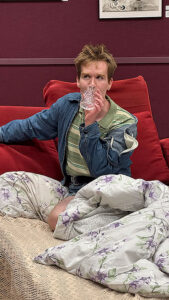
Tell us about the characters you are playing Ciara and Conor..
Ciara: “I’m playing Sally, Shay’s mum and there’s lots to like about Sally.
“She has quite a transformation and quite an awakening but it’s a very painful one.
“She’s left with lots of pain and trauma that she can’t really ever fully resolve because her son has died and she has to live with some of the decisions and the conformity that she went along with being a traditional Irish wife in the 80s in a Catholic family.
“She gets a second chance.
“It’s so sad and it’s so awful especially in parts of the play where they talk about many families who totally abandoned their sons when they were dying, wanted nothing to do with them, ‘Don’t contact us again, burn the bodies’: These are things that happened.
“It sounds obscene to hear it said out loud, but this happened.
“Sally didn’t do that but she did make a lot of mistakes.
“I think it’s her reflection and the transformation that she has which is what I like the most about it.
“It happens.
“We muck up in our lives.
“We make mistakes that we can’t undo with awful consequences that may or may not have happened but it’s living with her choices and things that she’s done but moving forward with it to bring it to a more hopeful place, to make better choices moving forward and to give her a chance to- not atone but that’s probably how it feels like for her, atonement.
“It’s a great character to play but very, very sad.”
Conor: “His name is Nellie and he is London’s favourite cowgirl.
“I think here’s lots to love about him but he’s somebody who carries a lot.
“A lot of things have happened to him and yet, even by the time we meet him, he hasn’t let that fundamentally change who he is.
“He’s still front-footed, unapologetic, unashamed, fearless at a time where fear is bred into you in that country.
“He is brazen in that regard.
“He’s very bold.
“He goes on a massive arc over the five years that the play’s set over and feels like, as an actor, such an honour to be able to experience that with him.”
Brian: “He leaves his mark on people.
“People remember him and people are the better for knowing him, unless they like a tidy kitchen.
“But aside from that, he’s an elevating person to know.”
Have you been shocked or had your eyes opened by some of those things that have come up in the story or rehearsals?
Ciara: “I think it is shocking in terms of that feeling, ‘We don’t talk about this, we don’t do this’ in the ‘80s, ‘90s.
“I remember that.
“So that side of it is familiar: That way of expected behaviour in families and what was talked about and what wasn’t.
“I definitely knew lots of people like Sally, how Sally starts anyway.”
Conor: “I feel like there was definitely huge echoes of that, the residue of shame and Catholic guilt and all of those things.
“They’ve not gone away.
“It’s been a massive, massive pendulum shift within my lifetime really and it has been eye opening looking at that time and reading the statistics, learning about what the culture was, what the politics were, what the healthcare was and wasn’t.
“I think a character, no matter who they are, what the story, always leaves a part of them with you to some degree and I feel already what this character will leave with me is quite massive and I’m already feeling shifts in my perspective which is just the privilege of the job too so I feel very grateful.”
Brian: “There are other characters, another lesbian character and I think what’s important about this play is that it highlights the role that the lesbian community played within the gay community in the fight against AIDS at a time when a predominantly male patriarchal government were not listening or paying attention.
“In fact doing the research I spoke to some older London gay men and told them what this play was about but I remember one or two of the older gay London men saying, ‘Are there lesbians in your play?’
“And I went, ‘Well yes, there are actually’.
“And they were all at pains to say, ‘That’s good because we would not have made it without them’.
“That was a really historically important moment of intersectionality where two marginalised groups became even more closely united in adversity really.”
Of course a lot of Irish men affected in this crisis never made it home, wouldn’t it be poignant to bring this story to Ireland?
Ciara: “I think it absolutely needs to go to Ireland.
“It has to go.”
Brian: “It has to be seen.
“I think there would be an appetite.
“I think it would be appreciated.
“I think people would love it if we can find a way to bring it back to Ireland.
“That would be one of the goals.
“It certainly deserves more than two weeks.”
Mammy’s House runs until 13 September Upstairs at the Gate.
For booking or more information, click here.