


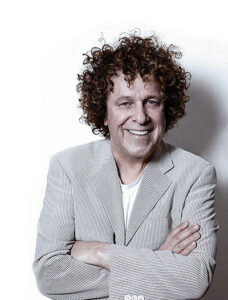
70s icon Leo Sayer told David Hennessy about his new anthology of all his studio albums and some previously unheard material.
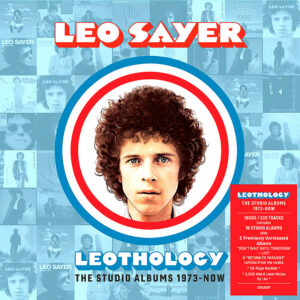
Leo Sayer recently released Leothology: The Studio Albums 1973-Now.
It is a comprehensive, 220-track, career-spanning box-set showcasing his recorded studio output, and some undiscovered music from the vaults, spread across a mighty 18 discs.
Leo is best known for his 1976 hit You Make Me Feel Like Dancing but he has sold more than 80 billion records worldwide and his music has been streamed almost one billion times.
Spending more than 400 weeks on the UK Singles & Albums Charts, the British music legend has enjoyed 19 UK Top 40 chart hits, including a run of seven consecutive UK Top 10 singles, from his 1973 debut The Show Must Go On through to 1977’s How Much Love, a run that included his transatlantic No.1 smash When I Need You.
The new 18 CD anthology includes all 16 original UK studio albums as well as two previously unreleased albums: Don’t Wait Until Tomorrow – Live, a 2008 concert recorded in Melbourne and Return To Paradise, a brand new compilation of previously unreleased tracks unearthed from Leo’s vaults.
Leo’s mother came from Fermanagh and his family spent this childhood going to Ireland on summer holidays.
Leo took time to chat to the Irish World.
You are releasing Leothology, how does it feel to have everything you have ever done brought together like that?

“It’s been fun putting it together.
“You find a lot of recordings and you go, ‘Hang on, that should be out’.
“So I played them to the to the record company and they said, ‘Yeah, go on, there’s an extra album in there’.
“It’s very nice that you’re able to look back into the past and find those things that never got a chance to come out.
“I’m very proud of the whole thing. It’s a lovely collection.”
I really like the previously unheard 1984 single Wrapped Up in Love, why have some of these tracks not been released before now?
“I think it was indicative of the times.
“I’d had huge success in the 70s and then going on into the 80s, up to about ‘84 or so.
“Our business is all about style and what’s in fashion, what’s not and it was very difficult to get a record deal but I carried on making records.
“That’s what 1992 is all about.
“Wrapped Up in Love comes from a similar kind of time a little bit earlier than that but a similar kind of connection.
“The creative juices had to still keep flowing because I always knew that my busy time would come towards the end of my career.
“If it is the end of my career, I don’t know.
“I think it carries on.
“But I knew that it would be later, when I’d be in my 60s or 70s, that I’d be doing all the big work, and that’s how it’s been.
“It’s been very much like that and, and suddenly I’m really feeling as creative as ever and making more records.
“Wrapped Up in Love was a session at Air Studios.
“I’d just written this song and we did it.
“But here’s the weird thing, I lost the tape.
“I couldn’t find it for years and then January this year, when we were putting together Leothology, I looked through my storage and I found a DAT and there was this song that I’d always remembered but I didn’t think I could release because it was missing and when I played it I thought, ‘Hey, that’s good enough to release’.
“That song is all about a night that I spent in Vancouver trapped in a hotel, snowbound.
“The Rolling Stones were there at the same time so I spent a lot of time with Keith Richards during those three or four days we were trapped at the hotel.
“All I wanted to do was get back and see my wife Janice who was down in Los Angeles.
“It’s all in that song: Missing the person and remembering how we were.
“We were so wrapped up in love.”
What has it been like to look back on your body of work. You’ve never been one to live in the past so I wonder what it was like to reflect like that for this anthology..
“I seem to be stuck in the past sometimes.
“I mean I’m always the one who says that I’m not living in the past and mentally I don’t but it’s part of my job really.
“I’ve realised that these golden years that we had of the 70s, early 80s, maybe even the end of the 60s, of creativity were so bloody special so I don’t think I can walk away from it and ignore it because so much was coming out that was really great.”
Did you know what had with hits like You Make Me Feel Like Dancing when you wrote them?
“You’re very driven when you’re writing songs.
“You Make Me Feel Like Dancing was almost a circumstance of accidents: Hearing a track on the radio, talking about it with the other musicians.
“We’re having a go jamming it in the studio and then Richard Perry turns around and said, ‘I recorded the jam session’ and then plays it back to you and says, ‘This is your big hit’.
“And then we finish it off and it took maybe five minutes of writing to come up with a chorus.
“You know you’ve got something good when it moves along in a very liquid form like that.
“It kind of feels like it’s meant to be.
“You don’t know, of course, where it’s going to go but you do know you’ve got something special and in knowing it’s something special, you’re putting one hundred million per cent of every ability that you have into it because it’s total focus, total concentration and total effort.
“We had the compulsion to follow up what we were thinking and make songs out of it, make records out of it, release the damn things, get them off our chests and I think that that’s the important motivating factor when you’re creative.
“It’s a bit like a painter, he’s not going to sit and not finish a canvas if it’s possible to do so.
“You do it, you get it out there and then you move on to the next stage.”
You have had great success, what’s the highlight of the whole thing? Is it some of the stages, awards etc?
“I don’t know if there is really a highlight because I think if you’re continuing, then you’ll always create highlights so in that way, what happens next week could be as thrilling as what happened 40 years ago, or 50 years ago in the case of You Make Me Feel Like Dancing which we’re talking about now.
“So I don’t know.
“You have to be in the moment, I think.
“It’s easy to look back and say, ‘Oh, that was the big one’ but I think that there were plenty of big ones and plenty of moments that got lost and that’s what’s exciting about this Leothology now with 240 songs or so on the box set.
“I hope people are going to pick out some of my favourites and ones that have maybe slipped away and not quite got noticed so they could be hits again.
“Maybe somebody will go and will record them again, who knows?
“Everything is there to be found and I think it’s a little bit like archaeology in that way.
“You lay down some good stuff, it gets buried slightly under the ground and then gets dug up again and that’s thrilling.
“That’s really good.
“That’s the best way to look back on a career because I think if you look back with regret, you’re not going to get anywhere but I look back with pride now and I think that there’s been so many different styles of Leo Sayer because I’ve always been a restless soul, I’ve always wanted to prove myself in different ways, different styles of music that there’s a great variety to be found in this material and in that way, I’m very proud of it.”
You grew up going to Ireland for summers, didn’t you?
“We did.
“It was all around the area of Swanlinbar, ‘Swad’ as they used to call it.
“My mum was born by Lough Erne, a place called Florence Court.
“Mum was from that area, born on the banks of the Lough Erne.
“Grandad built a farm near Swanlinbar, right on the border and we used to go over there for summers.
“It would be an excursion.
“I remember being sick on the northern sea, as everybody was, on the ferries in the old days.
“Then we’d get off the other end and drive to the country.
“I just remember hurling and all these amazing sports, and farm shows and ceilis in various people’s houses.
“Big, big family.
“Mum was one of 14 kids, there’s always lots of cousins that turn up when I do shows in Ireland.
“I just have so many fabulous memories and they all come back whenever I arrive there.
“Frequently if we’re doing a show in Belfast, I insist on driving that old country road and going past Swanlinbar and then going past Florence Court.
“I love it.
“It all comes flooding back.”
Do you think some of your musical inclination comes from your Irish roots?
“Probably all of the music comes from there because Grandad played the fiddle and played around with harmonica.
“I suppose that’s where I first saw somebody playing the harmonica which became, and still is, my main instrument.
“I mean I fiddle around with the keyboard but really the harmonica is the only one I could slightly call myself a virtuoso on.
“That all came from Ireland and came from sitting around in ceilis and watching people pulling this little metal organ out of their pockets and playing it.
“There was something magical about that.
“I thought, ‘Isn’t it great that you could just make music by pulling something out of your shirt pocket?’”
Isn’t it true that you’re related somehow to the famous Behan family?
“Yeah, it’s true.
“Didn’t really know Brendan but we knew Dominic.
“He would come and recite his brother’s works and things like that.
“Actually I did meet Brendan once, amazing man.
“These were guys with big loud voices.
“I think that’s where I realised at first that you had to have a big loud voice to be able to project and sing.
“These were very outgoing, very confident men and there was something about being in their company.
“They had a charisma and I think that’s probably the first time I actually observed a star, a celebrity, someone who really had that quality.
“Dominic Behan told me about a guy called Flann O’ Brien and from then on, I had to read everything that Flann O’Brien had done.
“It wasn’t just the typical Irish heroes, I got the very special Irish heroes: Seamus Heaney, people like that, so there’s a lot of the Irish culture must be in my music.”
Was it always going to be music for you?
“No, I was a graphic designer, artist.
“I was quite happy to do that but I had a nervous breakdown while I was working and I went back to my hometown, lived on a houseboat, met a bunch of guys that I knew who were doing music.
“I’d been fooling around with music before and all of a sudden I had a legit band and we went to an audition and got the job: Bang! Change of career, just like that, through circumstance.”
Do you still get as much joy out of performing as you ever did?
“Oh God, yeah.
“People ask me where I live.
“I live between the drum stand and the edge of the stage, that’s home.
“The rest of the time is just filling in.”

You have announced that this tour later in the year is to be the last tour of that size that we see you do. You’re not going anywhere but the tours in future will be more manageable, isn’t that right?
“Yes.
“Look, it’s not my title I put on that.
“I’d have just been happy to just put Leo Sayer up there and if anybody want to come, they come. If they don’t, they don’t.
“But I have to look at the consideration that in two years’ time when I do the next major tour, I’ll be 80.
“I just want to be able to do it well so I will need some more time off between gigs.
“I’ll have to do less but that’s alright.
“That’s life.
“You have to accept that we’re all coming of this age.
“Plenty of my contemporaries at the moment are retiring all around me or else finding they don’t have the ability or the voice anymore to do it.
“I’ve still got the voice and I’ve still got the ability so I’ll do it as long as I can.
“The show must go on.
“I can’t think of any good reason to stop doing what I love best.”
Has the longevity of your music even come as a surprise to you? I bet you didn’t think we would be talking about You Make Me Feel Like Dancing 50 years later when you were creating it..
“If you’re totally in a vacuum only listening to yourself, no, you can’t do it but I think you know when you’re doing a track and you’re writing a song, ‘Hey, this is going to work. It’s going to communicate’.
“Because you know who it’s going to communicate to so there is a thing in that.
“I think that guys like David Bowie, George Michael knew where their songs were going to go.
“Dylan knew who he was talking to.
“The Beatles knew who they were talking to.
“Writing Street Fighting Man or something like that, Keith would have turned around to Mick and said, ‘Hey, they’ll love this’.
“And he’d be right.
“We do know, I think, where it’s going at the time.
“We won’t sometimes admit it to ourselves because we might get a little bit too big headed but yeah, we do know.”
You have that amazing story of how you spoke to Elvis Presley and even arranged to meet in person but he sadly died before that could happen..
“It was an amazing opportunity.
“It’s very rare that you meet your heroes and they can be actually fabulously surprising and he was so surprising.
“He was so warm when I talked to him.
“Unfortunately it went no further.
“I only talked to him but he was so warm, so giving, so sharing, and really humble.
“And this is Elvis Presley.
“You’re going, ‘What?’
“I am still not sure these days if I deserved the time that he gave me but we would have got on great if we’d have got together.”
How would you like to be starting out in music now? Obviously it’s changed so much..
“Oh, it’s a different world.
“We didn’t have social media, we didn’t have mobile phones and that really affected creativity because you just had to use 100% your imagination whereas now you could get by using 40% of your imagination and the rest of it being tools to help you get there.
“Ours was a human intercourse, between people.
“It was just a wonderful thing.
“We trusted each other.
“We got the best out of musicians if we showed them the love and shared what we did with them, there was no just hiring equipment or tools to do the job.
“We built relationships that were incredible and I was lucky to have built relationships with great co-songwriters, great co-musicians, great co-producers, great people.
“In business as well and that’s usually the ugly side of the business with managers and everything.
“I had plenty of rip-offs but at the same time I had great guidance early on from Adam Faith.
“When you have someone who can open doors like he did, it really brought me to the public attention very quickly.
“It was all about people, and it’s not the same now.
“I don’t think I’d want to do this in this modern day and age.
“The song One Man Band, it’s all about that.
“I think that that’s what essentially Leo Sayer’s all about but it would be very difficult to do that in this day and age.”
Do you feel you are and have always been a one man band?
“Yeah because to do it these days, you’ve got to have a huge machine around you and honestly in those days you could just be five guys against the world, it was fantastic.”
Leothology: The Studio Albums 1973-Now is out now.
Leo Sayer tours the UK in October/ November.
For more information, click here.