

Film maker Fergus Dowd told David Hennessy about his film about Charlie O’Leary, former Republic of Ireland kit man who also established Dublin’s street leagues which produced so much Irish talent.
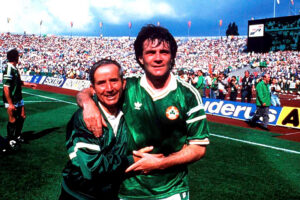
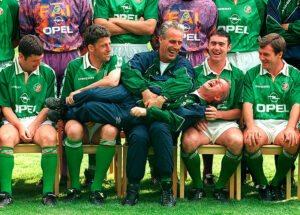
As kit man to Jack Charlton’s iconic Republic of Ireland team, Charlie O’Leary was there for some of Irish sporting history’s most iconic moments: Stuttgart ’88, the Stadio Olimpico in Rome in 1990 and of course Giants Stadium ’94.
But Charlie’s role in Irish soccer goes far beyond being there for the iconic moments.
By establishing Dublin’s street leagues in the 1940s, Charlie created the very thing where so many greats of Irish football learned their trade.
From there he would go on to referee and it was while officiating that he first came into contact with Jack Charlton.
The Charlie O’Leary Story- From Johnny Cullen’s Hill to The Olympic Stadium Rome tells the story of this unique Irish sporting figure.
The film screens at The Irish Cultural Centre in Hammersmith this week.
Film maker Fergus Dowd, whose previous film 406 Days about the Debenhams strike in Ireland, was featured in The Irish World took time to chat to us.
How did the idea for this film come to you? What inspired you to look at Charlie’s story?

“Well we were approached by Justice for the Forgotten.
“They represent the families of the Dublin/ Monaghan bombings and they approached us to do a film for the 50th anniversary of the atrocity in 2024.
“We did that film and one of the people who was caught up in the atrocity was a chap called Derek Byrne.
“Derek was only 14 years of age.
“He was a petrol pump attendant and on the day of the atrocity, he brought his football boots to work.
“He was to go for a trial with Tottenham Hotspurs in London the next day but sadly believe it or not he was pronounced dead in the hospital but he woke up in a morgue about seven hours later.
“Derek had told us about the Street Leagues that were in Dublin.
“I worked previously with a chap called Joe Moran and he had mentioned to me that if we were going to do a story on the Dublin street leagues that we needed to speak to a man called Charlie O’Leary, he had been central to it.
“The likes of John Giles, Liam Tuohy, Frank Stapleton, Niall Quinn all played in the street leagues.
“Tommy Dunne, who won the European Cup with Manchester United, played in the Dublin street Leagues and then it spread to Belfast, Donegal, Galway, Cork, around Ireland.
“It went on to the 1980s.
“Charlie was 100 years of age so we just approached the family for an interview about the street leagues.
“We went to his house.
“We had just gone to go to talk to him about the street leagues.
“We sat down with Charlie.
“He gave us a four-hour interview.
“He had actually founded the street leagues in 1945 in East Wall in Dublin and his was before schoolboy football.
“The street leagues were founded through the church, the sodalities.
“He mentioned to the parish priest about the idea of maybe a football tournament through the sodalities and that’s where the idea of the street leagues came.
“Charlie is actually on the 1926 census.
“He was born on 1 February 1924 in Townsend Street in a place called Leary’s Place which is just the six cottages off Townsend Street.
“His family moved to East Wall when he was four years of age in 1928.
“His father worked in a box company and he moved to become foreman of a sawmill O’Keefe’s in East Wall and the family got a cottage on site.
“East Wall was actually built on reclaimed land.
“The corporation didn’t go in there until the early 30s.
“They started to build houses in East Wall in the 1930s so a lot of families moved in.
“East Wall was very much a hotbed of football.
“It still is.
“That’s sort of how the street leagues came about.
“But through the street leagues, Charlie became a referee as a teenager.
“He was only 18.
“There was nobody to referee.
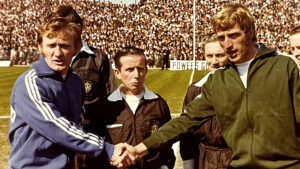
“He then became a junior referee and then eventually he became a League of Ireland referee for 20 seasons.
“He was one of the first FIFA-affiliated Irish referees so he would have refereed behind the Iron Curtain in the 60s.
“He refereed at Camp Nou Barcelona, refereed in the UK.
“He would have refereed the great Leeds team which Jack Charlton was involved in as well.
“He would have been great friends with Jock Stein and Sean Fallon from Celtic.
“He also was referee for the first televised FAI Cup final in the early 70s.
“He would have also refereed Santos, so Pele, when they came to play Dalymount Park.
“He speaks in the film about being linesman when The Busby Babes played Home Farm Selection and also about Liam Whelan’s death, the Munich air disaster.
“And he was great friends with Liam Whelan.
“Also he would have survived the North Strand bombings in the early 40s during World War Two.
“So you have this incredible story.
“He worked until 1980.
“His actual official job was a saw doctor in O’Keefe’s and he worked there in the sawmills from 1938 to 1980.
“The banks actually closed O’Keefes and then he got a job in the Department of Communications.
“But when he retired as a referee, the FAI asked him would he look after the visiting teams that came to play Ireland so he would have looked after the Italian side, with Paolo Rossi, that came in 1985 as the world champions.
“He would look after them for three days.
“He’d stay with them in the Shelburne, bring them out to Howth.
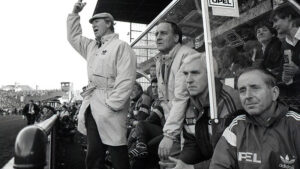
“So in 1986 when Wales came for Jack Charlton’s first match, Charlie was looking after the Welsh team and he went into the (Irish) dressing room to get a pump and Jack Charlton remembered him.
“He said, ‘Do I know you?’
“And Charlie said, ‘Yeah, I refereed you twice when you played for Leeds United’.
“He struck up a conversation and when Charlie left his dressing room Jack Charlton said to Mick (Byrne, physio), ‘What does he do?’
“And Mick says, ‘Oh, he does everything for the visiting team’.
“And Jack Charlton said, ‘That’s ridiculous. He should be with us’.
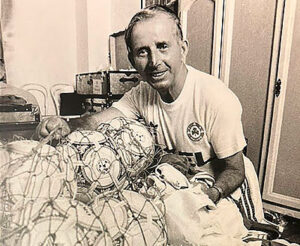
“That’s how Charlie became kitman of the Irish team.
“Obviously he was there for Euro ’88, Italia ’90 when he met the Pope and obviously USA ’94.
“He stayed on until 2000 with Mick McCarthy as well.
“As he says in the film, ‘I wasn’t there for Saipan, Thank God’.
“It’s just incredible.
“So to answer the question this project was going to be a film about the street leagues but Charlie gave us so much and his story was so interesting.
“It’s not every day you meet somebody who’s 100 years of age.
“And a lot of the stories have been done.
“Obviously Jack Charlton’s story is very well known.
“There’s been a lot of documentaries about Italia ‘90, USA ’94 and about the players and stuff like that but nobody had ever really done a story on the kit man.
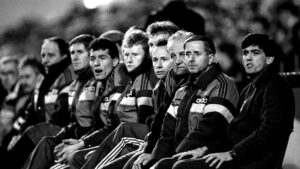
“Charlie and Mick Byrne were the glue between the players and Jack Charlton and the management staff.
“If a player had a problem, they would go and speak to Charlie and Mick and then Charlie and Mick would go up and speak to Jack so they were the middlemen.
“Before an international, they would go off the Howth, have a walk and think about things, ‘Right, what are we going to do this time?’
“They really created nearly a club environment at an international level.
“Charlie’s life transcends football on the island of Ireland in that he was born in 1924 when the Free State played their first match and he was there at the pinnacle of Irish football when Ireland got to the quarterfinals of the World Cup, so he’s sort of seen everything.
“His story was just an incredible one in that he was able to tell the stories from under the skin of the team.
“There were these anecdotal stories about Euro ’88 like when Ray Houghton scored the goal, you see Jack Charlton celebrating but he’s actually holding his head because he banged his head off a steel rail.
“He talks about Paul McGrath.
“If you remember the match against Italy in the Giants stadium, he was hardly able to hold his hand up.
“Paul McGrath had a shoulder injury but he gave one of the best performances ever by an Irish player so just to sit there and listen to these great stories was, yeah, an absolute privilege.
“He had all these stories.
“His wife was a big smoker and the first thing he did if they were playing away from home was to buy 200 cigarettes for his wife. The players heard about this and they used to hide the cigarettes.
“There was a great bond between him and all the players.
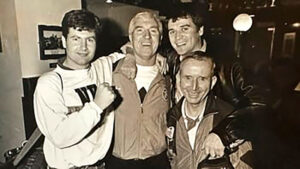
“To this day he’s still great friends with Paul McGrath, Roy Keane and Mick McCarthy and all these guys.
“They sent lovely messages the night that we had the film in the film festival in Dublin.
“Paul McGrath and Niall Quinn attended that night and there’s still a very close bond between that group.”
As you say Charlie was there for so many massive moments of Irish sporting history but his point of view is one we haven’t heard before..
“Oh yeah, absolutely.
“He was very much central.
“He talks about the day that Ireland beat England being the first time that he saw grown men cry and what an occasion it was to beat England in Germany in Euro ’88.
“I don’t think the team and Charlie realised the history they had created until they arrived home in Dublin for the homecoming.
“Because they were obviously in the midst of a tournament, they didn’t realise until they arrived back into Dublin Airport.
“I don’t think anybody expected them to do so well.
“You have to remember they were eight minutes away from a European Championship semi-final in Euro ’88, and then in 1990 they reached the quarter-final.
“I don’t think we’ll ever see the like of it again.
“It was before the Premier League.
“It was before all the money that came into football.
“There was a little bit of innocence about it in that you didn’t have these travel companies or travel agencies.
“It was a bit like the Joxer song in that it was boats, trains and planes and you just got there whatever way you could get there.
“There was a lot of innocence to the whole thing, I think and it’s sort of changed now in that there’s travel packages and the internet but there was none of that then.
“I don’t think you realised how many people would travel to Italy or to the games in Euro ‘88 until you actually arrived there and you saw the people.
“You can see the difference in USA ’94.
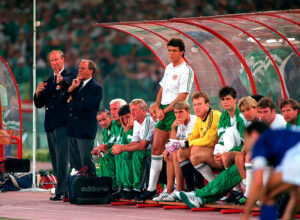
“When the team came home from 1990, there was a half a million people on the street and it took hours upon hours to get from the airport to College Green whereas when the team came home in 1994, and they didn’t do as well as they had done in the previous tournaments, they were flown to the Phoenix Park so it had become very corporate within those four years and football had started to change.
“His whole life has been football whether it be setting up the street leagues, refereeing, looking after visiting teams who came to Ireland to play international games here or with the actual international team as a kitman.
“He still goes to Lansdowne Road to this day.
“As part of the film, we brought him down to the dressing room and he hadn’t been in the dressing room in years.
“Obviously they have changed the stadium but when we were walking up the road to the stadium, the amount of people that stopped and wished him well.
“It was like bringing a king back, everybody stopping and shaking hands with him. The same when we got into the stadium.
“He’s an incredible man too.
“He’s now 102 but he goes to all the Q and As.
“He’s been really supportive of this film.
“And it’s great to tell a story as well while somebody’s alive because a lot of stories are told when the person has passed away so it’s nice that the person themselves get to see the film about themselves as well.”
Someone says in the film nearly gets more respect for what he has done locally than being there for massive international moments..
“He doesn’t support any teams in England or Scotland.
“He supports Bohemians locally.
“He’s involved with the Leinster Senior League.
“He would support Dublin in GAA and the Irish rugby team, so he’s very much a local person.
“He’s obviously very much supportive of grassroots football.
“He’s very much a man who is very supportive of local grassroots football which really shows in that his idea of the whole street leagues, which came before even schoolboy football, shows that sort of interest and determination he has.
“If you don’t have local grassroots football, you don’t have any future prospects.
“Even when he started the street leagues as a teenager, it didn’t really matter what skill level you had.
“His thing was, ‘Look, it’s participation. You’re playing for your street. You’re playing with your friends and you’re playing a game that you like’.
“And different kids had different skill levels.
“There was people that were really good but everybody was given a chance.
“To this day that’s why he’s involved in local grassroots football and that was the ethos of the street leagues back in the 40s.
“I think that’s still his ethos, that everybody should get a chance to play football irrespective of their skill level so it’s more about the enjoyment you get from playing sports rather than a real competitive thing.
“He was able to organise the street league.
“It was really Charlie and his initial idea that got kids playing football in Dublin and nowadays you don’t get that anymore.
“You don’t get kids playing on the street anymore or even in parks.
“Kids don’t play football on the street here anymore in Ireland which is a pretty sad thing.
“Society has totally changed but I think with this film, it’s very much a social history film and a nostalgic look at a bygone era, of a Dublin that’s bygone now.
“He’s born only two or three years after the War of Independence so he’s nearly lived since the Free State became a Free State.
“He’s nearly the same age as the country.
“He’s seen everything.
“So as well as that, you’re trying to get all that in to a film that’s only 90 minutes long.
“It’s incredible.
“He’s got great Dublin wit and, as I say, his story is remarkable.
“It’s rare, I suppose and the great thing about it is he’s seen so much and he’s lived through the most epic thing from a sporting point of view that’s ever happened in this country.
“That team was able to put Ireland on the map.
“I think it was Niall Quinn who said to us on the night at the Dublin Film Festival that whole journey with that Irish team nearly created the Celtic Tiger.
“People started to hear of Ireland and then obviously during that period the peace process started in Ireland and people started to come to the country from a tourist perspective as well.
“That team gave people, ‘Well, hold on a minute, I’m Irish and I’m going to enjoy this and we’re going to wave our flag’.
“So suddenly we had something to cheer about because in the 80s in Ireland there was high unemployment, you had the troubles and then suddenly this football team burst onto the scene and it just took off.
“And I think it did help in a way to create this whole Celtic Tiger.
“You had a lot of people who came home from England.
“Suddenly there wasn’t as much emigration then from ’96 onwards compared to 50s, 60s.
“Ireland just totally changed.
“I don’t know whether that’s a good thing because nowadays you can’t even buy a house in Dublin.
“But suddenly actually people started to, ‘Oh, Ireland?’
“And maybe before that, people didn’t really know much about Ireland apart from what they saw maybe on the news during the Troubles but suddenly we had the peace process.
“That’s one of the things Niall Quinn was saying to us, that he felt that the country started to change but maybe through what they were achieving in a way.
“Charlie was part of that.”
Do you feel honoured or privileged that you got to tell Charlie’s story in this way?
“Absolutely, yeah.
“It was a great project to work on.
“It’s a great pleasure.
“It’s just incredible so it’s a real privilege to speak and be able to sit in a room with somebody who was there when Ray Houghton put the ball in the net.”
The Charlie O’Leary Story- From Johnny Cullen’s Hill to The Olympic Stadium Rome screens 7pm at The Irish Cultural Centre Thursday 3 September.
The screening will be followed by a Q and A with film makers Fergus Dowd and Joe Lee as well as League of Ireland great Martin Lawlor. The Q and A will be hosted by Tom Watt well known for playing Lofty in Eastenders.
