


Ashleigh Harley was just 21 when, following a devastating ten-year delay in diagnosing her Ehlers-Danlos Syndrome (EDS), she became critically ill and was given just six months to live.
Now, against the odds, Ashleigh is alive and has turned the experience into a national campaign calling for earlier diagnosis and better support for young people living with complex, chronic and disabling conditions.
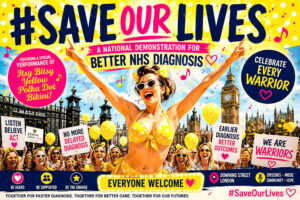
On Saturday 22 August, Ashleigh will lead the #SaveOurLives March outside Downing Street, bringing together hundreds of young people who have also experienced the consequences of delayed diagnosis.
Ashleigh has also just released the charity single, Itsy Bitsy Bikini and this Saturday there will be a very special musical guest.
Brian Hyland, the original singer of the iconic Itsy Bitsy Teenie Weenie Yellow Polka Dot Bikini, is flying from the United States to the UK to join Ashleigh for a special performance at Downing Street.
The event will also form part of the launch of Ashleigh’s charity The Dark Horse Foundation which aims to work alongside Parliament to explore new approaches to speeding up diagnosis and improving treatment and support for people who, like Ashleigh, can spend years navigating the healthcare system before receiving answers.
It was in her darkest moments that Ashleigh turned to music.
While in hospital, Ashleigh began writing songs for her family, believing she was saying goodbye.
Ashleigh is still continuing to live with significant health challenges, including regular seizures and the need to carry portable oxygen but her focus is now firmly on what can change.
Ashleigh says: “I was given very little hope, but I survived. I don’t want other young people to spend years being told that what they’re experiencing isn’t real or isn’t serious enough to investigate. If my story can help change that, then everything I’ve been through has a purpose.”

Ashleigh took time to chat to the Irish World ahead of the special march.
This march means so much to you, doesn’t it?
“Oh yeah.
“Obviously it’s personal for me because I almost lost my life four years ago with my illness.
“To have Brian’s support doing this new version of his original Itsy Bitsy Bikini is unbelievably exciting.
“I just feel blessed to be here to get to experience it.”
There must have been times when you didn’t know that you would be here let alone undertaking something as massive as this..
“No, even about a year ago I could never have imagined anything like this happening which is why I do believe that we’re doing something good.
“I think there are times in life where you get dragged into the darkest moments but they can become your greatest strengths so whilst that happened, I wouldn’t necessarily change it because I learned a lot and none of this would be happening now if it hadn’t have happened.”
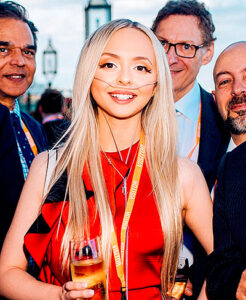
It was when you were in hospital that you turned to music, isn’t it?
“Yeah I suppose the thing that started the music was when I was at my very worst four years ago.
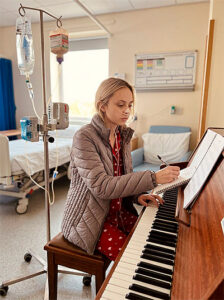
“They told me I was going to die and I had six months so I went down to the piano in the hospital.
“There was a chapel in the hospital with this cute little piano, bit out of tune,” Ashleigh laughs.
“But there was something about the place that felt safe and warm and not like the rest of the hospital so I dragged my feeding equipment and all my IV equipment that was keeping me alive into the room.
“I could just hear a song.
“I wanted to tell my family that I loved them and I wanted them to have something where they’d be able to hear my voice saying that I still love them even after I was gone.
“So I wrote my first song in the hospital.
“I didn’t really know anything about chords, melodies, anything like that.
“It was just feeling coming out.
“That’s how it started.”
Wasn’t it also in the hospital that you first reworked Itsy Bitsy Bikini, wasn’t it?
“It was a little bit afterwards.
“It was after I had been past my sickest point.
“I’d gotten a diagnosis and I’d started having treatment.
“I was dealing with someone who wasn’t being very nice to me about my illness and they dared me to do this song.
“For some reason they thought that that would make a fool of me or something.
“They just weren’t being very nice so I thought, ‘Let’s flip this around and turn this into a really cool song about finding strength from your pain’.
“That’s why I started.
“I did that version of Itsy Bitsy.
“It was on a dare trying to prove a bully wrong and I think maybe we can prove them wrong this Saturday. We’ll see.”
The original singer of the song Brian Hyland is coming to join you for a performance, isn’t that crazy?
“I know. Incredible, isn’t it?
“I couldn’t have dreamt that in my wildest dreams.”
You are planning to march to Downing Street which is incredible because there was a time when you were too sick to walk let alone march. You were also unable to sing for such a long time so there is poignancy in both of these actions, isn’t there?
“I genuinely believe it’s a miracle.
“It’s a miracle that I was able to be able to speak again as I’m speaking to you because I had to speak through a computer for quite a while because I couldn’t use my voice, I couldn’t use my jaw so just to be able to speak is a miracle in itself, let alone sing and record and record a single with a rock legend.
“For me, it’s a miracle.”
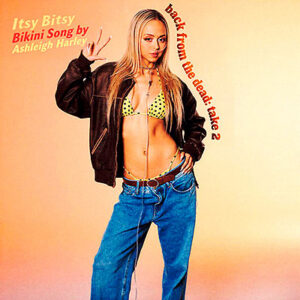
It got so bad that the doctors told you you were going to die..
“Yeah it’s hard for me to wrap my head around it still.
“It was love for my family that made me fight through.
“Well it was actually the pain.
“It wasn’t a nice feeling.
“It was a feeling of guilt if I let my parents lose their only child but whatever that was, it kept me here and then subsequently, the charity and the music and all that’s evolved.
“It’s like if you plant a seed, it grows and I think it’s because it’s come from trying to be here for other people.”
You were ten years waiting for a diagnosis, that is ten years in limbo really..
“Most teenagers get to cause all the trouble that teenagers cause and have fun.
“I didn’t get to do any of that and I certainly don’t want anyone else to grow up having their whole childhood stolen from them and so the more people who listen to the song, the more money we can raise to help save lives and get those young people who are like me diagnosed, so everyone sing along and dance along and the more you do it, you’ll save lives.”
You mention teenage years there. Were you a perfectly happy child and then all of a sudden this condition revealed itself and to make things even worse, you couldn’t get the answers you needed?
“Pretty much, yeah.
“I was born with it but it didn’t really affect me until I was about 11, 12 years old.
“They could have diagnosed it at birth and if they had diagnosed it at birth, they would have been able to prevent what happened to me but because it wasn’t diagnosed, it meant that my condition progressed and progressed and progressed to a point where I was on a life support machine.
“I remember the day it happened.
“Everything was fine and normal: Happy, feeling good.
“I love horses.
“I was out riding at the stables and all of a sudden, I went blind and I couldn’t move my hands.
“I couldn’t speak.
“The people with me thought I was maybe having a stroke but that was the start of a long very unpleasant journey.”
Being in that situation that you were in for ten whole years, was it hard to be hopeful?
“Oh yeah, it was brutal.
“It was deeply, deeply painful and for me the hardest part was because I was unable to get a diagnosis.
“It meant I was very socially isolated so I spent my youth not being able to have friends, go to school and it left me feeling like I wasn’t human, I suppose.
“Obviously when you’re young you don’t know anybody else who’s in that situation, you assume you’re the only one but as I’ve gotten older, I’ve also been able to get treatment.
“I’ve seen that there are lots of young people who are suffering this way and I thought with the music, the charity, we’re in a position to do something about it so let’s give it our best shot.”

Finally getting that diagnosis was light at the end of the tunnel, wasn’t it?
“Yeah, the NHS doesn’t diagnose these conditions so my parents had to figure out what was wrong with me, find the right specialist and pay a lot of money to get me the right treatment.
“Obviously not everybody has a family that can do that so I was very, very fortunate that I had a family that did that for me.
“Not everyone has that family to do that and that’s why our charity exists.”
The NHS is so stretched, it needs more support to deal with these cases where solutions aren’t so readily apparent, isn’t that right?
“Yes, absolutely.
“We’re developing a software tool to try and get young people the diagnosis they need quicker, easier.
“That’s all being developed as part of the charity and our ask of the government is to work with us to integrate that so then we can hopefully save more lives.
“We will save more lives.”
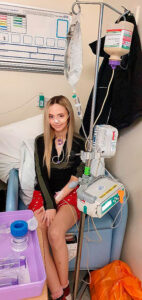
As you say you really were one of the lucky ones but not everyone can be that..
“I think the right to live a full life should be for every human.
“It shouldn’t just be someone who’s just lucky.
“It’s a law and I think people’s lives are worth fighting for and worth defending and we’re going to do it with the music.”
You are affecting change with your life now but wasn’t there a time when they told you it was only with your death that you could bring about the change you want to see?
“That’s when they were talking about discharging me unsafely.
“This was in the middle of the third wave of COVID so there were a lot of COVID patients.
“The hospitals were full.
“I was on life support but they didn’t know how to treat me and the doctor’s decision was, ‘Well we’ve got a COVID patient who we’ve got medication we can give them whereas we haven’t got medication we can give you’.
“My mum obviously contested that and she said, ‘Please don’t discharge her because if you leave her without food, the ability to walk and breathe on her own, she’s going to die’.
“And the doctor turned to my mum at that point and said, “Well if you want it to be done differently, use Ashleigh’s death to lobby the government..,’ which is obviously a terrible thing to say to someone.”
Terrible thing to hear as well..
“Yeah, terrible.
“But I recovered and obviously I wrote the music for my mum, for my dad and then I thought, ‘No, let’s use this to make the change, not my death. Let’s use this music that I felt was God given in that time and then maybe it will help other people’.”
You still have health challenges but can you enjoy life now?
“Yeah well I have my limitations and I have to manage myself carefully but I get to live a pretty full life and I love my life.
“It’s great.
“I wouldn’t change a single thing about it.
“I get to do all the things that anybody gets to do and it’s full of friendship and love and happiness and family and I couldn’t want for anything really.”

You have changed the lyrics to the song from ‘she was afraid to go to the doctors’ so it reflects your own experience. It must have been a horrible time of going from doctor to doctor and not getting anywhere..
“Yeah. Really, really, really horrible.
“Terrifying in fact because your life is in that person’s hands and if you don’t get someone who’s going to handle that with care, that’s a terrifying position to be in.
“I think there’s an element that gets forgotten or has been forgotten in healthcare that when a patient is that ill and they’re going to a doctor, that doctor is in a very, very immense position of power and has a lot of responsibility.
“I’ve had good experiences and bad experiences.
“Obviously I’ve met some doctors who I would say I wouldn’t be here today if they hadn’t have helped me the way they did and then there are others that turned to my mum and said, ‘Well use Ashleigh’s death’.”
You are making music, films, riding horses. It certainly doesn’t seem like you have let the condition hold you back..
“No, definitely not.
“You can’t.
“I think as humans we’re very adaptable and you will suffer in life.
“That’s one thing that we can all guarantee but from that pain, it can make things actually better.
“It’s a strange law of the world but, like I said, I wouldn’t change what happened.
“I still have my struggles but my life’s better than it’s ever been for all of it.”
That’s an incredible thing to say. You wouldn’t change it after all the challenges you have had?
“I don’t (want to change anything).
“It’s not that I wish I hadn’t gone through it, I don’t want anyone else to go through it.
“I’ve been through it and I’m out the other side now.
“Singing with Brian Hyland outside Number 10 Downing Street wouldn’t be happening if all of the bad things hadn’t happened so I wouldn’t change it because I’d be a different person and I’m good with the way things are.
“I wouldn’t want anyone else to go through that level of suffering.”
The lyric video to the song has that phrase, ‘You don’t look disabled’. Another cause you are passionate about is understanding around invisible disabilities..
“Yeah.
“For example today you look at me.
“You can see that I’m not feeling very well because I have got a tube on my face but I could take this off and you would never know that this is something that I deal with on a daily basis.
“We really ought not to judge people based off of immediate assumptions.
“It doesn’t do any good in the world so the disability doesn’t have a look.
“Suffering doesn’t have a look.
“You just can’t make assumptions.
“That video was put together by a friend who lives with the same condition as me and she frequently feels very judged and not seen because of the condition and I feel the same way.
“I think we’ll operate better in society if we understand each other better.
“So yeah, wish us luck.
“We’re gonna need it because it’s one hell of a task we’ve got on our hands.”
Ashleigh has family in Dublin
“I love Ireland.
“I’ve been a few times.
“I love it so much.
“It’s beautiful.”
What’s next beyond this march and performance?
“Myself and Brian have been talking about recording a Christmas single together.
“That was the song I wrote for my mum and dad when I was dying.
“It was a Christmas song and I think that’s going to be a really beautiful.
“Watch out for the December one we’re going to do too so we’re not done yet, we’re just getting started.”
That would be an emotional one, wouldn’t it?
“Yeah, my mum can’t listen to it without crying.
“And I might cry.”
There might be the tears but the main thing is you’re still here, isn’t it?
“Yeah and there will be more young people we work with in the same situation who will get to sing it too which makes it worthwhile.
“It makes it worth fighting.”
The #SaveOurLives march takes place Saturday 22 August.
Itsy Bitsy Bikini is out now.
For more information, go to thedarkhorsefoundation.com or search Ashleigh Harley on social media.
