


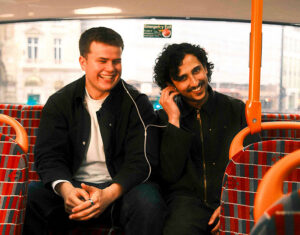
John Dinneen told David Hennessy about his new play The Jolly Fisherman, based on real events and current themes, which has called a ‘must see’ of this year’s Edinburgh Fringe.
The Jolly Fisherman, written by John Dinneen, is set to be one of the highlights of this year’s Edinburgh Fringe.
The Jolly Fisherman is from multi award-winning Kick It Anywhere, the producing and writing duo John Dinneen and Alex Urwin.
The Irish World featured another of their productions last year in Brixton Calling. Brixton Calling was the OFFIE’s most awarded show of the season (Best Production, Best Sound & Music and Best Design 2026) as well as being WhatsOnStage-nominated Best Studio Production.
While Brixton Calling was written by Alex Urwin and produced by John, they have switched roles for this piece with John, who is from West London with family in Clare, Limerick and Cork, being inspired to write a tale about belonging, friendship and the places we call home.
The play stars global Fringe phenomenon Alex Hill (Why I Stuck A Flare Up My Arse For England) alongside, making his professional Fringe debut, Jonny Khan (Olivier-nominated The Shitheads, Royal Court Theatre).
Cast as boyhood best friends Alan and Amir who must hold tightly to their friendship as their worlds pull them further apart.
Layla Madanat directs the drama inspired by true events.
John Dinneen took time to chat to the Irish World.
Do you remember the inspiration for The Jolly Fisherman?

“Yeah, it came from an article.
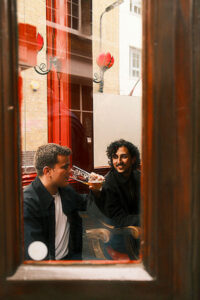
“I came across an article about a pub in East London called The Jolly Fisherman.
“In that article was just a whole world of story and I felt really emotional and conflicted about it.
“I spent the next two years trying to work out how I felt about it.
“It became a story about two friends.
“I can track it all back to that very specific BBC News article, and the reaction underneath it.”
What was it about the story that affected you so much?
“Well, it’s a couple of things.
“Where I’m from in West London but also in the West of Ireland, a pub is a really big centre of the community.
“I think of Murphy’s in Kilkee or Jono’s in Ealing.
“When you read about a pub closing down, you always feel a little bit sad.
“The article was about how planning permission had been put in to turn the pub The Jolly Fisherman into a mosque, a Muslim place of worship.
“I found that really interesting.
“What does that do to a community, that rapid community change and community shift?
“I just thought it was really interesting and really specific and touched on loads of things that we’re really thinking about in our British identity at the minute.
“I say to people that I’m British and Irish and I’ve always felt in my Irish side there’s a really clear sense of collective identity and on my British side, it’s really unclear.
“I’m really interested in why that is and how those things evolve.
“And basically one article seemed to have all of that in it.
“I couldn’t stop thinking about this pub and what it meant and what it must have meant to the people living on the street.”
You say as well as the story itself one of the things that struck you was the reaction to it..
“You can imagine the reaction.
“Some people would say, ‘Let’s not talk about this issue’.
“And I say, ‘That’s just going to get us into deeper problems if we don’t talk about these things’.
“What I’ve tried to do with this story and with the script and with the people that I’ve brought to the project is say, ‘Let’s look at this place, let’s look at this pub, let’s look at what’s happened here and then let’s tell a story that’s not divisive but that’s unflinching, that really tries to think about it with humour and empathy and really just tries to get to the heart of what this means to people’.”

Let’s speak about the two characters at the heart. Alan and Amir are friends on different sides of this division..
“In my early versions of it, I called them ‘friends before they knew that they were meant to be enemies’.
“They were boys on the bus together.
“On the one hand, you’ve got Alan and he’s born and bred Barking East London, that’s where he considers home and the Jolly Fisherman has always been on his street.
“And then Amir is British/ Pakistani, new to the area.
“The boys just become really unlikely friends but really good friends in a way that you have these people in your lives that you don’t really know why you get on with them so well but you do.
“As the boys start to become young men, the forces in both of their lives are trying to tell them what to think and who to be.
“That’s really difficult when you’ve got somebody that you love but also that the world is trying to pull you apart.
“The more I thought about the story, the more I thought about these two boys and about how actually I think they’re representative of all of us because everybody’s trying to tell us what to do and what to think, especially online and especially in these places where there’s only two sides of the coin and you have to be on one extreme or the other extreme.
“Actually people are just way more complicated than that and so trying to represent that in these two boys and in their conflict and in their friendship was the heart of it.”
Was it important to represent both cultures?
“Johnny Khan is the guy who’s going to play Amir and he helped me.
“I actually wrote this all from the white British boy’s perspective and I showed it to a few people and they said to me, ‘John, you’ve got to show the Muslim character as equally complex and as full and as human’.
“I worked with Johnny and it was one of the first things I said to him.
“I said, ‘Johnny. As somebody who’s grown up British/ Irish and somebody who knows about the last 100 years in Ireland and about Northern Ireland, I’m not afraid of religion and I know how divisive religion can be as a cultural thing and as a political thing and how it alienates other people’.
“I said, ‘I’m not afraid of that so I want to really learn and fully get your side of this’.
“What was amazing when we were working on the script together was he helped me so much with the understanding of how difficult this can be from the Muslim side as well.
“It’s hopefully a show that some people would say, ‘Oh, this is a show about a pub becoming a mosque, that’s kind of divisive’, and actually hopefully when people come and see the show, they actually see that it’s really about bringing these two guys together and finding the common humanity and the common friendship between the two.”
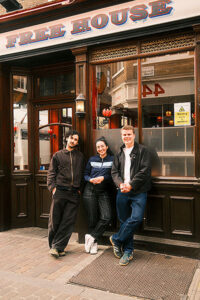
Let’s talk about the two guys involved, Alex Hill and Johnny Khan. What has it been like to see them bring this story to life?
“It’s the best bit.
“Alex Hill was the first guy attached.
“He took a show to Edinburgh two years ago called Why I Stuck a Flare Up My Arse for England.
“It was his first show out of uni and it blew up.
“We saw his show last year at Edinburgh.
“I had just finished an early draft and I saw Alex Hill in his show and I said, ‘That guy is Alan’.
“And I was like, ‘I need to get this guy to do the show because he’s so funny, he’s so vulnerable, he’s so good at acting’.
“And then once he was attached, it was about finding the right guy to play Amir and that was a challenge because I knew that I needed to find somebody that I loved and loved the show and wanted it to be what we’d hoped it would be.”
“Alan and Amir definitely feel like they’re from the same place but they’re from two sides of the same place and what does that mean?
“I think that that’s true of a lot of the stuff that I read and a lot of the stuff that I thought about when I was over in Ireland growing up and knowing the stories that we did and knowing the history that we did.
“It’s being from the same place but feeling like you’re from two different sides of it and how do you interact with somebody from the other side?”
The story is concerned with the individuals with the greater story happening around them. I mean people might be outraged about what’s happening but it’s not Amir’s fault..
“There’s the idea of blame but then also there’s big loss.
“Alan’s character has really lost something.
“When you lose something, you grieve for that and when you’re sad, sometimes that turns to anger and I think that’s happening a lot in Britain at the minute.
“Oisín Rogers, the guy who runs the Devonshire in Soho, was just on the Amol Rajan podcast talking about how much pubs matter, and you’ve got Gerry O’Brien, who ran the Churchill Arms in Kensington talking about how much pubs matter.
“I think in Ireland we’re so much better at saying pubs are really, really important places for everybody to meet and chat and have a great time, whereas in England they’ve become a bit Weatherspoons, a bit Green King, a bit kind of blanket.
“They’re not really community spaces anymore.
“They’re more just like corporate spaces that take money from you, especially the central London ones whereas in Ireland, especially in West Clare, that’s not the case, they’re community spaces.
“I was really interested in that and The Jolly Fisherman that I built is really built on community and heart and then what that means to community when you lose that.”
The thing is if there are no places for community to meet like pubs, there won’t be any community..
“Totally.
“I went to The Jolly Fisherman three or four times.
“I stood outside the pub and I met this lady from Clonmel and she said to me, ‘It used to be wonderful around here’.
“And of course there’s nostalgia but you could see it in her eyes.
“She was saying, ‘I knew this community’.
“And the community has changed so much in the last ten years that it’s just really interesting where communities now spend time and what happens to community if you take that space away from them?
“The pub didn’t just close as a pub and turn into a place of worship, it was closed for five years.
“If it became a Tesco, if it became a block of flats, would people be as up in arms?
“It’s interesting understanding that reaction.
“When I’ve sent the script to people the best compliment I can get is that, ‘You’ve really tried to understand this from everybody’s perspective and you haven’t tried to get any easy answers or be divisive. You haven’t tried to make it into sides.
“Somebody said to me, ‘Is this a political play?’
“And I said, ‘No, it’s about friendship’.
“But if you go above the friendship, you can see lots of political stuff in it but it’s just about friendship between two guys and a place on a street.
“That’s what I tried to base it in really, the friendship rather than thinking about politics or about religion or about the whole country.
“I just wanted to make it a really specific story about these two boys and their friendship.
“It brings up all the questions, I’m not sure it gives any of the answers other than to say, ‘Let’s all look at this and let’s all think about this and let’s all talk about this openly because if we don’t, that causes more alienation and also there’s all of this stuff going on about it’.
“But hopefully it’s just a good story from start to finish that makes you laugh, makes you feel something and then all of the political stuff and all of the things about Britain kind of come after.”
It’s already getting a lot of traction, The Guardian called it one of its ‘must see’ shows at this year’s Fringe..
“Yeah, we were delighted by that.
“We were surprised and delighted.
“We had a show on last year called Brixton Calling which was about the origin story to Brixton Academy and again about a friendship between a guy called Simon Parkes and his best pal, Johnny Lawes.
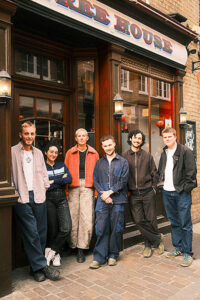
“Me and Al, the guy I do the writing, producing with, we’re clearly just interested in in friendships and in places and how that changes over time and what that means for everybody.
“We were delighted with The Guardian and hopefully the show picks up more traction when we’re up there.”
This sounds similar to Brixton Calling in that it is also a human story with bigger themes around it..
“Yeah, me and Al say we’re interested in the ordinary people at the heart of these extraordinary stories.
“For Brixton Calling, that was true and for The Jolly Fisherman, that’s true as well: Just ordinary people that happen to find themselves at these fault lines between either moments or places and then asking, how do these people react in these conditions?”
You had a play on in Dublin once, how did you come to put a show on there?
“I actually studied in Trinity.
“I did Irish literature in Trinity for a year.
“I studied English at Oxford and then I went over to Dublin and Dublin was this amazing place of creativity and drama.
“I saw a show every week and I was like, ‘I have to try and do this, I have to try and write one of these things’.
“There’s a James Joyce story called A Painful Case about a woman called Emily Sinaco, a fictional story about a woman who dies on the train tracks in South London.
“It’s in the Dubliners series, but you never hear from Emily Sinaco once in the story so I wrote a play telling the same story but from her perspective.
“It got put on in the Trinity Players and then it got taken to the Smock Alley.
“I’d love to bring it back but it’s not for right now.”
You have mentioned Kilkee in Clare, you also have family in Cork and Limerick..
“My dad is from Cork and my grandmother’s still in Cork.
“She’s just the most remarkable woman.
“She was in the Cork camogie All- Ireland team in 1956.
“She got to the All-Ireland final.
“She’s a huge inspiration to me.
“My grandad was the station master in Ennis for a long while.
“And then on my mum’s side is Paddy and Mary Burns and they are from Limerick so we’re all from the similar neck of the woods.”
Your ancestors came from Ireland to Britain. It seems like this is a story that could easily be told about tension between Irish community and the wider community in previous decades like the 70s, 80s or 90s..
“Yeah, totally.
“I hadn’t actually thought about it before this but there is the hostility that my mum and dad came into in London and what Irish immigration represented.
“It is just really relevant now, especially even in Ireland.
“There’s a lot of anti-immigration protests in Dublin and it’s really interesting to see how that’s playing out back in Ireland.
“I think it is a really relevant story.”
The Jolly Fisherman runs 5- 31 August at Underbelly, George Square as part of Edinburgh Fringe.
For more information and to book, click here.