


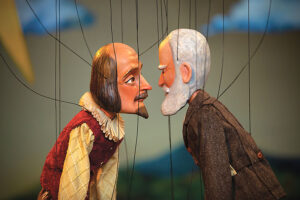
Damian Farrell and Gerry Hoban told David Hennessy about their puppet film voiced by Colm Meaney and Sir Derek Jacobi that explores the great Irish playwright George Bernard Shaw and his attitude to William Shakespeare.
Damian Farrell and Gerry Hoban’s Shakes Versus Shav will screen at The Irish Cultural Centre as part of the forthcoming Shaw Festival.
Starring Colm Meaney and Derek Jacobi, the short film has won numerous awards including Best Comedy at the Bloomsday Film Festival Dublin.
Irish documentary maker Gerry Hoban together and Dublin based puppeteer Damian Farrell co- produced the film based on George Bernard Shaw’s very last published play Shakes Versus Shav, a puppet play first seen at the Malvern Festival in 1949.
This new madcap puppet film production features the voices of Colm Meaney as George Bernard Shaw, and Derek Jacobi as William Shakespeare and was released to coincide with the 75th anniversary of the play’s original publication.
Bernard Shaw wrote Shakes Verses Shav barely a year before he died in 1950 at the grand old age of 94.
It was a final opportunity for the Irish playwright to celebrate his work and legacy, while taking a sly swipe at what he saw as Shakespeare’s overblown reputation.
Gerry and Damian took time to chat to the Irish World about Shakes Versus Shav.
How did the journey of making Shakes Versus Shav start?

Gerry: “We are not George Bernard Shaw experts at all but about seven or eight years ago, I did a documentary for the Beeb and for RTE on George Bernard Shaw.
“I was up in his house which he left to the National Trust which is up in Ayot St Lawrence.
“I was going through it with the caretaker and she opened an old shoe box and there was this 18 inch long wooden puppet.
“I’m going, ‘What the f**k is that?’
“A Beautiful 1949 original wooden puppet of Shaw.
“It transpired that it was made by one of Shaw’s friends, one of Britain’s greatest puppeteers, Waldo Lanchester.
“They were great mates and so Lanchester made a puppet of Shaw, made a puppet of Shakespeare and said to Shaw, ‘Will you write us a play? I’ve made the puppets, go ahead and write us a play..’
“And that’s essentially what happened.
“Shaw was a year away from dying so he wrote this little Punch and Judy show about who’s the best out of Shakespeare and Shaw.
“So it came about through me making a documentary on Shaw in general.
“I restored that puppet for that documentary.
“Damo helped me restore it and we used it a little bit in that documentary and afterwards Damo, who’s a master puppeteer/ animator, said, ‘Wouldn’t it be mad if we did something with the puppets and recreated that original play?’
“So that’s where Damo came in.
“It’s his mad idea, it’s his fault.”
Damian: “Gerry’s documentary won the IFTA for best documentary that year and a lot of people had commented on the puppet.
“That was what inspired me to have the conversation with Gerry, ‘Do you think there’s something in this 10 minute play that we could be very authentic about the puppetry and the history of it and the back story and make a short film?’
“That was the start of the journey.”
Gerry: “And to be fair, that’s when people like the Shaw Society kick in.
“They’re the people who are behind this Shaw Festival because they’re so enthusiastic about Shaw.
“When we went to raise money from the film board and other sources to make the puppet film, they gave us immediate support, not financial support but their imprimatur as the keepers of the flame of Shaw really helped get it over the line.
“They’ve been really good to us.
“We had a private screening for the Shaw Society about 12, 18 months ago in London which was a brilliant evening.
“They’re fascinated by it (Shaw’s work) and the fact that they’re now doing an entire Shaw festival is great because Shaw made the biggest mistake ever as an Irish person: He left and we don’t take great to people who leave.
“He left at the age of 19 or 20.
“His parents had split up.
“He went with his mum to London and so therefore I think he certainly slipped off the inter and leaving cert thing in Ireland, his stuff wasn’t on our syllabus as we were growing up.
“He, to an extent, became very English yet he remained very Irish.
“He had an Irish passport.
“He refused a British knighthood.
“He said, ‘I was born an Irishman, I’ll die an Irishman’.
“He was a big supporter of independence.
“He wrote a defence for Roger Casement when Casement was tried for treason after the rising.
“He’s kind of slipped between the cracks.
“The other problem about Shaw is his plays tend to be very long so after he died, these three and four hour Victorian or Edwardian plays or comedies of manners or critiques of capitalism or class or society just went out of favour but the people who look after his work now give you a pretty good carte blanche to edit if you need.
“Rather than having a four and a half hour bum number, you can really pare it down and when you pare it down, most of his principles: His pacifism, his feminism, his socialism, his vegetarianism, his anti-animal cruelty, his class warfare stuff is right on the button which I think is why he’s back around again.
“Dame Sian Phillips is opening the festival.
“Judi Dench was the honorary chair of the Shaw Society.
“When I did the Shaw documentary, I was able to interview people like Nicholas Hytner and Ralph Fiennes had just been in Man and Superman at the National Theatre.
“They were all quite eager to be interviewed for the documentary so I think his essence and his principles are coming back into fashion.”
Damian: “I think the very substance of the Shakes versus Shav play is that he’s trying to take the wind out of the sails of Shakespeare a little bit and in doing so kind of raise his own status.”
Gerry: “He had a very big impression of himself and he felt that people blew smoke up the a**e of Shakespeare a bit too much.
“He didn’t hate Shakespeare, he thought Shakespeare was an amazing writer.
“He just felt that worshiping of Shakespeare to the exclusion of others, including himself, was the wrong way so he came up with the expression, bardolatry.
“He felt that there was too much idolatry given towards the bard and equally he was quite pissed off that Shakespeare had his own adjective, Shakespearean so he created an adjective for himself, Shavian.
“The puppet show is essentially a chance for him to get an entire lifetime of bitterness at the attention shown to Shakespeare out of his system.
“He also was big fan of boxing.
“When he came to London first, because he was a failed playwright for years, he wrote reviews.
“He wrote opera reviews, he wrote music reviews, he also wrote boxing reviews for the newspapers so the fact that he, in puppet form, could get the chance to beat the crap out of Shakespeare- He was 93 years old, it must have given him a great thrill to write that.”
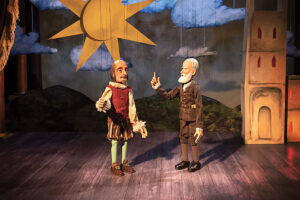
Damian: “This is the last thing he ever wrote that was published and it was performed as a live puppet play by Waldo Lanchester and his company late 40s, early 50s and that was it. It kind of just disappeared off the radar after that.
“There’s a line in the foreword to the play where Shaw says he believes that ‘the development of stage craft into film craft may destroy puppet charm’, and he warns people that if you add too many special effects and too much flourish to it and make the puppets too much like real actors, you kind of take away from it so we very much lent into that aesthetic in making this movie and things like Shaw as the puppeteer pulling the strings is a motif that’s appeared across a lot of critique of his work over the years.
“There’s some great illustrations done for New Yorker magazine and stuff like that where he is standing above two actors pulling the strings.
“He didn’t have much time for actors either.
“He just didn’t really want them to input anything or interpret anything.
“It was just like, ‘Stand there, read the lines, don’t bump into the furniture’.
“And that’s what he loved about puppetry, that it’s wooden and that gives you total control over it.
“There’s loads of great little touch points that make it good fun.”
Gerry: “He was a funny fecker.
“That’s kind of what’s lost sometimes but he was very smart.
“At the end of the day, it’s a 16 minute Punch and Judy show and if you know Shaw and you know his relationship to Shakespeare, there’s a whole layer of other stuff you get.
“And you don’t really need to know.
“At the end of the day, it’s just two puppets beating the crap out of each other.
“I kind of see it a bit like Waiting for Godot.
“By the end of it, they’re just exhausted, they’re punch drunk.
“It’s like the end of Raging Bull, they’re trying to fight to sort of say who’s the greatest and in the end, they’re both collapsed.
“They’re going, ‘Ah fuck it, let’s just chill, let’s just acknowledge that we’ve both done our bit’.”
Damian: “There’s this nice arc to it.
“It starts off quite silly and then goes quite poignant even in the way we puppeteer the characters.
“They start off feeling much more like Team America where they’re kind of flailing about, doing crappy boxing and then by the end of it, the movement is much more considered and much more pronounced and much more subtle so it kind of carries the weight of the words a little bit better at the end as well so there’s a lot going on in it when you start to dissect it.”
Gerry: “Dolly Parton said, ‘It takes a lot of money to look this cheap’.
“We put a lot of work into making it look so naive and kind of ramshackle, it’s intentionally ramshackle at times.
“And the most important thing from an Irish point of view as well is that we were talking about Shaw, he loved boxing, he used to be a boxing reviewer and when you’re trying to cast the voices or the characters of these two people who are kind of facing up against together, we’d always seen Shaw as a little Dublin gurrier Street fighter.
“When you see some of the archive, Shaw was quite well spoken and he had that kind of slightly lost Irish accent, posh Irish accent but we didn’t want to do it like that.
“We kind of wanted them to be a bit more, ‘Come on, you little bollix ya’ like outside a pub at closing time and so Colm was a great fit for Shaw and I’m delighted he did it.
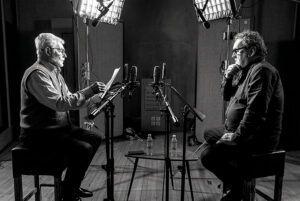
“And then we had to go for somebody who was proper Shakespearean so we asked Sir Derek Jacobi and Sir Derek Jacobi, to our great surprise, said yes and they were brilliant.
“So we had a day in the studio with them and they bought into it.
“When the two puppets are taking chunks out of each other, having a knight of the British Empire and Jimmy Rabbitte pretending to punch each other in a sound studio in North London was quite surreal actually.”
You must be pleased with the response the film has got..
Gerry: “I think it does resonate.
“I don’t think you have to be a fan.
“You can enjoy it on its own not knowing who the two puppets are but I think it does resonate.
“As I said at the beginning, we’re not experts so to have made something that is true to the mentality and people go, ‘That’s a really good interpretation of Shaw and Shakespeare and their attitude to each other’, I was quite choked with that.”
Damian: “Everybody knows Shakespeare, a lot of people know Shaw, very few people know that he wrote a puppet play as the last piece of work that he did.
“People go, ‘We like this but what is it? Is it animation, is it a drama, is it a comedy, where does it sit?’
“The project has picked up a couple of awards. It has picked up a comedy award.
“It has picked up best literary short.
“It has picked up awards at an animation festival even though it’s technically not animation.
“It has picked up an audience award because the audience just go, ‘We’ve never seen this before’.
“It doesn’t just fit into one box.
“It fits into multiple boxes.”

We have spoken a lot about Shaw’s feeling about Shakespeare but what do you think Shakespeare would have thought of Shaw? Would it really have been carnage if they met?
Gerry: “Shaw was definitely a celebrity in the age of celebrity.
“He had an ego the size of Manchester, you have to presume that Shakespeare in his pomp would have had the same adulation and ego.
“Put two alpha males with big egos, they probably would have ended up taking clumps out of each other.”
Damian: “It would be interesting if those two puppets landed on Shakespeare’s desk and Waldo said to Shakespeare, ‘Will you write me a play about Shakespeare and Shaw?’ and see how that would turn out.
“There would probably be a lot of similar themes.
“There would probably be a lot of the same kind of ideas in there for sure.
“But it’s an interesting notion.
“They both had a way with words.
“They fought with their words so their words were sharp and cutting and witty so if Shakespeare was biting back, they would be as cutting as Shaw’s words would have been.
“It’s not a true version of Shakespeare, it’s Shaw’s version of Shakespeare and it’s written to fulfil his vision of what he thinks Shakespeare was like.
“He writes Shakespeare as a slightly puffed up buffoon or somebody who likes his own self-importance and that makes it all the more entertaining and all the more fun when they beat the crap out of each other.”
A festival like this shows how important Shaw remains, doesn’t it?
Gerry: “I’m very much looking forward to it.
“It’s the very first Shaw festival which kind of shows that he’s only just coming out of the shadows again if they’re only having the first big Shaw Festival now.
“There was a big Shaw festival in Ireland last year.
“It’s a resurgence.
“I would like to see Shaw back on the syllabus.”
Shakes Versus Shav will screen 7pm Sunday 12 July at The Irish Cultural Centre as part of Shaw Festival.
The inaugural Shaw Festival takes place Friday 10- Sunday 12 July at The Irish Cultural Centre in Hammersmith. For more information and to book, click here.
