


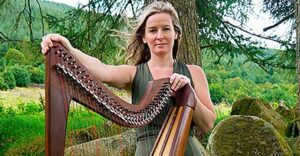
Singer- songwriter Bróna McVittie, formerly of The London Lasses, told David Hennessy about her forthcoming album and accompanying book all inspired by Irish myth and folklore.
Rostrevor singer‑songwriter and harpist Bróna McVittie returned recently with the single, The Stolen Child, the lead single from her forthcoming album Supernatural, due for release later this year. The album is a companion to McVittie’s recently published book A Way with the Fairies, a richly woven folklore anthology exploring Irish fairy lore alongside mythic tales from across Europe.
A trained biologist and lifelong lover of mythology, McVittie is known for blending traditional song with nature‑infused lyricism and shimmering experimental soundscapes.
Her previous albums We Are the Wildlife (2018), The Man in the Mountain (2020) and The Woman in the Moon (2022) established her as a pioneer of cosmic folk, earning acclaim from MOJO, Uncut, The Independent and BBC Radio, and leading to performances at WOMAD, Celtic Connections, the National Concert Hall Dublin, Kings Place London and festivals across the UK and Ireland.
In 2022 The Irish World saw her at the Return to London Town festival in Cricklewood.
This really was a return to London for Bróna as she sang with the London Lasses for more than ten years.
On the album each track mirrors a tale from the book, reimagining myths, poems and folk narratives through McVittie’s distinctive blend of harp, guitar, ethnic instrumentation and experimental electronics.
It also features three international guest artists: flamenco guitarist Antonia Jiménez (Spain), bandurist Anastasiya Voytyuk (Ukraine) and vocalist‑composer Jausmë (Lithuania): each contributing to a single track and expanding the album’s reach across Europe’s storytelling traditions.
Bróna took time to chat to the Irish World about the new project.

How did The Stolen Child come about?
“I don’t know if you’re familiar with the WB Yeats poem of the same name.
“It would be one of his earlier poems and it’s very much influenced by the landscapes in Sligo.
“He used to go to Sligo because his mother was from there and I think his idea of the fairy world is quite shaped by Sligo landscapes.
“I’ve been a fan of his since I was a teenager so for me, it’s a great honour to take his words and to put my music to them.
“It’s a musical interpretation of his poem which is about a fairy taking a child off to the fairy world so crossing the divide between this world and the other world.
“And in the chorus line, there’s a line that says, ‘Come away, O human child!
To the waters and the wild
With a faery, hand in hand,
For the world’s more full of weeping than you can understand’.
“And it seems to me that that lyric seems very relevant today because in the world that we live in now, things just seem to go from bad to worse and the idea of escaping to a fairy world is quite appealing right now so perhaps it could be therapy for someone to transport them to another place and certainly that would be my intention musically.
“And that’s something that people have said to me, ‘I love your music because it transports me to another place’ so I feel very honoured then to be helping them out in that way.”
You have been very inspired by fairies, folklore and other myths not just for this album but also for the accompanying book. It’s a subject you are very drawn to..
“Yeah, for the past ten years, the first three albums that I’ve released have all really been drawing upon the well spring of folklore and mythology which obviously we have in great abundance of here in Ireland and so it felt like time to maybe invite people to dive a bit deeper into the inspiration behind the music.”
Has it always been an area of interest for you?
“Absolutely, 100%.
“I think it has been since childhood.
“I grew up in Rostrevor where I am also now based again.
“Although I lived in London for 20 years, I’ve been back here for 10 years and that’s when I started my solo career in music.
“I think that fairies are something that people locally here would not necessarily nowadays admit to believing in but if there was a fairy tree in someone’s garden, they will not move the fairy tree but people who come in from outside, who don’t know about these things, can get a bit gung-ho.
“If they want to build their house on a nice plot of land and there’s some fairy trees there if they remove them, then bad things happen and we have these stories in abundance.
“While people will not necessarily admit to believing in fairies like I do, they will never move or harm or damage a fairy tree.
“It’s funny that you would have that superstition but then say, ‘Oh no, it’s not because I believe in fairies’.
“I think it’s quite funny.
“We’re a bit of a strange mixture of the things that we’ve believed since childhood and then things that we’ve come to believe in our adult lives.”
A lot of fables and other messages are simply warning to respect the land, isn’t that right?
“It’s true and I think people nowadays maybe have less respect for the land than we used to and maybe because we now live in such an immersive, global, digital world there’s also a little bit of a risk that people’s own folklore and heritage from their country or even a particular area or county may be something that young people today might grow up unaware of unless their parents particularly have an interest in it.
“It seems to me that if we lose that knowledge, that seems to me a bit of a shame so that was another inspiration really for putting the book together.
“It’s collected tales from across the island and also there are some European tales in there so I invited collaboration from some amazing female artists.
“One is a female flamenco guitarist from Spain called Antonia Jiménez.
“She composed a piece inspired by a folk tale from Spain about a witch who uses her powers for good even though the devil tells her, ‘You must only use your powers for bad’.
“There is an old Ukrainian folk song which was given to me by a Ukrainian singer and player of the bandura, Anastasia.
“She has written a fantastic song called White Bird which is very, very much influenced by her experience of living in Ukraine at the moment with the war and the story in the original old song that inspired her was about two doves, one of them gets shot down by a hunter and the dove that’s left, the female dove, can’t find a new mate.
“She doesn’t want to.
“Anastasia’s song is essentially a little bit like the phoenix rising from the ashes.
“It’s to do with retaining our integrity in a situation of conflict and war so that’s a beautiful contribution to the album and the book.
“And then the other European collaborator is a Lithuanian singer Jausme and her song Brothers is inspired by a Lithuanian folk tale where twelve brothers are turned into ravens and their sister goes on an epic mission to get them restored to human form.
“So in addition to the Irish fables I’ve collected, we have those European fables as well so it’s opened the project out beyond my interest in Irish folklore and mythology.
“It’s been a really interesting journey and I still feel like I’m beginning on the journey because this book feels like I’m only scratching the surface in a way.
“There are so many others that I could go back to so it feels like almost it could be like a lifetime project in a way.”
What started you on the process of collecting the stories?
“We have a festival here in Rostrevor called International Fiddler’s Green Folk Festival and we have people come from all over the world and one of those people was a good friend of mine, Dr Bruce Victor who is a psychiatrist and musician that works with me.
“I’d been to a gig in the festival and Bruce was at the gig separately.
“I went with my mum and then we bumped into each other afterwards and then we all walked together to my house.
“My mother-in-law was in the house and we sat down.
“We were just chatting and somehow the conversation got to fairies.
“My mum brought me up to believe in fairies and she still believes in fairies and she was talking to my mother-in-law, who’s from Lancashire originally, so she remembers her father telling her folklore tales.
“We were just chatting about fairies and it was just an everyday conversation and our American friend Bruce, I could just see him sitting there and his jaw was kind of dropping and he was thinking, ‘Are these people for real?’
“And then afterwards, he turns around to me and he goes, ‘Here, maybe you should do your next album on the fairies…’
“And from that conversation, the seed was sown in my head and then next thing I knew, I was writing a grant application to the Arts Council of Northern Ireland and sketching out this project that involved international collaborators and all sorts.
“I was basically just thinking, ‘Dream big’.
“And then I was very pleased that the Arts Council agreed to give me the money.
“And then I was like, ‘Oh God, well this means I actually have to do it now, doesn’t it?’
“I’m a little way down the road now but I’m pretty pleased with the way it’s working out.”
Nature is a theme that runs through all your albums to date, isn’t it?
“Nature has always been an interest of mine.
“I actually studied biology at university and so I have this sort of molecular view as well of what’s happening in the natural world and I find that fascinating.
“I think that there’s many, many other artists as well that are very influenced by the natural world but I would say actually that all the folklore is very much tied to the land so in all of the stories and songs, there are references to place and so the two things are very much tied together.
“Our folklore is often shaped by the landscape and the flora and fauna are obviously part of that landscape so I see the two things as being intertwined really, one doesn’t exist without the other.”
Was it studying biology that brought you to London?
“I actually went to Oxford and I then moved down to London after I had finished my degree because I was already starting out on my musical journey.
“I did my first gigs ever in Oxford when I was at uni.
“Then it seemed that London was a good place to go and it was more the music that I was passionate about than actually doing some work related to biology.”
Did you grow up playing in sessions and things like that?
“No, not at all.
“In fact if I had been born a Catholic here in Rostrevor, I would almost certainly have grown up with the music and the sessions but I was born into a Protestant family and it wasn’t really part of our culture.
“I didn’t grow up with traditional music and really, to be honest, I only really got into it in London through the London Irish music scene so very much thanks to Karen Ryan as well for inviting me to be a lead singer for the London Lasses.
“That was actually my first introduction to the whole trad world which I absolutely love.”
So you moved to London and were not long then linking up with Karen and all?
“Yeah, it’s interesting.
“I think it was like being away from this country somehow, I felt a need to make a connection with home and so I actually came back and went to a Gaeltacht over in the west coast in Donegal near Gweedore and I spent some time with a native singer, a sean-nós singer and I learned some songs from her to start off songs in Gaelic Irish.
“Then when I came back to London after that trip I thought, ‘I really want to keep singing these songs’ so I started up an acapella group and I got four or five other lovely singers to create harmony versions of the sean-nós songs, and we used to sing them at festivals.
“One of the festivals we sang at was Return to Camden Town as it was then.
“That’s how I met Karen because she first booked my acapella group to perform.
“Karen heard me sing in one of the folk clubs and basically that’s how I got into the London Irish community.
“It was through my own desire to make that connection to back home, to what I had never been connected to because I didn’t grow up in that community because it was very segregated here.
“Rostrevor would be predominantly Republican. The schools here are Catholic schools.
“The state school where I went when I was a kid, there were 30 kids in the entire school and that was the Protestant community in Rostrevor so we were very much in the minority and we just didn’t meet each other because we weren’t doing sport together.
“I never had the opportunity to learn fiddle.
“I would have loved to learn fiddle actually, I have tried but it’s too late now.
“But I do love the fiddle.
“It’s an amazing instrument.”
Are things different now in that regard with segregation etc?
“The school where I went is now a very successful integrated primary school.
“They have kids from both sides of the community and they have kids from other cultures as well so I would say that definitely the opportunities have opened up now.
“I have spoken to some Protestant parents who actually would send their kids to play Gaelic football and I think that’s fantastic because it was very much, like I say, when I was a child, there wouldn’t have been any consideration that you could have done anything like that.
“I don’t know why.
“It’s just that’s the way it was but now there definitely are opportunities for people to explore traditional music and religion doesn’t have the same segregation.
“Segregation still exists in Northern Ireland unfortunately, there still is segregation particularly in some areas.
“I mean certain areas of Belfast, for example, you still find communities are segregated but even in rural areas, you’ll find segregation still exists but the people who are willing to step outside of their comfort zone are changing things and the young people coming through now as well working with different political parties, they’re much more open minded.
“They don’t have the same entrenched views as our more mature politicians who just seem to get stuck on the same things all the time so it’s definitely changed for the better.
“It’s a much nicer place to be than it was when I grew up here.”
You have played big events like Celtic Connections and Return to London Town here in London, what leaps out as a highlight of what you have done?
“In terms of performance over the years, there’s two that stay with me.
“Getting to play the National Concert Hall in Dublin was just amazing.
“Some concerts you can really feel like you’ve made the connection.
“It was just such a lovely gig and the audience were just so responsive.
“I find that that’s something that I love about the difference between performing here in Ireland and in London.
“Audiences are quite tough in London, you don’t know they’re enjoying themselves.
“They might be but they don’t let you know.
“We do here.
“We’re much more open and maybe a bit more on the surface enthusiastic than audiences in London can be.
“The other one that really stood out to me was doing WOMAD.
“That was just so lovely again because you could see the audience and you could just feel everyone reacting.
“You could see people moving to the music and it’s such a wonderful festival so that was a real treat as well.”
The Stolen Child is out now.
A Way with the Fairies is out now.
Supernatural is out around Halloween.
For more information, click here.
