


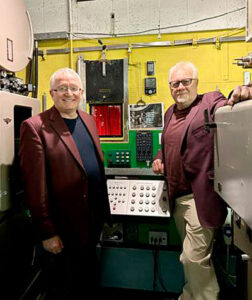
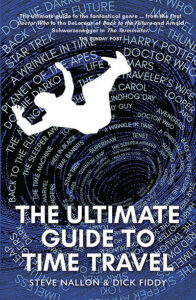
Steve Nallon, well known for voicing Margaret Thatcher on Spitting Image, told David Hennessy about his new book, written by Dick Fiddy, The Ultimate Guide to Time Travel.
Steve Nallon, best known for voicing Margaret Thatcher on Emmy-winning ITV show Spitting Image, has teamed up with British Film Institute archive television programmer Dick Fiddy for a new book that discusses time travel on the small and big screen, The Ultimate Guide to Time Travel.
In it Nallon and Fiddy look at cultural hits such as Doctor Who, Goodnight Sweetheart, Back to the Future and It’s a Wonderful Life seeing what they share and establishing what the ‘rules’ of time travel are.
Steve’s CV also includes voicing the likes of the Queen Mother, David Attenborough, Brian Clough, Bruce Forsyth, Alan Bennett and Roy Hattersley for Spitting Image which attracted 14 million viewers, puppeteering for Brian Henson-directed movie Muppet Treasure Island, co-writing BBC Radio 4 programme The Nallon Tapes, playing Cissie in stage production Cissie and Ada and writing Jeremy Vine featured Steve Nallon’s Ghost Stories and his debut novel The Time That Never Was.
Steve took time to chat to the Irish World about the new book.
Why is time travel so fascinating to you?
“Well I’m a child of the 60s.
“If you were a kid in the 1960s you watched stuff like Doctor Who, Catweazel, The Time Tunnel.
“Time travel was just there as children’s entertainment but it was partly educational because it was a way of taking them back to the Elizabethan age and introducing them to say Elizabeth I.

“About 10 years ago, I started writing two novels for 12 to 14-year-olds, but it’s basically a time travel story.
“When I was putting that together, I started making a list of all the films, TV and books that had used time travel and how they did it, the rules that they had created.
“What I discovered was every series, book, film had different rules and I came to the conclusion that you can have any rule you wanted in time travel but you have to be consistent.
“The publisher, Luath Press, said, ‘Steve, this is a book’.
“And I said, ‘Well, I’m happy to develop it but let me do it with Dick Fiddy’ who is one of the world’s leading experts on television and film so we wrote the book together.
“I think it’s an interesting topic because it’s like any science fiction or supernatural story or fantasy story: It isn’t the nature of the time travel, it’s what you do with it.
“You can have a romantic time travel.
“You can have adventure.
“It’s a way of looking sometimes at social issues, sometimes it’s personal psychological issues.
“A Christmas Carol is a time travel story of sorts which reminds Scrooge of his childhood.
“The rule there is that ‘these are but shadows’, you can watch them. You can’t interact with them.
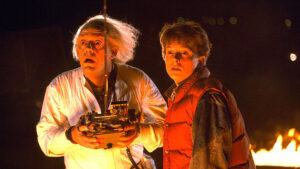
“But of course Marty McFly in Back to the Future, he not only interacts with the past, he also interacts with his mother and his father which is going to cause all sorts of problems.”
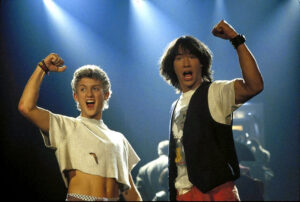
As you say there are all sorts of directions you can go with it like say a great series of films like Back to the Future but then you have a terrifying glimpse of the future like The Terminator or silly things like Bill & Ted..
“All of them are doing something slightly different.
“Terminator’s a warning about technology.
“It’s a little metaphor saying, ‘Just be cautious about developing your technology’.
“There are films like Sliding Doors where you focus on one particular moment that you think has changed your life.
“And with Marty McFly’s Father, it’s a punch when he punches the bully.
“I’m less convinced that that’s actually the case but human beings, because we like stories, we like to go back in memory and time and say, ‘This is the moment. This is the great moment when my life changed’.
“My own theory is that those moments are very few and far between.
“But time travel stories focus on those moments and the road less travelled.
“But, as you say, there’s Bill and Ted’s Excellent Adventure which is very silly but it’s silly in a historical sense because, if my memory is correct, they go and get people like Socrates and bring them back and have fun with them so there’s sort of an educational side to it as well.
“And now I’ve written the book and I mention it, people are always challenging me.
“In fact somebody got me the other day.
“They said, ‘Have you heard of this film?’
“And I said, ‘No, I haven’t’.
“He said, ‘Well, it’s a time travel film. Why haven’t you heard of it?’
“I said, ‘Well, there’s hundreds out there. It’s not always possible to watch every single time travel story on Netflix’.
“I spent a lot of time researching two Korean television series that were very good.
“Korean television is up there with the best of them now.
“And there’s one from Turkey.
“And there was several in America.
“Travellers was one.
“There was a time probably about 10 years ago when you put on Netflix, you couldn’t move for time travel stories.”
As you say it is a genre that has remained fascinating back as far as the 60s..
“Well, here’s the irony.
“Back to the Future was turned down and the reason why it was turned down by pretty much every studio, it was picked up eventually by Universal but the point was that everybody turned it down for the very simple reason: Time travel movies didn’t make money, and that’s true.
“There was a prestigious one that was the very good version of the HG Wells story, The Time Machine but on the whole pre- 1980s and pre- Back to the Future, time travel didn’t make money.
“And then, of course, suddenly within a couple of years of each other, you get Back to the Future and The Terminator and then suddenly everyone said, ‘We’ve got to make more time travel movies. Time travel movies make money’.
“Exactly why it hit the zeitgeist at the time, I don’t know.
“The thing about Back to the Future was it was set in 1985 but it was written by guys who were teenagers in the 50s and it was a nostalgia movie.
“For a generation that would have been in their 40s or 50s in the 80s, they’d have gone to Back to the Future and said, ‘Wow, this is a nostalgia movie. I remember these songs. I remember dressing like that. I remember the hairstyles and prom dates and all that sort of stuff’.
“So there’s an element of nostalgia in it.
“It’s a box ticker really, time travel, because you’ve got a philosophical angle, a psychological angle, a nostalgia angle, a comedy angle, an action angle, sociological action.
“You can just decide which of those your time travel story is going to cover, romantic, whatever.
“I know people who I told about the book and they say, ‘Well, I’d never read that because I don’t like stories about things that can’t happen’.
“I think that’s very limiting because nearly all my writing comes in that slightly fantasy, supernatural version of storytelling which allows you to explore all sorts of things in an entertaining way but also there’s a little message that is there as well.
“I don’t like karate movies.
“I don’t really get martial arts and things like that but people do say to me, ‘Steve, they’re not about karate, they’re about male bonding’, or ‘they’re about mentor figures’, or ‘they’re about fathers’.
“I understand that but I’m not into martial arts movies.
“Maybe I should be more open to it but that’s a slightly different point because that’s the sort of violent thing I don’t like.
“The point is if you write a ghost story and your ghost story’s about the ghost, it’s not a very good ghost story.
“And if you write a time travel story that is about how you travel back in time, it’s very unlikely to be a very good time travel story.
“It’s what you do with it.
“It’s what you do with your TARDIS, it’s not the TARDIS itself.
“It’s what you do with it, where you put it.
“The point is the TARDIS always goes where there’s an interesting story.
“That’s what Steven Moffat said when we interviewed him.
“He said, ‘The thing about the TARDIS is it’s a vehicle, literally a vehicle to take the doctor to an interesting situation and interesting characters.”
The Back to the Future vehicle is the Delorean..
“I think Back to the Future, particularly the second and third ones, they follow the rules incredibly well.
“They don’t break the rules.
“They explore the rules of time travel.
“There’s a scene where Doc actually draws time on a blackboard and explains it and that is probably one of the best explanations that there is.
“It’s just brilliant in its logic.
“Many stories have some sort of way of working out whether what they have done in the past is altering the present.
“What happens in Back to the Future is it’s the polaroid image and when Marty and his family begin to disappear, that’s when it’s clear that he hasn’t altered the future in a good way and when they all reappear, he knows that he’s going to be safe.
“You just need that image.”
Let’s change topic and talk about Spitting Image. You did many voices including the late Margaret Thatcher. You still enjoy doing her voice?
“Yes, always happy to do her.
“Well, she’s a fun character.”
Although you inhabited her as a character, you were not a fan of her politics, were you?
“Not particularly.
“Now I’m older I see her importance and I see why historians particularly rate her very highly.
“She is rated very highly compared to her predecessors such as Harold Wilson or Callaghan.
“Wilson was a brilliant man but he never fulfilled his promise and other prime ministers that followed, for all sorts of different reasons, history will not be kind to them and I think history is beginning to be kind to Mrs. Thatcher.
“I didn’t vote for her but I can’t go back in time and I wouldn’t want to go back in time and change my vote anyway. I’m happy with who I voted for.”
What feedback did you get from the ‘establishment’ to the impressions and what you were doing with Spitting Image?
“I think their attitude was that satirists and the Spitting Image people were very negative and didn’t achieve anything.
“Her attitude was that there was a negativity there and what they did was not achieve anything.
“Of course I don’t think she understood that what we were achieving was the fact that 14 million people every Sunday night just laughed at her.
“That’s a great achievement, making fun of historical figures.
“Suppose Spitting Image never had existed, would the world be different? Would the political world be different had Spitting Image not existed?
“I don’t think it would have changed election results but we would probably have more deference towards politicians and those in charge than had Spitting Image not existed.
“Had Spitting Image not existed, deference would be stronger.
“Another way of putting that is that Spitting Image caused a lack of deference to authority figures whether they be in the royal family or whether they be politicians.
“Now whether you say that is a good thing or a bad thing, that’s entirely up to your politics but I do think that Spitting Image was a game changer in that sense.
“I was involved in a play doing voices recently. It was about Liz Truss and a nice audience member after the play said, ‘What impact did Spitting Image have?’
“And I said, ‘Well Spitting Image, in a way, gave us Liz Truss because there were so many very able people from politics or from business or academia or from the unions that thought, ‘I don’t want to go into politics and have the piss taken out of me and be open to ridicule. I don’t want that, why would I? Why would I want that for me or my family?’
“I think the calibre of politicians has gone down in the last 30 years and we ended up with Liz Truss.
“It’s a silly point and I’m not seriously blaming Spitting Image for Liz Truss but what you can say is the calibre of politicians that we have now on all sides is not a fraction of what I remember in the 1970s and 80s.
“It’s just nowhere near the ability of the people when actually in the Labour cabinet of the 1970s pretty much any of them could have been Prime Minister: Roy Jenkins, Denis Healey, Shirley Williams, Barbara Castle.
“These were very, very able people.
“Tony Benn in his own way.
“But I just don’t see that in any party at the moment.”
Do you have Irish heritage?
“I’m Irish.
“I’m Nallon, right?
“We traced our history.
“We think we come from County Mayo.
“My theory, and it’s only a theory, is that there were very few Nallons in the world.
“Nolan, of course, is an Irish name.
“I think that one of my ancestors came over from Ireland, possibly in the potato famine and possibly they were illiterate or possibly the person at Liverpool just put the name wrong and actually created the name because it doesn’t really exist much prior to the 19th century.
“There’s very few of us, and we’re all Catholic.
“No proof of this but we think we come from County Mayo.
“That’s my theory but of course I’d have to be a time traveller to prove it.”
And have you got to spend much time in Ireland?
“I’ve been to Dublin.
“I worked there.
“I went on the James Connolly tour and around the post office where all the bullet marks are still there.
“I said, ‘Oh, by the way, when I was at University, I played James Connolly in a play’.
“The tour guide said, ‘I want to buy you a drink. You played James Connolly’.
“And I said, ‘Well, I don’t know much about the politics of it. I remember reading it about the time’.
“But he was terribly impressed that I’d played James Connolly so he took me to an Irish pub and bought me a drink.”
Back to the book and the idea of time travel, since it is such a fascination for you, do you think you would return to it in the future?
“We might update the book.
“We did a bit of an update with some of the stuff that had recently come out but it got to the stage where we just couldn’t keep up with the time travel stories that are out there.
“I think it’s an odd book but I think its appeal will be for anybody interested not just in time travel but the philosophy of time.
“We talk a lot about movies and television series but we also show how certain plays, films have taken the science of Einstein and also gone back to Aristotle and his understanding of time and where God appears in time and scientific developments and so on.
“We’re not experts in any of these areas of theology or philosophy but it covers a wide range.
“It’s not just how the TARDIS works, it’s for fans but also those who are philosophically interested in the nature of time travel and time itself.
“It’s a wide base.
“Even if you’re not naturally interested, it’s an interesting thing to talk about.
“As we say there’s a lot of different ways you can go with it and that’s what the book is able to explore.
“We tried to explore as many of those as we could.
“Nowadays you get Westerns that are time travel.
“You get sitcoms that are time travel.
“It’s in all genres.
“It’s not just the TARDIS or the DeLorean, it’s in a wide range of genres.”
The Ultimate Guide to Time Travel by Stephen Nallon and Dick Fiddy is available here.
