

Chiké Okonkwo is starring in Oscar Wilde’s An Ideal Husband at Bristol Old Vic, bringing fresh energy to the classic play. He spoke to David Hennessy about the production, its themes and why Wilde’s work still resonates today.

Oscar Wilde’s classic An Ideal Husband is coming to Bristol Old Vic straight from its run at Lyric theatre in Hammersmith.
For what must be a must, it is being brought to life by a completely black and mixed race cast.
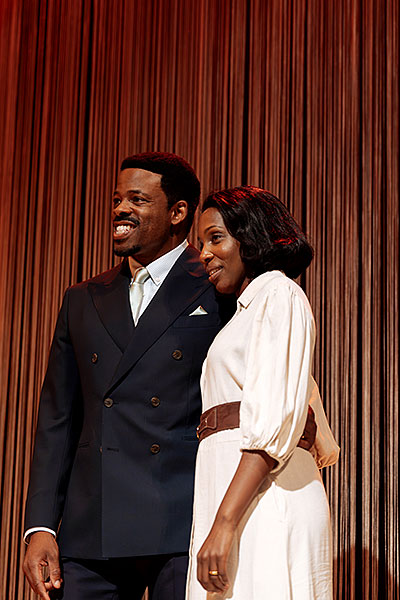
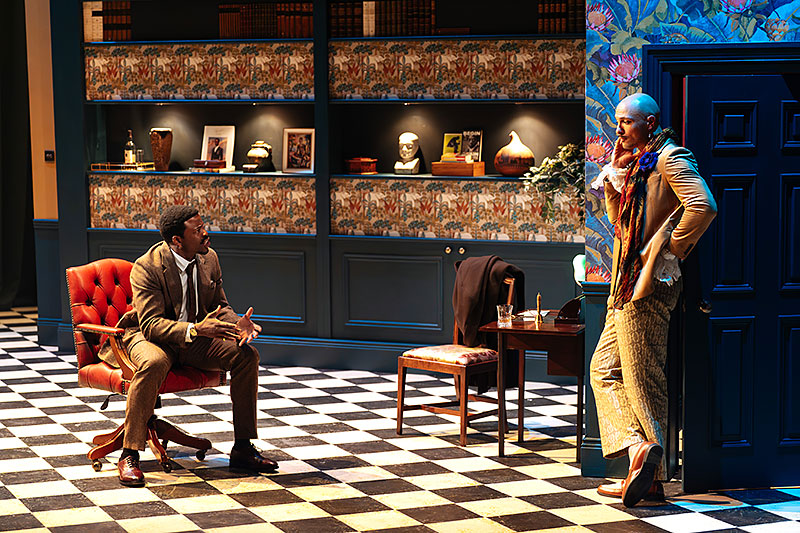
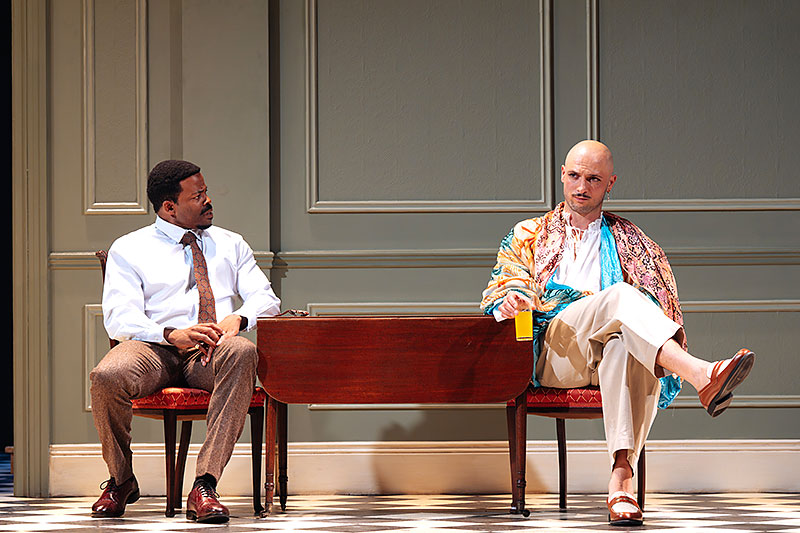
Nicholai La Barrie directs a cast that includes Chiké Okonkwo as Sir Robert Chiltern.
First produced in 1895 An Ideal Husband is a tale of blackmail, political corruption and public and private honour.
Sir Robert presents as the ideal husband but when Mrs Cheveley and threatens to expose secrets from his past, his marriage and good name are all at risk.
Chiké took time to chat to The Irish World about the play while it was in its Hammersmith run.
What drew you to the play and the role?
“I live in New York. I’ve had a big portion of my career in the US and done a lot of TV and film out there but I started my career in the theatre here.
“In actual fact I used to live just about a mile away from the Lyric Hammersmith when I was at the beginning of my career.
“Actually when I was starting out, it was a dream to be able to work at a theatre like the Lyric where It’s so historic and it was like my local theatre growing up so I’m grateful that the opportunity’s come now for me really.

“This play came about because I was looking to do theatre again after a long time away and to do classics.
“I did a lot of classical text in my career but to do a classic is just such a brilliant thing because you get to see from over 130 years ago the resonances in the text today.
“So that was the real reason, the real thing that drew me to it: The idea that Robert Chiltern, the character I play, is a success in every metric you can use but he also is fallible and human.
“I really love to see how those ideas land in the room every night with his fallibility.
“I did have a lovely zoom with Nicholai La Barrie, the director, and Heather Basten, the casting director, and it was sort of a meeting of minds from the very first conversation, we had a really nice chat, we had similar ideas or thoughts about why the play was relevant to today and what Robert Chiltern represents within the play.”
Tell us about those resonances today because it strikes me as a very modern story despite being over 100 years old. Do you find the themes very prescient still?
“Absolutely.
“In fact when I was reading it and considering it, the Strait of Hormuz had just been closed and people were making a lot of money from insider trading sort of things or that was the allegations and to see then that being something at the centre of this play, it was the building of the Suez Canal where my character Robert Chiltern made his fortune and it was before poly betting, it was before the crypto markets but it’s a very, very similar thing that’s happening.
“And then also political scandal has happened throughout time, throughout British history, throughout American history and this is a particularly bad scandal and he wouldn’t be able to survive it so I think about the resonances today with Peter Mandelson or whoever it might be.
“There are constant reminders that power unchecked eventually catches up on people if they’re not smart or moral, one of the two.
“I loved that idea.
“I love the fact that I was reading this play whilst there were things happening in the real world right now that were very, very resonant and also the fact that we are all fallible.
“I really wanted to explore that idea more of, what does it mean to make a mistake and if you’re earnestly, truthfully sorry and apologetic, is there a way back or do we just get cast off into the wilderness forever?
“That was another reason for me to want to dig deep into the text and it really hasn’t disappointed.”
Oscar Wilde remains part of the zeitgeist. Even in recent times we have seen The National doing The Importance of Being Earnest and Sarah Snook starring in The Picture of Dorian Grey..
“Truly.
“When you start as an actor, it’s a great thing about growing up in the British theatre that you read everything, you read as much as you possibly can and so I remember reading not only his work, his novels, his plays but also about him because I was just always really taken by the idea of these artists who speak to their times and who are not afraid to speak truth to power.
“This was the last play that Oscar Wilde wrote and was produced.
“He was arrested shortly after the opening and then his name was removed because he was deemed controversial at the time but that ability to speak to the society he lived in and to really put it under a massive magnifying glass, I just find that so brave.
“I think there have been a number of artists I’ve respected and loved throughout time whether it be Bob Marley or Marlon Brando or Paul Newman, people who would speak to their times because art is apolitical but then it’s a sort of political act getting up on a stage every night and speaking these words.
“I just really respect the fact that there are artists who have come before who’ve sort of staked their lives and their careers on the fact that they’re going to stand up for what they believe in.”
Themes in the play such as respectability, secrets, scandal and forgiveness are seen as being something very personal to Wilde and the times he was living..
“Yeah, it feels it and that’s the great thing about these revivals that have happened of a number of his plays because when you’re doing it night after night and seeing how each audiences engage with the material, you just get to go deeper and deeper and deeper and that central theme of forgiveness, of not placing people on a pedestal, of loving people for who they are, it seems to me that it was a real preoccupation of his at the end of his career and, sadly, the end of his life and he just wrote about it so eloquently in this play and in other works of his.
“It’s funny.
“I was actually introduced to his work very, very young.
“I was about 12 or 13 when my local drama group in southwest London did an adaptation of some of his short stories.
“We did The Selfish Giant in the first half and the Happy Prince in the second half, both beautiful short stories but I think both stories really look to his inner morality, what his desires were for the world.
“The Happy Prince is a really beautiful story about this statue who wants to give of himself to the people that he sees beneath him and, I think, really helped to shape a bit of my world view.
“I played the Happy Prince when I was in that production and it’s amazing to come back and revisit his work 30 years later.”
This is, to my knowledge, the first time it has been done with a fully black cast. Does that bring a new perspective?
“Yeah, it’s funny because the text is fairly intact.
“We obviously bring it up to date just because we don’t ride in carriages anymore but then we also choose to keep things like letter writing instead of sending an email or a text.
“There were moments where we felt like it was worth stripping away, we didn’t really add too much, we didn’t add too much at all actually, it was more about stripping away and I think in that we managed to hold on to the very core of Oscar Wilde’s ideas.
“I tend not to think too much about the sort of cultural makeup of the people on the stage but I do love that there are nuances that perhaps our audience members will respond to in a different way because of who is on the stage in front of them.”
Are you aware they are also simultaneously staging this play at the Gate in Dublin?
“Yeah, I did see.
“I love it and it shows that obviously there is something in the zeitgeist, there’s something in the air that people felt that this was a relevant time to tell this story.
“I’d love to see it if I could get over but it’s really nice to know that there are other people exploring this as well.
“Of course we’re here in London at the Lyric Hammersmith.
“We’re heading to Bristol after this so we’ll be at the Bristol Old Vic, a beautiful old historic theatre and a great place to have these words spoken again but it’s nice that more and more people are, first of all, interacting with Oscar Wilde’s work, that there’s been more recent revivals of his work.
“It’s great that these ideas are still being passed over and I think it’s amazing that two different sets of people just at the same time decided that this was a great story to tell and I really hope that the Dublin production is going great as well.”
You say you would love to get over to see it, have you spent much time in Ireland?
“Oh my gosh, yes.
“When I was in my teens, I was in a company called the National Youth Music Theatre which was a company that changed my life quite frankly.
“We would tour musicals.
“But I was in Belfast with a show in at the Waterfront Hall, had the best time and then, because of the people I met at that time, I then would just stay around in the summer in Ireland and the next two or three summers I came back and was driving around the north of Ireland and all the way down to Donegal and then did more of the south.
“I spent a bit of time in Dublin as well.
“Those formative early days for me to spend them in an environment that I found just so- I’m gonna be very honest- just very loving and open in a way that I felt like England and London wasn’t to me at the time, so it was a formative time and I always enjoy going back and I still have very dear friends up in Ballycastle in the north.”
So you found a warmth in Northern Ireland which was, I assume, in conflict at that time?
“Oh my god, yeah.
“It was 2001 so the troubles were still very much happening around us whilst we were there actually.
“Of course there were certain places we wouldn’t necessarily need to go to and we were teenagers but the welcoming was very, very different to my upbringing in England.
“I remember driving in the north and just being in the middle of nowhere, stopping at a pub and the man who owned the pub came and sat outside in the garden with me and had lunch just to ask me questions and hear about my life.
“I was just always so taken by that.
“It has been my experience for the last 30 years and going back I always enjoy my time.”
You come from a Nigerian background but in spite of that, do you feel at home in Ireland?
“It’s a great question and honestly, because I live in New York and there is such an Irish immigrant population, there is always a kinship and not only because I’m not from America but also just because I think there’s quite a lot of cultural similarities.
“We’re very family orientated.
“We’re very connected to our families in lots of ways and I have found a kinship with Irish people, Irish culture in my life wherever I’ve been in the world actually.
“So yeah, there is a feeling of coming home and actually, for years, I had a picture that I took of the Irish countryside on my wall because I always felt like maybe if I ever got to the point where I could get a home there, I would.
“You’re reminding me of that so literally it could be a homecoming at some point.”
Back to the play another theme in the piece is Wilde’s mocking of the upper classes, isn’t it?
“Absolutely, and again that points, I think, to his bravery and his activism because the stakes were pretty high for him and they proved to be the highest stakes possible because after this play was produced, and I think because of that slightly mocking air to it, he had a lot to risk in putting this story out there and putting these ideas about the upper class out there.
“He did risk it all.
“I do think that there is something to be said for someone who is willing to take everything that they possibly can and put it on the line, and I think that’s what Oscar Wilde did.
“I think he really put it all on the line to get these ideas out there and sadly he suffered for it but now 130 years later, we’re much the richer for it.”
You say you connected with the director Nicholai Le Barrie, what would you say about his direction?
“What incredible director, energy, man.
“Just his enthusiasm for the craft, for the storytelling is infectious.
“His desire to build a company that felt like a family felt absolute.
“In the early days of rehearsal, that time where you’re around the table, he was constantly aware of the fact that he needed or wanted to bond us as a company and he did such an incredible job of doing that and I think you can feel it in the play.
“People often say afterwards after the show when they come out, you can just tell how everyone is enjoying it.
“You can tell how connected we all are and I think that’s always in art making. It’s a really important skill.
“It was an entirely thoroughly thrilling experience working with him and I’m really just grateful that audiences are responding to the work that he’s putting out there into the world because I think he’s a very, very gifted and special director.”
We should also mention the Lyric’s Artistic Director Rachel O’Riordan. Although she is not directing, I get the sense she is there in the room with you..
“Yeah and that’s a really great way of putting it, ‘In the room with’ us is how Rachael felt.
“Even when she wasn’t in the room with us physically, her presence in that building was and I’ve got sort of shivers thinking about it.
“It makes me emotional almost because I’m just so grateful that there are people like Rachel, like Nicholai who’ve devoted their entire lives to storytelling, to theatre, to community because the Lyric Hammersmith is such a community-focused theatre.
“I’m a fan for life of the Lyric hammersmith so I’m really grateful that she’s steering the ship.”
Has it been special for you returning to the stage?
“I think we’re very fortunate in this time period of human existence where AI is around and people are concerned and it feels as though we’re inexorably moving in a direction that does not feel sort of like it’s for the collective good, being able to be in a space where AI cannot take over, being in a space where you can connect just person to person, that’s something that cannot be replaced and it’s something that I, at this particular period of my life and my career, am so grateful to experience night after night because so much of the other work that gets done in storytelling, whether it’s film or TV, you can feel the encroachment slightly from the outside in and this feels pure and it feels, like we said earlier, working with a text this old, 131 years old this year, it’s timeless, and to invest your time and energy into the timeless is something that I, as an artist, really, really am grateful for.”
An Ideal Husband is at Bristol Old Vic 10- 20 June.
For booking and more information, click here.
