


Former Republic of Ireland midfielder Gary Waddock leads Wealdstone to Wembley on Sunday in the FA Trophy final against Southend United, with some unfinished business to settle
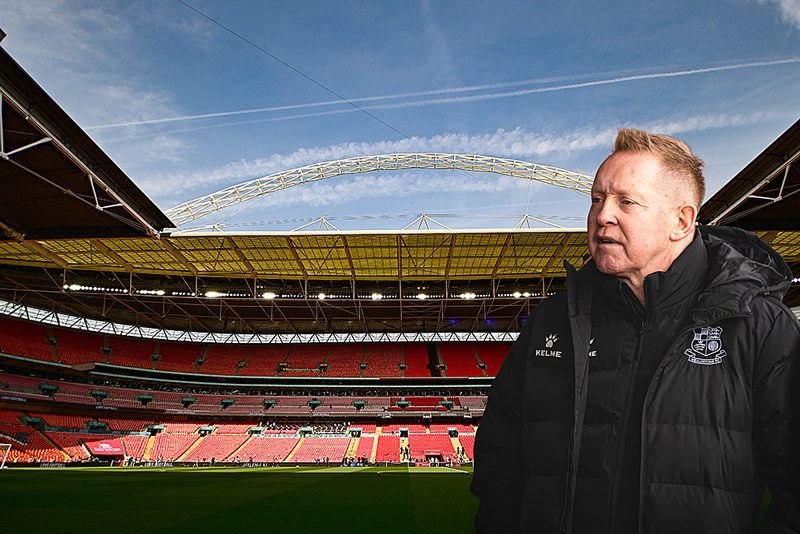
Gary Waddock will hope to exorcise the demons of Wembley visits past when he takes his Wealdstone United team to the home of English football on Sunday in the FA Trophy final.
It’s an all-National League affair with the Stones taking on Southend United on the hallowed turf.
Having finished 25 points above Wealdstone in the table and reached the play-offs, the Essex team will be firm favourites.
But 64-year-old Waddock and his players are on a mission.

Photo: Wealdstone FC
For Wealdstone, whose Grosvenor Vale ground is a wind-assisted puck of a sliotar from McGovern Park, 2026 marks the 60th anniversary of the club’s FA Amateur Cup triumph at Wembley, when they defeated Hendon 3-1.
It’s also 41 years since Wealdstone’s only previous FA Trophy success, when they beat Boston United 2-1 at Wembley, with a young Vince ‘Vinnie’ Jones in their squad.
But for me, as a local lad, going back to Wembley as a manager of this football club I’m delighted
The club has understandably been gripped by Wembley fever ever since the team’s dramatic last-gasp semi-final win over Marine a few weeks ago.
They’re now just 90 minutes away from writing another famous chapter in the history of a club founded way back in 1899.
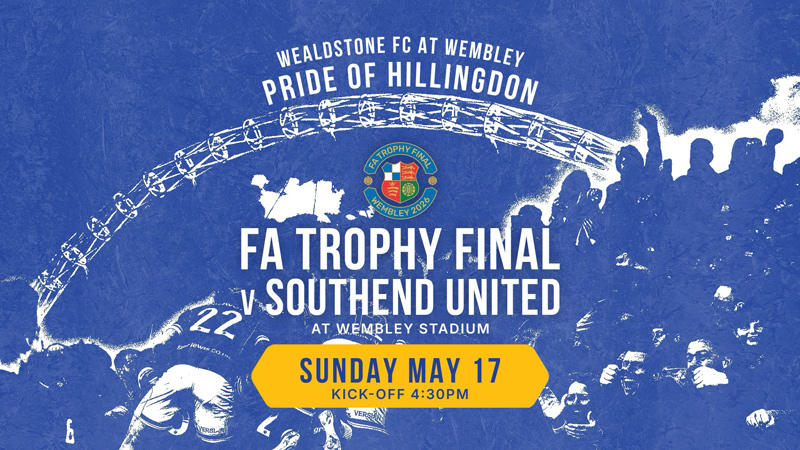
“It will be fantastic to go back there (Wembley),” Waddock told the media after the Marine game.

“It’s every kid’s dream to go to Wembley and I mentioned that to the players throughout the week [leading up to the semi-final].
“But for me, as a local lad, going back to Wembley as a manager of this football club I’m delighted.”
For Waddock, Sunday is perhaps the chance to settle a few very old scores at a ground, within sight of which he grew up, in Alperton.
His visits there with Queens Park Rangers, Ireland and Walsall would make victory with Wealdstone a moment as special as it is overdue.
Good things come to those who wait, as the saying goes. Well, Waddock’s waited long enough to be a Wembley winner.
Relaxed
In 1982, Waddock was the mopped haired young central midfielder who helped QPR reach the FA Cup final at Wembley for the first time in their history.
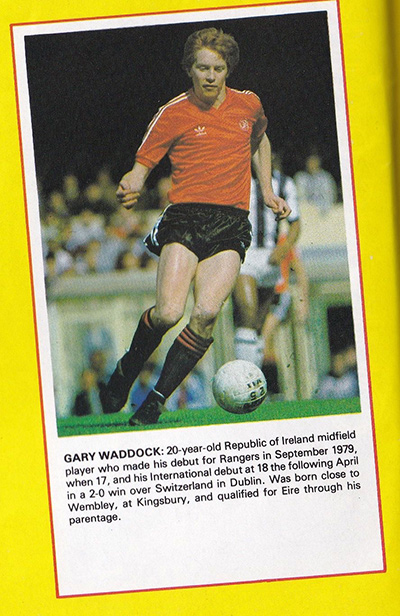
A Division Two side, the Loftus Road club were overwhelming underdogs against a star-studded Tottenham Hotspur team which had beaten Manchester City in the previous year’s final.
Waddock, who’d celebrated his 20th birthday on St Patrick’s Day, was handed the job by QPR manager Terry Venables of curtailing the influence of Spurs’ mercurial midfielder Glenn Hoddle.
No easy task, but it was a very relaxed looking Waddock who was interviewed by the BBC’s Bob Wilson on the Wembley pitch before kick-off.
It was a dream for every young player to play at Wembley in a cup final and I was lucky enough to achieve that
“I could have walked up here in five-ten minutes. I can see the floodlights from the back window [of my house],” he told Wilson.
Speaking to the Irish World, Waddock reflected on that interview and the whole experience of the cup final.
“As a young lad, that was great at the time for me,” he said.
“The FA Cup final was huge – it’s changed now. On the day of the final cameras would follow you from the hotel on the coach, en route.
“[As a fan] You’d wake up in the morning, and you’d be sitting there on your settee from 9am till 7pm.”
He added: “Going into the game everyone said to me ‘just remember the day, because it will go in a flash’.
“I wanted to remember everything about the day, and that’s probably what made me calmer.
“But not only that, when I was a young kid – and I think every footballer would say the same – the dream was to play at Wembley in a cup final.
“I was lucky enough to achieve that, so why then bottle it on the day? And that’s how I approached the game. Go and enjoy it.”
Respect
Waddock actually came close to missing the final due to an FA hearing, he later recalled.
“But luckily I got off with a warning instead of a suspension. It would have been terrible to have missed out,” he said.
The sides’ first meeting on 22 May 1982 saw QPR hold a Tottenham side containing Ireland internationals Chris Hughton and Tony Galvin to a 1-1 draw after extra-time.
Hoddle’s 110th minute strike looked to have won the cup for Spurs.
Waddock was down injured near the centre circle when the goal was scored – the result of a challenge by Hoddle in the lead up.
Any sense of QPR injustice was wiped out within five minutes as Terry Fenwick levelled.
QPR were no strangers to replays, having come through them to get past Middlesbrough and Blackpool on their way to the final.
Tottenham and QPR reconvened at Wembley five days later when Hoddle’s sixth-minute penalty proved decisive.

The Division Two side threw everything at Spurs in search of an equaliser, having a goal disallowed and hitting the crossbar, but to no avail.
It had been a truly heroic effort by Waddock and his teammates.
“Nothing can compare to playing in the cup final at Wembley,” he told the Irish World.
“Tottenham were a First Division side. We were a Second Division side. So, to get to the final was brilliant.
“To take Spurs to a replay was fantastic on our side. We gained a lot of credit.”
A dejected and exhausted Waddock climbed the Wembley steps to collect his runners up medal wearing Hoddle’s shirt, having gone at each other hammer and tongs for 210 minutes.
“I think it was just a respect thing at the end. For me to get his shirt, with the player that he was, is a nice memory for me,” Waddock says.
Promotion
FA Cup final disappointment was tempered the following season by promotion to the First Division under Venables, with QPR finishing ten points clear of nearest challengers Wolves.
They finished the 1983-84 First Division season in fifth place – an incredible achievement which brought UEFA Cup qualification.
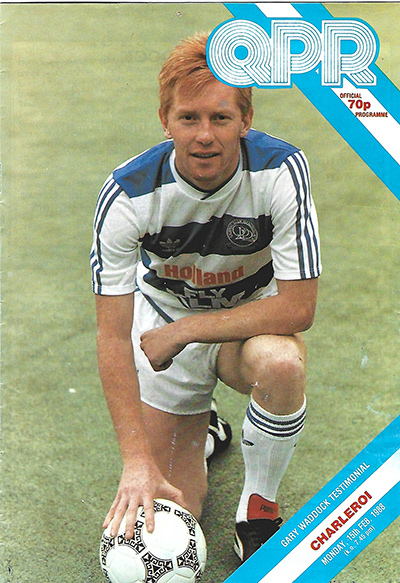
Having established themselves as a top-flight club, Wembley beckoned again for QPR when they contested the Milk Cup final in April 1986, only to lose 3-0 to an Oxford United side containing John Aldridge, Ray Houghton and Dave Langan.
Waddock started QPR’s early round wins over Hull and Watford, but in November 1985 suffered a career-threatening knee injury against Sheffield Wednesday.
No Waddock, but QPR’s 12-man squad for Wembley did include Michael Robinson and John Byrne, as well as Northern Ireland’s Alan McDonald.
Four years after FA Cup heartache, it was another Wembley disappointment for QPR and their fans, and Waddock.
International
Waddock was already a full Ireland international when he stepped out at Wembley for the 1982 FA Cup final against Spurs.
Born on 17 March 1962 to parents from Gorey, Co Wexford, and Cappamore, Co Limerick, Gary Patrick Waddock’s allegiance was never in doubt.
Born in Kingsbury, he grew up a short distance from Wembley Stadium in Alperton.
He attended Lyon Park Primary School in Wembley and still maintains close ties.

Photo: Lyon Park Primary School
On a 2024 visit he signed a QPR shirt, which remains on display in the school office.
The previous year, he was a guest for the official opening of its new multi-use games area alongside the Mayor of Brent, Cllr Orleen Hylton, and another former pupil and footballer Jonathan Rowe.
Capped at U21 level in 1979, Waddock was given his senior debut by Alan Kelly in a 2-0 win over Switzerland in Dublin on 20 April 1980.
He was 18 years, one month and 13 days old.
Alongside him were the likes of Mark Lawrenson, Kevin Moran, Don Givens and Tony Grealish – another famous London Irishman.
His first Ireland goal came in a 3-0 win over Iceland in September 1983 in a European Qualifier in Reykjavik – Waddock supplying a smart left foot finish to a typically silky Liam Brady run and cut back.
Eoin Hand, who had long since taken over as Ireland manager, described Waddock as a “tigerish tackler with a strong engine” in his autobiography.
He’d find the net again the following month in a 3-2 defeat to the Netherlands in Dublin.
Grealish’s ball into Frank Stapleton was laid off perfectly into Waddock’s run, and his low shot found the bottom corner to give Ireland a seventh-minute lead.
A Brady penalty doubled the advantage, but a Dutch side containing names like Marco van Basten, Ronald Koeman and Ruud Gullit scored three second half goals to win 3-2.
Waddock arguably saved the best of his three Ireland goals for last, and the visit of reigning world champions Italy to Dalymount Park in February 1985.
A friendly, it was a game notable for the debut of Paul McGrath as a substitute.
Hand’s side trailed 2-0 at the break to Marco Tardelli and Paolo Rossi and Co.
But Irish hopes of a famous result were revived in the 53rd minute when Stapleton laid the ball back for Waddock to unleash a sweet left foot strike from the edge of the area, which sailed past the desperate dive of Italy goalkeeper Franco Tancredi.
“I was pleased with it!” says Waddock.
“I wasn’t renowned for being a goalscorer, but to score against Italy and Holland was unbelievable.”
It prompted a pitch invasion at a Dalymount Park bursting at the seams, with fans famously pictured watching the match from on top of the stands.
A glorious defeat is how it ended for Ireland with Waddock’s goal the team’s highlight.
Comeback
It was with Ireland that Waddock returned to Wembley on 26 March 1985 for a friendly against England.
Bobby Robson’s side won 2-1 with Brady scoring Ireland’s goal.
After winning 19 caps between 1980 and 1985, Waddock was recalled by Jack Charlton and played against the USSR – he hit the post in Ireland’s first attack – and Turkey in the lead up to Italia ’90.
It was a fairytale comeback after battling his way back from the serious knee injury which had threatened to end his career.
But there would be no fairytale ending as Waddock was left out of Charlton’s final World Cup squad at the eleventh hour at the team’s training camp in Malta, with the Ireland boss opting to draft in the uncapped Alan McLoughlin instead.
In later years, Charlton said he should have taken Waddock.
“It was a difficult time for me, with what I had gone through with my injury. I wanted to get to the highest level possible and the World Cup would have been the highest level,” said Waddock in a 2021 interview.
“So, to fall short was disappointing personally for me but great for Alan when he came in.
“I shook his hand and wished him luck, it was a decision that Jack made, not Alan, so I had no hard feelings towards Alan.
“It never came up between the two of us after and it didn’t have to, it was Jack’s decision and all I could do was wish him well, though it was a hard time for me then, but time is a great healer, it happened and I dealt with it.”
McLoughlin would go on to score the goal that clinched Ireland’s place at the 1994 World Cup. He passed away in 2021. Charlton died in 2020.
Synonymous
It is, of course, with QPR that Waddock is synonymous. A product of the club’s youth systems from the age of 12 or 13 under the tutelage of Theo Foley.
He progressed through its ranks to make his senior debut under Tommy Docherty on 28 August 1979 against Bradford City in the League Cup Second Round.
Waddock was aged 17 years, five months and 11 days.
His full debut followed in December 1979 against Charlton Athletic in the league, and over the next few years he established himself in the QPR engine room.
Despite battling his way back to fitness from that knee injury Waddock played just five games in 1986-87, and his last appearance for the club came against Arsenal at Loftus Road in May ‘87.
In total, he amassed 240 appearances for QPR, scoring ten goals, before departing for Charleroi in Belgium where he rebuilt his career.

Photo: Hatters Heritage
He subsequently enjoyed spells at Millwall, Swindon Town, Bristol Rovers and Luton Town. He made 178 appearances for the Hatters, scoring three goals.
His managerial and coaching career since hanging up his boots has taken him from QPR – academy and first-team – to Aldershot Town, Wycombe Wanderers, Milton Keynes, Oxford United, Barnet, Portsmouth, Southend United, Cambridge United, Walsall and now Wealdstone.
And not without success; in 2006-07 he steered Aldershot to the National League title with an impressive 101 points in his first season in charge.
In 2010-11 he took Wycombe to League One and was assistant head coach of Cambridge United when they did likewise in 2020-21.
Over the past 20 years, Waddock has established himself as a hugely experienced and respected figure in the game.
Hence his appointment as Wealdstone manager in February with the club 14th in the National League table and only nine points above the drop zone.
They’d finish it one place lower, but 14 points clear. Job done.
But management and coaching has so far brought no change in Waddock’s Wembley fortunes.
He left his role as assistant head coach at Walsall to take up the Wealdstone job, having last season helped the Saddlers reach the League Two Play-off final at Wembley.
They lost 1-0 to AFC Wimbledon.
Wealdstone, with whom he has a deal which runs until the summer of 2028, represents the closest things to a homecoming for Waddock, bringing him back to where it all began, in north west London.
A sign perhaps of life coming full circle. All that’s missing for Waddock – after all these years – is that glorious Wembley day in the sun.
“I’ve been there once or twice, and it would be nice to win,” he says.