

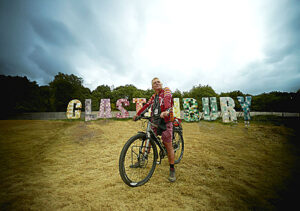
Nick Kelly, well known from former band The Fat Lady Sings/ solo career and also as a film maker, told David Hennessy about his documentary The Song Cycle that makes a point about the industry of music festivals tackling climate change and screens at The Irish Cultural Centre as part of London Breeze Film Festival.
The documentary The Song Cycle will screen at The Irish Cultural Centre in Hammersmith as part of London Breeze Film Festival this month.
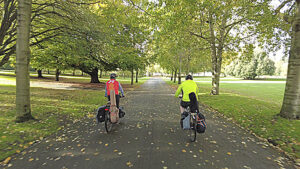
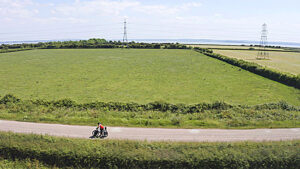
The film follows veteran rocker Nick Kelly as he cycles from his home in Dublin to the Glastonbury Festival, a distance of 360km, playing a number of gigs in Ireland, Wales and Bristol on the way.
Inspired by comments by Coldplay saying they couldn’t justify touring in the face of the climate crisis, Nick set out to make a point about sustainability.
Nick Kelly came to prominence as frontman of the band, The Fat Lady Sings.
Based in London, the band had a string of Irish top 20 singles in 1990 and 1991.
The band built a substantial live following including sold-out gigs at London’s Town & Country Club (now The Forum) and Dublin’s National Stadium..
The band released their debut album Twist in 1991. This gave them singles like Man Scared that would give them their greatest chart success in America and Arclight which they continue to be remembered for.
In October 2024 Arclight was voted one of the Top 50 Irish songs of all time by a panel of 50 Irish Music Critics.
Their second album Johnson was released in June 1993 with the single Drunkard Logic became the band’s highest UK chart position.

The band would then tour America and it was then that Kelly surprised many by quitting the band.
Since then Kelly has had a solo career. In 1998-99 he won Best Solo Male Artist at the Hot Press Irish Music Critics Awards.
In 2012, Between Trapezes was one of the featured albums in Tony Clayton Lea’s book 101 Irish Records You Must Hear Before You Die.
He would also embark on a film making career. In 2011 his short film Shoe made the Oscar shortlist.
The Fat Lady Sings have reformed for rare one-off shows. Kelly has also featured as part of The Unelectables, a group which also featured Seán “Doctor” Millar of The Cute Hoors.
With Doctor Miller, Kelly also formed the duo DOGS which is who he played Glastonbury with.
The film also deals with the reason Nick had to leave Dublin.
Son of politician John M Kelly, he felt he couldn’t be taken seriously as a rock and roller in Ireland but London provided anonymity.
Has the film started a conversation about the environment as you would have hoped?
“We had a really, really good reaction to the film.
“First of all, I’m not a saint at all.
“But I really like festivals and I really like live music.
“I really am depressed at the thought that if 80% of the carbon footprint is travel for big musical events, that maybe they would become unviable so I’ve got a really vested interest in proving you can do these things.
“I feel like a bit of a fraud when I look at the extent to which some other people do these things.
“But I do think it’s really good to just prove that it’s not impossible and especially as I’m not like this sylphlike 23 year old either.
“I think people do get the environmental sustainability message.
“A lot of the reaction is as much to the more personal aspects of the film.
“There’s sort of an empowerment thing more generally that’s in the film and a lot of people would have said that to me about as you get older especially, that you can feel kind of useless and powerless certainly about the climate crisis and even as an artist, you can feel invisible.
“There’s a thing about going out and trying to even land a punch somehow on the universe that I think people have responded a lot to that bit as well.
“I think one of the things I’m proud of is that it’s a film about sustainability which makes you laugh and makes quite a lot of people cry.
“The human story works for people.
“Our problem with the climate crisis is that mostly pieces of art or pieces of communication around it tend to be terrifying and shaming and disempowering like, ‘The world is dying, it’s your fault and there’s nothing you can do about it’.
“And those three things tend to not produce action in people.
“Just saying, ‘Everything is shit and you’re to blame’, we tend to not go out and then think, ‘Okay, I must try harder’.
“I do think trying something is quite a helpful message because we sort of need to be encouraged to feel that.
“I think it’s really important to try lots of things in your life and try everything with good spirit and as an artist, the thing that really cuts through and resonates- It’s always surprising to you.
“You make all these things and you think, ‘Well, that’s my big hit’.
“It never is your big hit.
“The big hit is something that you knocked off in an afternoon.”
You must be speaking about Arclight. Of all the songs you released as The Fat Lady Sings, that one endures but you would never have thought it would be that way..
“Arclight was the sixth biggest single that The Fat Lady Sings, a not very famous band, had so we had five singles that did better in the charts than Arclight but that’s the one that’s stuck in people’s heads and grew.
“It’s a very mysterious process but it’s what I think more generally about art.
“And one of the beautiful things about art is that it works in a different way on people’s consciousness.
“The thing I think most people I know who make art have in common is that it’s their bodies that make the decision, not their brains.
“They have an instinct to do something and then quite often they post rationalise it especially.
“I don’t talk about lyrics for that reason because I’ve had very often the embarrassing thing where somebody will say, ‘That song of yours, it’s about X’, and I’d say, ‘No, it’s not’.
“And then I’ll think about it for a while and think, ‘It kind of is about x’, and X being, by the way, a really humiliating and embarrassing thing that you would never have consciously written about.
“I think art is speaking in a language that you don’t understand.
“I think what makes it so powerful is our visceral responses to the world.
“Your gut instinct that you put down on a song or in a page, that speaks to the guts of other people.
“They feel it.
“So you don’t quite know what you’re doing and therefore, by extension, you don’t know which of all the things you’re doing is going to have that effect.
“You do enough of them, something or a couple of things will cut through and they cut through in a way that’s quite profound.
“Even about things like climate change, I think the thing that will produce a result won’t necessarily be facts and statistics.
“It could be a big tune.
“It could be a beautiful painting.
“It could be a TV show.
“And I think what you have to accept is it might not be your song but give enough monkeys a typewriter.
“That’s what I feel like.
“I feel like I’m a monkey with the typewriter.”

From its foundation in 1986 to the split in 1994, The Fat Lady Sings were based in London. It was probably good to be there for industry reasons but wasn’t it true that you had to get out of Ireland. With your father’s politics, it could be hard to be taken seriously in the music business there..
“Well, you’ve completely put your finger on it.
“I completely didn’t feel like a rock and roll person in Dublin at all and I’m pretty certain that had I stayed in Dublin, it would have been hard for me to take myself seriously.
“I certainly don’t think other people would have taken me very seriously just because we’re all slaves to iconography.
“I think in Ireland at that time, we had people who looked like they should be painters and writers and musicians and we kind of tended to revere them and say, ‘They’re all like that and then the rest of us aren’t like that’.
“I felt very much in the second category.
“I’d spent a little bit of time in New York and the anonymity of it and the fact that nobody knew anything about you, that was immensely empowering to me so going to London gave me that again.
“Had I not made that move, I don’t think I would have had a career as a musician.
“It’s very hard to succeed in London but if you do manage to gain some respect and success, it’s real.
“You don’t have to go and do it all again.
“In Ireland there was bands that would do really, really well in the Irish charts and then they would come over to London and it would be like another huge mountain.
“I didn’t think my competition was A House or Something Happens, I thought my competition was George Michael or Manic Street Preachers or whatever.
“If you’re from a big place, you have to get around but if you’re from a small place, you have to get out.
“Of course, there’s an economic reason for diaspora but there’s cultural reasons for diaspora as well which is you needing to stretch your wings and to find a place to redefine yourself.
“For example if you start off and you are an inept solicitor’s apprentice whose father is the Attorney General and you decide you want to be a pop musician, you have to go because it’s too distressing to the matrix for you to change.”
In the film you speak about your late father and the large shadow he cast. You also speak about his passing but how you continued touring at the time, was there catharsis in speaking about it?
“In making this film, I did work out things about my own relationship with my father so I’m glad about that.
“The film I made a few years before, The Drummer and the Keeper there were aspects of that which were very much based on personal stuff.
“You write from your instincts but I wouldn’t tend to talk about personal things.
“I would be quite protective of my family.
“Around The Drummer and the Keeper, because one of the characters is autistic and my son is autistic and he was 12 at the time I said, ‘Listen, I’m probably going to be asked in interviews where I got the idea for Christopher’.
“It wasn’t just him.
“Through him I met lots of autistic people.
“I said, ‘Do you mind if I talk about that and he said, ‘No, it’s okay’.
“I was quite uncomfortable about it but it was actually a big moment of growth and revelation for me because the sky didn’t fall in and I felt it was good to be a bit more out about it.
“My instinct before that would have been to not to be in the closet about things.
“The Drummer and The Keeper went all over the world and I was being always asked about my connections to the autism community.
“I think having gone through that, I’ve felt more comfortable about exploring that one as well.
“I think there was definitely catharsis when I did the interview.
“The other thing is my siblings in particular who’ve all seen the film, they were fine with it as well.
“The other thing that could have happened is you could have said something that would have upset other people but the older I get as well, the less you honestly, ‘Does anybody really care?’
“I feel much less constrained because I sort of think, ‘God, what are you editing yourself for?’
“When you’re younger, you’re very worried about what people think about you.
“You get older and everybody’s told you what they think about you already.”

You talk about the end of the band which came as a surprise to many. You went to America with high hopes but it ended up being the end of things..
“I think I was carrying a huge amount of pressure on my shoulders.
“The band became quite a big thing and lots of other people’s hopes and dreams are resting on your shoulders.
“It was immensely frustrating because I felt that next level of success was within my reach but not within my grasp.
“I just couldn’t quite get it.
“We thought, ‘Okay, this (America) will be the thing that will break us through’.
“But actually it kind of was the last straw.
“There was an incredible moment.
“We’d got to number 28 in the American alternative charts with Man Scared and we were thrilled.
“It was largely on radio play.
“The record company in America came and said, ‘Well, you could put out Arclight next but it takes a long time to get going that song because you’ve kind of got a verse, another verse and a bridge and a chorus.
“You need to do an edit to bring it in quicker.
“So we had this huge existential artistic crisis of, ‘Should we do this to our beautiful child?’
“And eventually we said, ‘Okay, you can do the edit to basically come in on verse two for the single’.
“So then it was about six weeks later and I remember saying to the management, ‘What’s happened to Arclight in America? Is that in the charts?’
“They checked and nobody had sanctioned the edit.
“The edit would have cost about $800 which, by the way, we would totally have paid if we thought that was the difference but the point was in the record company, we weren’t even important enough that even though they thought that that would make it a hit, nobody had sanctioned the $800 to pay the money to make that a hit basically, and nobody said anything about it.
“You suddenly realise that unless you were somebody’s burning priority and that somebody was quite a powerful person, you couldn’t be successful.
“I just thought, ‘Okay, it’s not in my power to make this band break through and also I am actually going mad’.
“I think it was a surprise for the rest of the band and it was a surprise for management and it was a surprise for the record company.
“I remember coming home one day and there was 28 messages on my answering machine because everybody was understandably and justifiably kind of furious.
“I probably didn’t handle it very well but I just had got to the end of the road.”
Are you going to cycle to the screening?
“I think we’re meeting at 11.15am in Trafalgar Square.
“If anybody’s around and wants to cycle with me, I’d be thrilled of the company.
“I’m really looking forward to the screening.
“It’s our UK premiere so I’m very excited to see what people make of the film.”
The Song Cycle screens at 1.30pm Saturday 25 October as part of London Breeze Film Festival.
London Breeze Film Festival runs 22- 26 October. Londonbreezefilmfestival.com.
For more information about Nick, go to nickkelly.ie.