



Crime writer Gary Donnelly told David Hennessy about his Belfast crime series which depicts a post- conflict Belfast and has just come to the publishers, Acorn & Ink.
Gary Donnelly is a London- based Belfast crime writer best known for his DI Sheen series.
Donnelly’s series began with the first book in the series Blood Will Be Born which was first published in 2017.
This would be followed by 2020’s Killing in Your Name and Never Ask the Dead which was released in 2021.
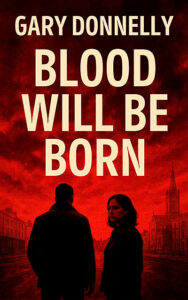
Now publishers Acorn & Ink are bringing DI Sheen to a wider audience with Blood Will Be Born the first to be recently published in the new format.
DI Own Sheen swore he would never return to Belfast, the home he left as a child with trauma robbing him of his memories of it.
In Blood Will Be Born he returns to the city looking for answers.
He is paired up with rookie DC Aoife McCusker but neither knows about the personal battle the other is dealing with.
Investigating a gruesome murder in post- conflict Belfast, Sheen and McCusker find themselves on the trail of an escaped IRA veteran and the murderous young man who set him free.
Gary Donnelly took time to chat to the Irish World.

How did the series come to you? I understand it comes very much from you growing up in Belfast, troubled as it was in those times..
“Yeah, I lived and breathed Belfast until I turned 18 years old and then I came over to England for university.
“It was a huge change in my life but my formative years, the things that really stay with you, make you who you are.
“Those childhood and adolescent years living in West Belfast, and I think it’s probably worth saying from the get go, not living badly.
“We knew not really much different.
“I was aware of it as being newsworthy and noteworthy and probably different, but I think it was laying down a lot of bedrock for when you start looking for material to write.
“I’m really proud to have said that that’s where I’m from and while I wouldn’t wish a repeat of any of those experiences on anyone else, particularly on my own children, I feel like it’s a tremendous privilege to be able to say we lived through that and hopefully came out better for it in many ways.”
Coming to London seems like a necessary part of your journey for creating DI Sheen, this English- raised police officer who returns to Belfast looking for answers about his childhood and family..
“Sheen initially started off as a helpful vehicle for me to objectively return to material which tends to be very divisive by its very nature, tends to be controversial, tends to be very, very tricky to navigate particularly for one who has lived and breathed a very one-sided experience of that troubled, conflicted era in Ireland’s history.
“The experience of being an outsider, of being alienated is something that I think was really, really helpful in a way.
“Sheen gave me a license to be able to go in with a mask of objectivity or at least with a sense of being able to guide it: What he could do, what he could ask, what he didn’t know, what he was neutral and naive with was helpful for me.
“I re-edited the book for this version of the publication.
“I thought, ‘Gosh, there is a lot of alienation in this book, there’s a lot of isolation and feeling not quite a part of things’.
“I was an Irish man living in London and I was able to bring that sense of being ‘other’, being an outsider, not quite being able to understand things on my own terms and use that for Sheen.
“I didn’t even realise this until after I drafted it.
“In a weird way Sheen is a kind of inside out version of some aspects of my life.”
I know it is referred to as the DI Sheen series but I think of it as the Sheen and McCusker series as Aoife is just as important a character..
“I really like the way you picked up on that.
“Actually all the editorial has always emphasised the need for that balance.
“What was really encouraging for me was that most of the positive reviews tended to emphasise her as a favourite character.
“I must say I found it challenging to write a strong female lead.
“I was daunted by the possibility of it.
“It’s easier to write a male villain, I don’t know what that tells you about me but there’s a natural reluctance to try and adopt the female voice but I’m really glad I did.
“It was really important to have a foil against the sort of traditional chauvinism that sometimes might be associated with police procedurals.
“In many ways I knew what I was doing when I created Aoife.
“I wanted her to be the future in a society that was hinging on times of change.
“She’s from a Catholic nationalist background in Belfast.
“She is of the community which probably in previous generations would have felt excluded or very reluctant to engage with police work.
“It’s a small thing but it was important.
“I kind of kept her name spelt in the sort of Irish way, Aoife which I thought could be a bit of a mouthful for certain readers particularly those who are not familiar with Irish names but I sort of thought, ‘Well, I’m not going to compromise on it’, and I’m glad I didn’t.
“She’s an important character and I don’t think the series can work in the absence of that character.”
You say you returned to book for editing, what was that experience of going back to the start of these characters and this series that has now spanned several books like?
“It was really rewarding and really intriguing and very, very strange in a way.
“There are so many unwritten novels out there.
“There are so many potential books to be written and I think as we change as individuals, the type of book that you can write evolves and changes with us.
“I think that’s something I’ve learned over the last number of years since the book was written.
“So going back, I kind of look at it and had a few moments where I was able to wryly sort of smile and think, ‘I forgot I included that’.
“I think the other thing was that at a more holistic level, looking back at the book and then re-editing the series, I got a slightly better feel for some of the themes and heartbeats within the work.
“It’s proudly a thriller.
“It’s a crime page turner but I think it kind of taps into issues that at some level maybe I wasn’t even fully conscious of.
“I think the bits of Belfast that I retained which are factually accurate are numerous but there’s also other little parts of it which I just inserted and shoehorned in and made them in some ways for convenience and out of fun and interest.
“The idea of Belfast Heights, this brooding psychiatric hospital that overlooks a city which has got a fractured and bloody past and a lot of trauma, I think that’s really telling.
“I sort of thought that’s saying something about a society that maybe x number of years ago, before I first put pen to paper, I wasn’t quite as tapped into’.”
Although it was written some years ago, the book feels very timely with recent riots and tension in Belfast..
“It’s worryingly timely in some ways.
“The book was written almost 10 years ago.
“Although this is a reprint, it still felt very, very timely and very relevant.
“At this time of year, the action centres around the build up to the 12th of July in Belfast which historically was an incendiary tinderbox.
“When I watched the news, I did have a bit of an ‘Oh wow’ moment because there were a couple of highly controversial, highly publicised or mis-publicised events which then sparked a series of very, very divisive riots and that’s exactly what happens in the book.
“What was fascinating was that even though some of the rationale and some of the roles that were being played in the book are replaced with other rationales and other hatreds, it’s still very much followed certain worn paths.
“I don’t want to say it’s satisfying but it’s definitely something that makes me feel I’m really glad I had something to say in that conversation.
“I think legacy in the North of Ireland over the over the last decade or so or more, the legacy conversations and the legacy conflict, in a way, is the one that still rages on.
“I’m really proud that I managed to put pen to paper using the sort of power of fiction to actually explore what those legacy issues potentially mean for people and actually what their consequences are which, as we’ve seen, can be very dangerous particularly when people feel disenfranchised or people are still to some degree ghettoised.”
It’s not often represented in books like this but a character like John Fryer, a former Provo and others who were involved in the Troubles on both sides, struggling mentally due to what he’s seen and been through really rings true..
“Those of us who have grown up with these situations as a very living backdrop to our lives, I think it tends to be food for thought.
“I’m a psychology teacher by day and I did a graduate degree in psychology so there’s a lot there for me.
“I’ve got this interest in what makes people tick.
“The percentage of sadistic, sociopathic behaviour is minimal and yet violence, as we see across the world in many conflict situations and just in day-to-day life, sadly is prevalent so I think the vortex of violence pulled people who under ordinary circumstances may not otherwise have found themselves involved in things which probably haunted them.
“I think this idea of haunting also appears within the book fairly overtly as the entity of the ‘moley’.
“I think it’s tremendous traction for stories and I know that there’s an up and coming generation of Irish writers- some from Belfast, some from West Belfast actually- who have been very successful and I wish them all the best and who are peddling and developing stories which don’t necessarily address the wider sociopolitical conflicts and problems of the past but I think if you can do that, you ought to.
“I think personally fiction which doesn’t address it misses the monster in the room and I can’t speak for everyone but certainly this Belfast series is something which grows from that backdrop and it’s the skeleton upon which a lot of the storytelling can take place.
“I think some of the backdrop and the skeletal structure of the work and the novel is social and political and parochial in that sense, but I think really the beating heart of these stories are personal.
“They’re human and they’re personal.
“It’s about the love and the loss, the betrayals, the vendettas and the trauma going back to that idea that not everyone was an unthinking monster and because of that I hope, it’s a bit of a grand claim but I hope they can have the universality and appeal of the Harry Bosch novels by Michael Connelly who really uses the tapestry of a noir version of LA in the same way I do for Belfast.
“You don’t have to be from there, you don’t have to have lived it because really it’s about the characters.”
You used the word ‘haunted’ there. Both John Fryer and Christoper are haunted, aren’t they?
“Yeah, it’s a really good thing to note.
“What I found really interesting on re-read is that they’re haunted in a different way.
“Fryer is haunted by the weight of his own awful deeds and Christopher’s haunted by the loss of a father ultimately.
“In a way they both represent elements of disgruntlement and disenfranchisement with the cost of a peace process.
“For one former IRA guy, there wasn’t a total victory.
“Whatever way they want to paint it, there was a terrible price paid and terrible things done and never a total victory in that situation.
“And then for Christopher, whose dad was in the RUC, I think he’s probably emblematic of a group of people for whom the RUC and its emblems were ghosted away.
“One of the exchanges for peace was the loss of that name, the loss of that past.
“There’s a line in the book where he says, ‘I’m the orphan child of the peace process’.
“And it’s also about, in a way, fatherhood and childhood.
“Christopher lost his dad and got a surrogate almost in Fryer, and Sheen lost his childhood.
“Sheen can’t remember his Belfast childhood.
“That started off through sheer laziness in a way on my part.
“When I was trying to compose a biography I thought, ‘I’ll just come back to that’ but then as I wrote it I thought, ‘That kind of weirdly works’ because that’s a form of repressed memory in a way.
“That’s another way of saying this guy is more connected to this place than perhaps overtly it seems.”
Another thing that struck me about Fryer’s story is that a killer like him, although he would have said he was fighting for his community and his cause, is not needed or wanted in a time of peace. That is shown in how he has been betrayed and discarded at the start of the story..
“Yeah, Fryer’s a character that I really enjoyed writing.
“Fryer to me was a challenge because it’s fair to say an IRA veteran is at best divisive with a readership, particularly if your book is about the North of Ireland.
“If your book is going to be sold in English bookshops, at least half your audience or more are not going to sympathise so part of what I wanted to do was write a character that people couldn’t help but empathise with and in the same way, Christopher also, he’s not the guy you want your daughter to bring home but I think one of my things was, ‘I want people to feel for these guys’.
“And if that’s been achieved, hopefully something positive has.
“When I was writing John Fryer I sort of thought, ‘Well, it’s pretty simple stuff. What do you do when your raison d’etre, your whole reason for being stops?’
“My dad and I have had chats about this over the years.
“He experienced the troubles much, much, much more in a full on adult way because he had to get up and go to work every day.
“As my dad once said, ‘What do you do when you’re planning paramilitary operations, attacks. What do you do when someone tells you, ‘Right, you’re not doing that anymore’?
“And then you follow the story wherever that takes you and it took me to Belfast Heights with Fryer not in a very good way and pretending to be comatose.
“I think probably anecdotally- I don’t have any facts to support it but I think a lot of these people didn’t end in a happy family situation.
“It ended sadly. It ended badly.
“There’s a wider kind of analysis of the ultimate damage that violence does.
“The old Shakespeare quote, ‘The evil that men do lives on and on’.”
There is also the Loyalist commander Cecil Moore, was he inspired by any real life figures? I can’t help thinking of people like Johnny Adair..
“Not at all.
“I think it’s so awesome that the final creative work is done in the mind of the reader.
“That’s who he is for you in a way.
“There’s a little moral vacuum just in the heart of this guy.
“And this by no means is attributing this kind of behaviour only to loyalist paramilitarism.
“There tends to be a correlation with various forms of unpleasantness and criminality if you look back at some of the figures, and it wasn’t even from the same side actually, of sexual deviancy.
“That’s challenging stuff but in book two, that is a little bit more front and centre.
“I really enjoyed writing that character because he is a real scoundrel and like any wrong ‘un, he’s kind of cool to write.
“He was an interesting guy.”
Blood Will Be Born and Killing in Your Name by Gary Donnelly are out now on Acorn & Ink.
For more information, click here.